The Silent Wellness Killer: How Phone Anxiety Hijacks Your Nervous System

The Silent Wellness Killer: How Phone Anxiety Hijacks Your Nervous System
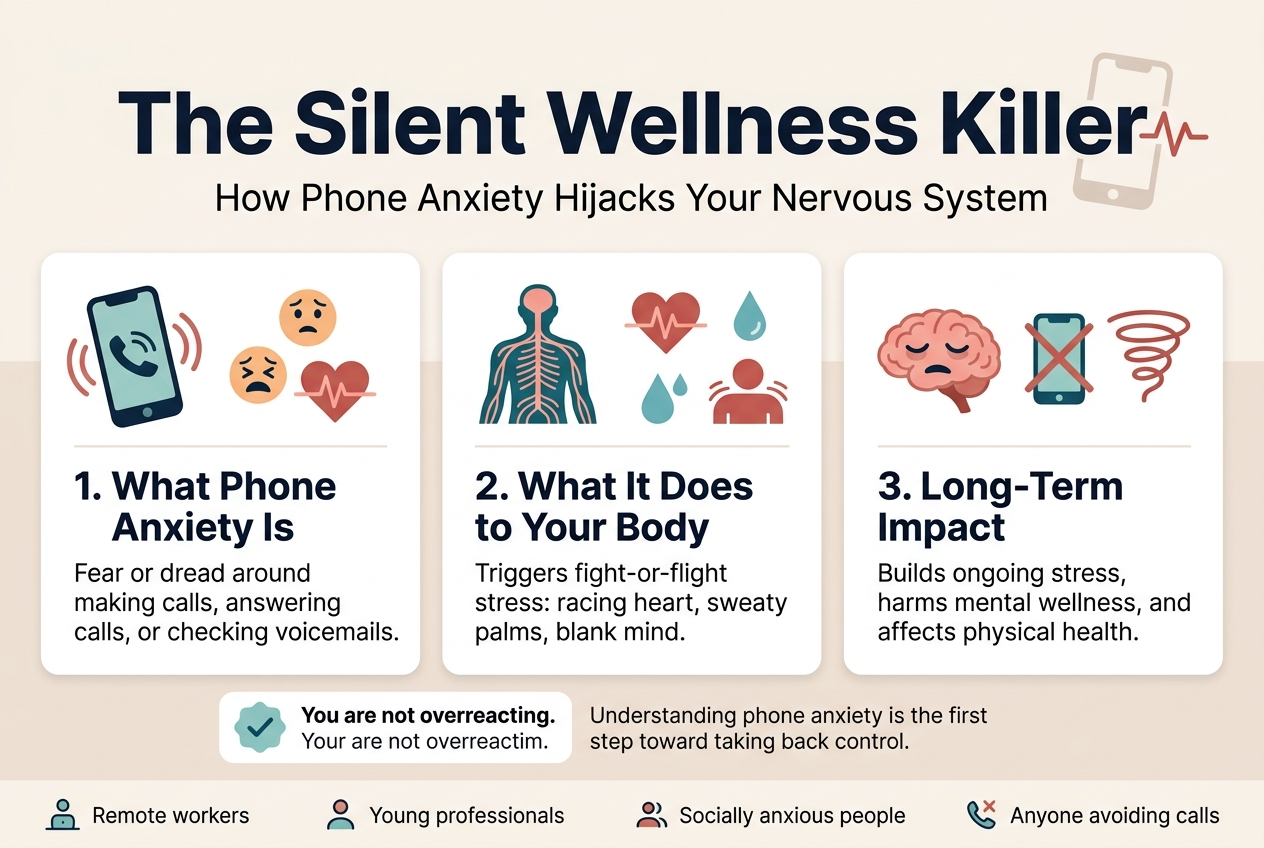
Aspect ratio 3:2, full-bleed modern infographic illustration, clean professional wellness style, soft off-white background with teal, navy, coral, and muted red accents, bold sans-serif typography, clear hierarchy, wide horizontal layout with three main content blocks across the center.

Top section: large bold headline centered at top in dark navy text: "The Silent Wellness Killer" with a smaller subtitle beneath it: "How Phone Anxiety Hijacks Your Nervous System". Add a subtle phone outline icon near the title with a red stress pulse line.

Middle section split into 3 wide horizontal cards or columns:
1) Left card with a smartphone ringing icon and anxious face/heartbeat symbols. Heading text: "1. What Phone Anxiety Is". Body text: "Fear or dread around making calls, answering calls, or checking voicemails."
2) Center card with a nervous system graphic icon, heartbeat line, sweat drop, and tense shoulders symbol. Heading text: "2. What It Does to Your Body". Body text: "Triggers fight-or-flight stress: racing heart, sweaty palms, blank mind."
3) Right card with a tired brain icon, crossed phone icon, and spiraling stress line. Heading text: "3. Long-Term Impact". Body text: "Builds ongoing stress, harms mental wellness, and affects physical health."

Bottom band across the width: include a small supportive callout box with a calm checkmark icon and the text: "You are not overreacting." followed by smaller text: "Understanding phone anxiety is the first step toward taking back control."

Add small audience labels in a thin footer row with simple icons: "Remote workers" "Young professionals" "Socially anxious people" "Anyone avoiding calls". Use balanced spacing, clear section dividers, subtle shadowed panels, and a polished editorial infographic look.

You pick up your phone to make a simple call, and suddenly your heart races, your palms sweat, and your mind goes completely blank. Sound familiar? You’re not alone β€” and no, you’re not overreacting.

Phone anxiety is quietly affecting millions of people, and most don’t even realize it has a name. If you dread making calls, avoid voicemails like they’re a tax audit, or feel your chest tighten every time your phone rings, this is written for you β€” the remote worker, the young professional, the socially anxious person who’s been brushing this off as “just a quirk.”

Here’s what we’ll dig into together:

  • What phone anxiety actually is and why it’s showing up more than ever
  • What it does to your body β€” specifically how it triggers your nervous system into full-on stress mode
  • The real damage it causes to your mental and physical wellness over time, plus practical ways to start taking back control

This isn’t about judgment. It’s about understanding something that’s been messing with your health quietly, in the background β€” and finally doing something about it.

Understanding Phone Anxiety and Why It Is More Common Than You Think
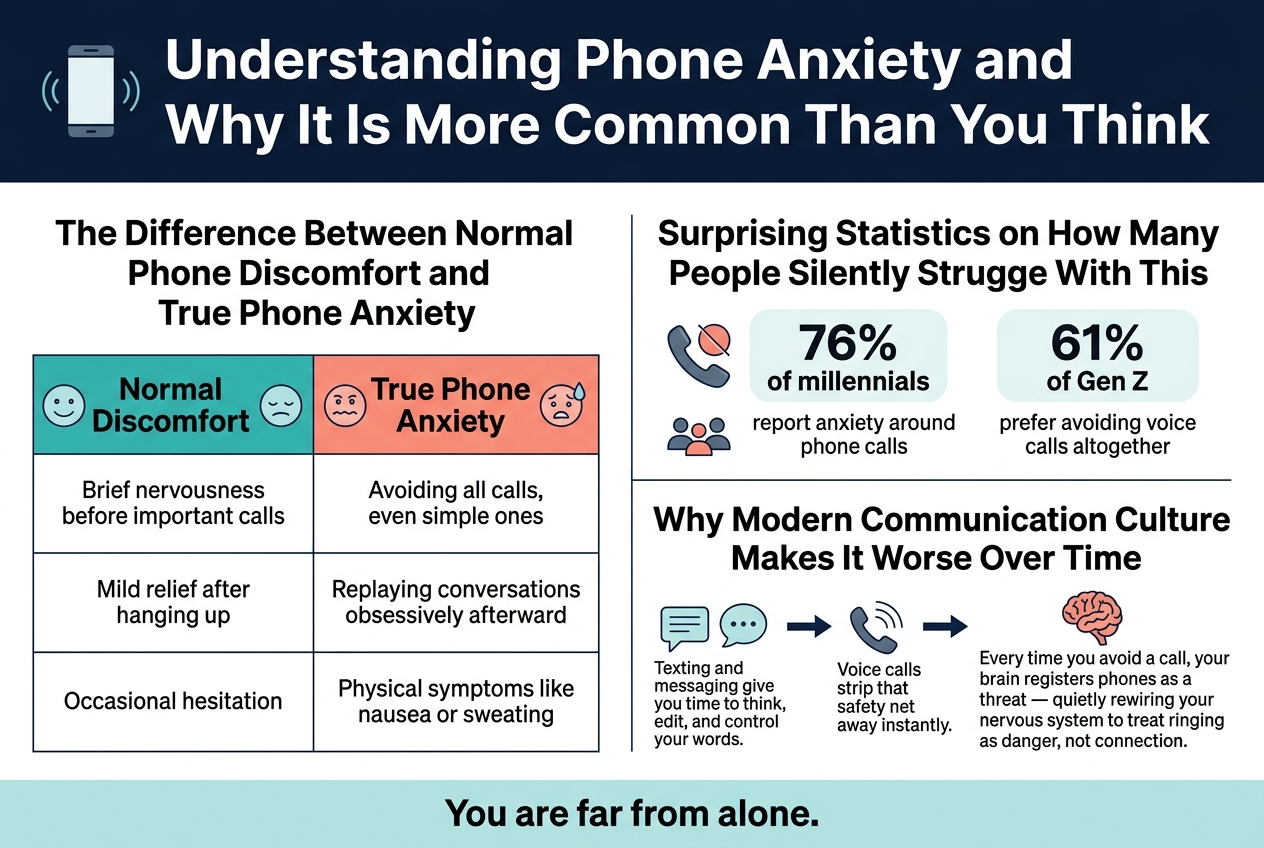
Create a full-bleed landscape infographic in 3:2 aspect ratio with a clean modern editorial style, white background, navy and teal accents, soft coral highlights, and bold sans-serif typography. Use wide horizontal sections and a clear visual hierarchy, not a narrow centered poster.

Top banner across the full width:
Large bold title in dark navy: "Understanding Phone Anxiety and Why It Is More Common Than You Think"
Add a small phone icon with subtle signal waves on the left of the title.

Middle section split into three wide content blocks across the page:

Left block:
Heading: "The Difference Between Normal Phone Discomfort and True Phone Anxiety"
Below the heading, place a two-column comparison table with simple icons.
Left column header in teal: "Normal Discomfort"
Right column header in coral: "True Phone Anxiety"

Rows in the table:
"Brief nervousness before important calls" | "Avoiding all calls, even simple ones"
"Mild relief after hanging up" | "Replaying conversations obsessively afterward"
"Occasional hesitation" | "Physical symptoms like nausea or sweating"

Use a small calm face icon for the normal side and a tense face icon with sweat drops for the anxiety side.

Center block:
Heading: "Surprising Statistics on How Many People Silently Struggle With This"
Show two large statistic circles or cards:
"76% of millennials"
"61% of Gen Z"
Under the stats, add the text: "report anxiety around phone calls"
and "prefer avoiding voice calls altogether"
Include a muted phone icon and a small group-of-people icon.

Right block:
Heading: "Why Modern Communication Culture Makes It Worse Over Time"
Display a simple visual flow with icons and arrows:
Text message icon + speech bubble icon next to the text: "Texting and messaging give you time to think, edit, and control your words."
Arrow pointing to a ringing phone icon next to the text: "Voice calls strip that safety net away instantly."
Arrow pointing to a brain and nervous-system icon next to the text: "Every time you avoid a call, your brain registers phones as a threat β€” quietly rewiring your nervous system to treat ringing as danger, not connection."

Bottom strip across the full width:
A concise takeaway bar in light teal with bold text: "You are far from alone."

Use strong section dividers, clear spacing, and balanced horizontal composition. Keep all text sharp, readable, and exactly as written. No extra text, no borders around the overall canvas, and no poster frame.

The Difference Between Normal Phone Discomfort and True Phone Anxiety

Feeling slightly awkward before a difficult call is completely normal. True phone anxiety is different β€” it’s when your body physically reacts before you even dial. Your heart races, you delay calls for hours, or you let voicemails pile up because listening feels overwhelming.

Normal DiscomfortTrue Phone Anxiety
Brief nervousness before important callsAvoiding all calls, even simple ones
Mild relief after hanging upReplaying conversations obsessively afterward
Occasional hesitationPhysical symptoms like nausea or sweating

Surprising Statistics on How Many People Silently Struggle With This

You are far from alone. Research shows that nearly 76% of millennials report anxiety around phone calls, and roughly 61% of Gen Z prefer avoiding voice calls altogether. Many people quietly manage this daily without ever naming it as anxiety.

Why Modern Communication Culture Makes It Worse Over Time

Your communication habits have dramatically shifted. Texting and messaging give you time to think, edit, and control your words. Voice calls strip that safety net away instantly.

Every time you avoid a call, your brain registers phones as a threat β€” quietly rewiring your nervous system to treat ringing as danger, not connection.

The Science Behind How Phone Anxiety Hijacks Your Nervous System
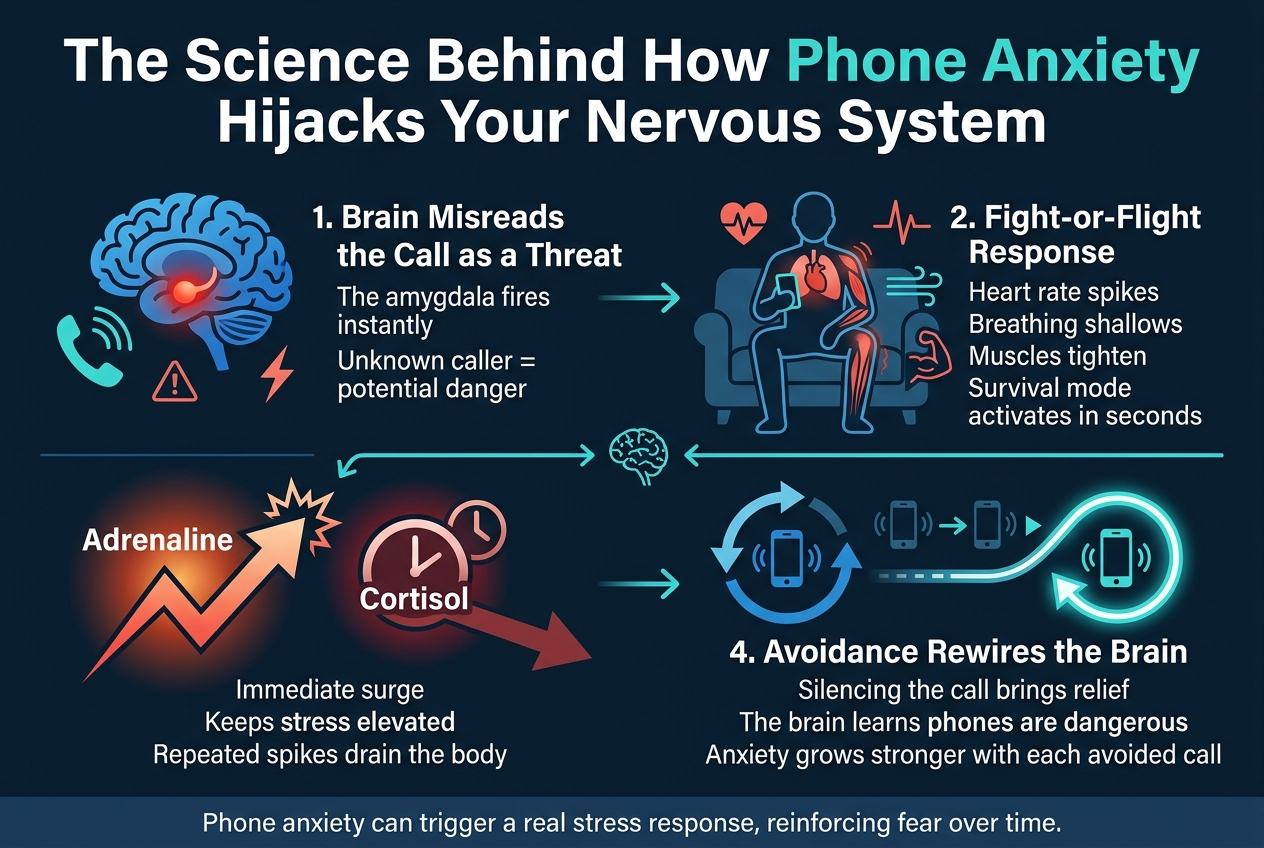
Create a clean, professional full-bleed infographic illustration in a 3:2 aspect ratio with a modern medical/science style, deep navy background, teal and electric blue accents, white text, subtle red/orange stress highlights, and crisp sans-serif fonts. Place a bold large title across the top: "The Science Behind How Phone Anxiety Hijacks Your Nervous System". Use a wide horizontal layout with four organized sections across the canvas, connected by arrows and simple neuroscience icons. No poster frame, no inset margins.

Section 1 on the upper left: a blue brain icon with a glowing red amygdala area and a ringing phone icon nearby. Heading text: "1. Brain Misreads the Call as a Threat". Body text: "The amygdala fires instantly" and "Unknown caller = potential danger". Add a small alert triangle and a lightning bolt.

Section 2 on the upper right: a stylized body silhouette seated on a couch with a phone in hand, showing heart, lungs, and tense muscles highlighted in red. Heading text: "2. Fight-or-Flight Response". Body text: "Heart rate spikes" "Breathing shallows" "Muscles tighten" "Survival mode activates in seconds". Add a heartbeat line, shallow breathing lines, and flexed muscle icon.

Section 3 across the lower left-center: two large hormone symbols with arrows. Label one icon "Adrenaline" with a sharp upward arrow and a burst symbol. Label the second icon "Cortisol" with a clock and a long trailing arrow. Body text: "Immediate surge" "Keeps stress elevated" "Repeated spikes drain the body". Use orange-red glow for adrenaline and darker red for cortisol.

Section 4 across the lower right: a looping neural pathway graphic with repeated phone notifications turning into a stronger, brighter path. Heading text: "4. Avoidance Rewires the Brain". Body text: "Silencing the call brings relief" "The brain learns phones are dangerous" "Anxiety grows stronger with each avoided call". Add a circular feedback loop arrow and a reinforced neural pathway line.

Include a small footer strip with the summary text: "Phone anxiety can trigger a real stress response, reinforcing fear over time." Use clean spacing, clear hierarchy, bold section headings, and professional infographic icons throughout.

How Your Brain Misreads an Incoming Call as a Threat

Your brain’s amygdala β€” the alarm system buried deep inside your skull β€” doesn’t always know the difference between a ringing phone and a growling predator. When your phone lights up unexpectedly, your amygdala fires instantly, tagging that unknown caller as a potential danger before your rational mind even catches up.

The Fight-or-Flight Response Triggered by Phone-Related Stress

Once that alarm fires, your nervous system shifts into full survival mode. Your heart rate spikes, your breathing shallows, and your muscles tighten β€” all within seconds. Your body is literally preparing to run or fight, even though you’re just sitting on your couch.

The Role of Cortisol and Adrenaline in Escalating Your Anxiety

  • Adrenaline surges immediately, sharpening your senses but also flooding you with dread
  • Cortisol follows, keeping your stress levels elevated long after the call ends
  • Over time, repeated spikes wear your body down, leaving you feeling chronically drained

Why Repeated Phone Avoidance Rewires Your Brain for More Fear

Every time you silence that call, your brain registers avoidance as relief β€” and rewards it. That reward teaches your neural pathways that phones are dangerous, making your anxiety grow stronger and harder to shake with each avoided call.

The Hidden Ways Phone Anxiety Damages Your Overall Wellness
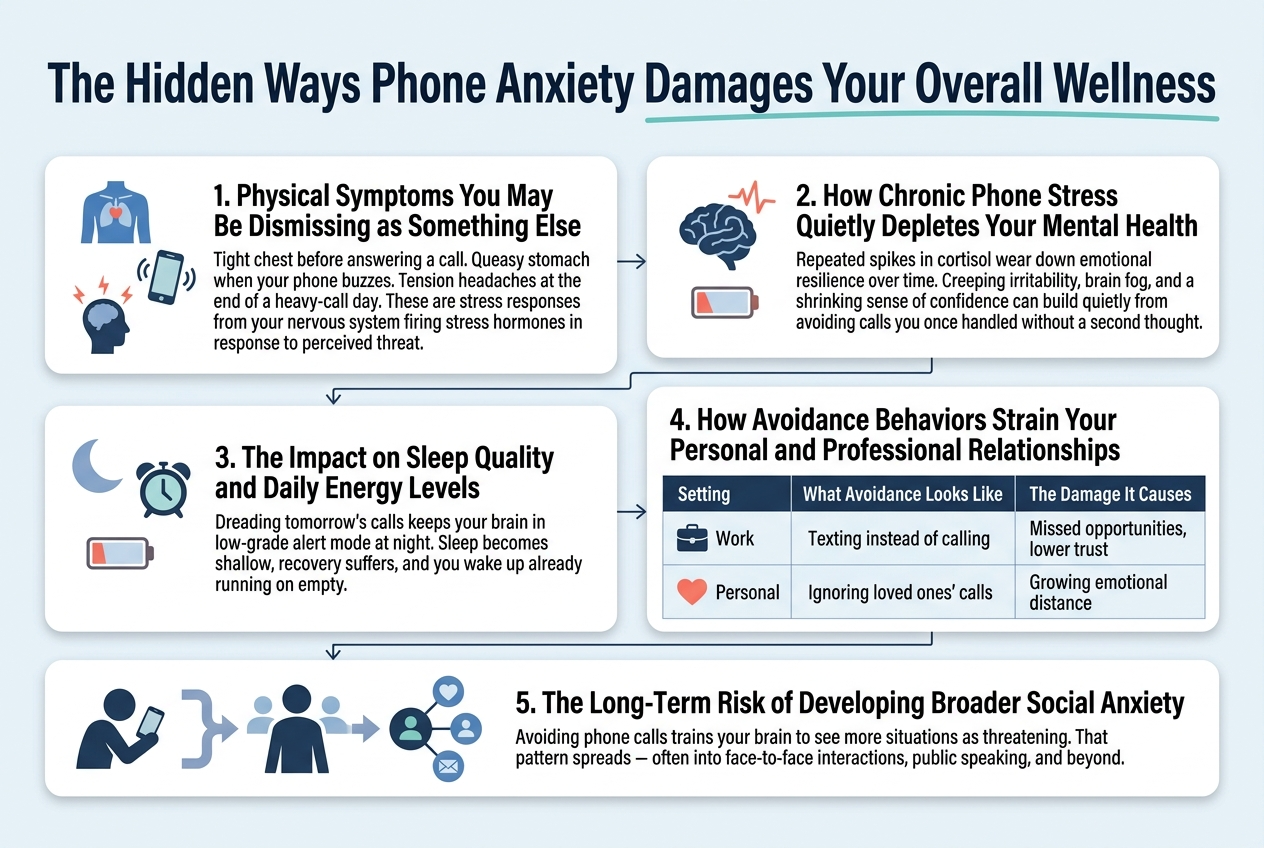
Create a clean professional infographic illustration in a 3:2 aspect ratio, full-bleed background with no frame and no large outer margins, using a modern flat editorial style. Use a white background with deep navy, teal, soft blue, and coral accents. Add a bold top title in large dark navy sans-serif text: "The Hidden Ways Phone Anxiety Damages Your Overall Wellness". Place a thin teal accent line under the title.

Below the title, arrange five wide horizontal sections in a balanced two-column layout with clear spacing, not a narrow vertical stack. Use rounded rectangular blocks with subtle shadows, each with a distinct icon and numbered label. Use clean sans-serif fonts, strong hierarchy, and small section headers in bold.

Section 1, top left: a blue chest icon, a phone buzz icon, and a headache icon beside the heading in bold: "1. Physical Symptoms You May Be Dismissing as Something Else". Under it, include short body text in smaller readable font: "Tight chest before answering a call. Queasy stomach when your phone buzzes. Tension headaches at the end of a heavy-call day. These are stress responses from your nervous system firing stress hormones in response to perceived threat."

Section 2, top right: a brain icon with a stress wave and fading battery symbol beside the heading in bold: "2. How Chronic Phone Stress Quietly Depletes Your Mental Health". Under it, include body text: "Repeated spikes in cortisol wear down emotional resilience over time. Creeping irritability, brain fog, and a shrinking sense of confidence can build quietly from avoiding calls you once handled without a second thought."

Section 3, middle left, spanning wide: a crescent moon, alarm clock, and exhausted battery icon beside the heading in bold: "3. The Impact on Sleep Quality and Daily Energy Levels". Under it, include body text: "Dreading tomorrow's calls keeps your brain in low-grade alert mode at night. Sleep becomes shallow, recovery suffers, and you wake up already running on empty."

Section 4, middle right, with a simple two-row table design titled in bold: "4. How Avoidance Behaviors Strain Your Personal and Professional Relationships". Create a small table with column headers: "Setting", "What Avoidance Looks Like", and "The Damage It Causes". Use two rows exactly:
"Work | Texting instead of calling | Missed opportunities, lower trust"
"Personal | Ignoring loved ones' calls | Growing emotional distance"
Add small icons beside each row: a briefcase for Work and a heart for Personal.

Section 5, bottom full-width: a pathway or chain reaction graphic with a person shrinking from a phone, then expanding into multiple social icons, beside the heading in bold: "5. The Long-Term Risk of Developing Broader Social Anxiety". Under it, include body text: "Avoiding phone calls trains your brain to see more situations as threatening. That pattern spreads β€” often into face-to-face interactions, public speaking, and beyond."

Include subtle connecting arrows or flow lines between sections to suggest progression from physical symptoms to broader anxiety. Use simple symbolic icons only, crisp legible text, and a polished infographic layout with strong visual hierarchy and ample whitespace.

Physical Symptoms You May Be Dismissing as Something Else

Your body keeps score. That tight chest before answering a call, the queasy stomach when your phone buzzes, or the tension headaches at the end of a heavy-call day β€” these aren’t random. They’re your nervous system firing stress hormones in response to perceived threat.

How Chronic Phone Stress Quietly Depletes Your Mental Health

Repeated cortisol spikes wear down your emotional resilience over time. You may notice creeping irritability, brain fog, or a shrinking sense of confidence β€” all quietly fueled by avoiding calls you once handled without a second thought.

The Impact on Sleep Quality and Daily Energy Levels

Dreading tomorrow’s calls keeps your brain in low-grade alert mode at night. Your sleep becomes shallow, recovery suffers, and you wake up already running on empty.

How Avoidance Behaviors Strain Your Personal and Professional Relationships

SettingWhat Avoidance Looks LikeThe Damage It Causes
WorkTexting instead of callingMissed opportunities, lower trust
PersonalIgnoring loved ones’ callsGrowing emotional distance

The Long-Term Risk of Developing Broader Social Anxiety

Avoiding phone calls trains your brain to see more situations as threatening. That pattern spreads β€” often into face-to-face interactions, public speaking, and beyond.

Spot the Warning Signs Before They Escalate
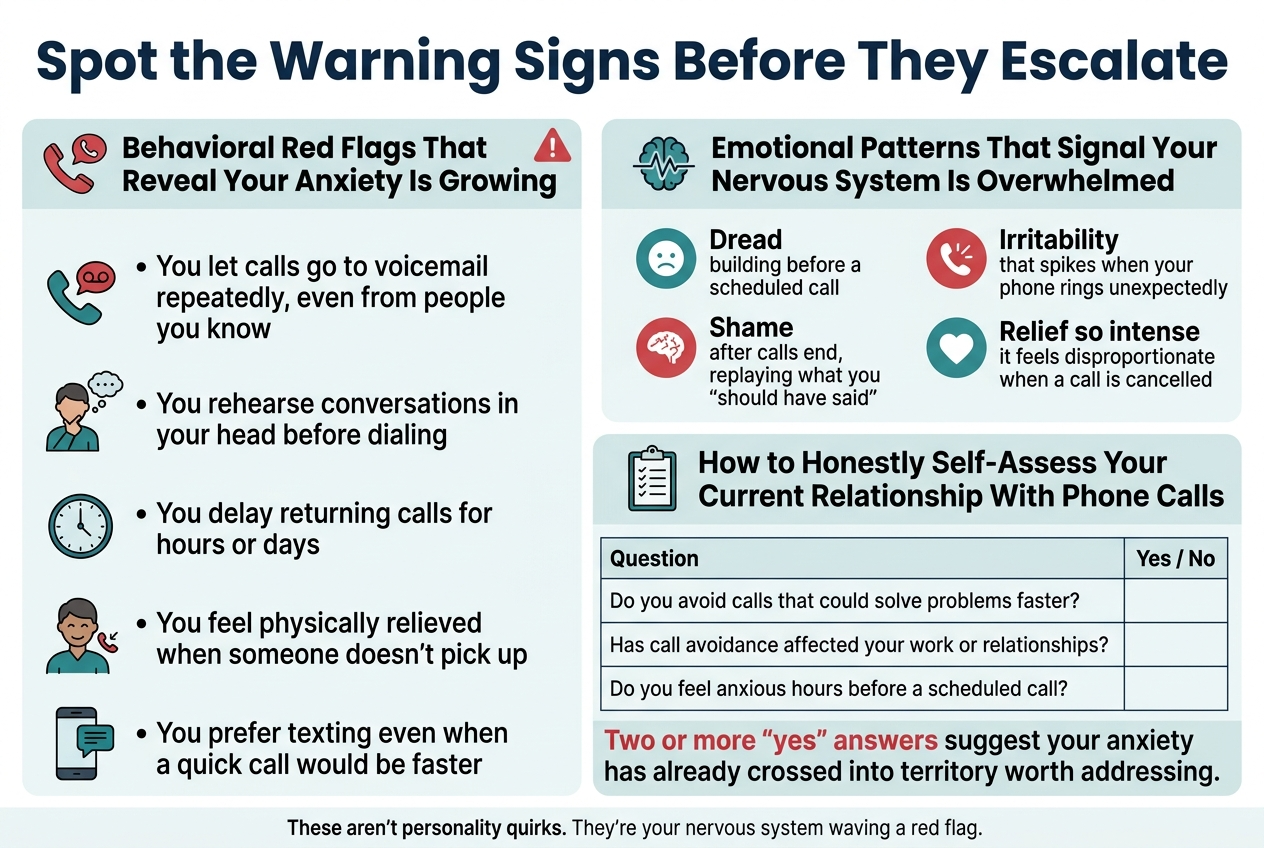
Create a clean, professional infographic in a 3:2 landscape aspect ratio, full-bleed layout with no frame, using a modern sans-serif font, bold dark navy headings, white background, teal and blue accents, and red warning highlights. Place a large bold title across the top: "Spot the Warning Signs Before They Escalate". Under the title, create a wide two-column layout with clear section blocks and simple line icons.

Left column section header in bold: "Behavioral Red Flags That Reveal Your Anxiety Is Growing"
Place 5 numbered bullet points, each with a small icon:
1. phone icon with voicemail symbol β€” "You let calls go to voicemail repeatedly, even from people you know"
2. speech bubble icon β€” "You rehearse conversations in your head before dialing"
3. clock icon β€” "You delay returning calls for hours or days"
4. relaxed exhale icon β€” "You feel physically relieved when someone doesn't pick up"
5. text message icon β€” "You prefer texting even when a quick call would be faster"

Right column section header in bold: "Emotional Patterns That Signal Your Nervous System Is Overwhelmed"
Place 4 emotion bullets in stacked colored blocks with small expressive icons:
- warning triangle icon β€” "Dread building before a scheduled call"
- ringing phone icon β€” "Irritability that spikes when your phone rings unexpectedly"
- shame face icon β€” "Shame after calls end, replaying what you 'should have said'"
- relief burst icon β€” "Relief so intense it feels disproportionate when a call is cancelled"

Across the lower third, add a highlighted sentence in a red-tinted callout box with a subtle alert icon:
"These aren't personality quirks. They're your nervous system waving a red flag."

At the bottom, create a self-assessment section spanning the width with a bold header: "How to Honestly Self-Assess Your Current Relationship With Phone Calls"
Use a clean table with three rows and two columns labeled "Question" and "Yes / No". Include the exact questions:
"Do you avoid calls that could solve problems faster?"
"Has call avoidance affected your work or relationships?"
"Do you feel anxious hours before a scheduled call?"
Add a footer note in a small accent box: "Two or more 'yes' answers suggest your anxiety has already crossed into territory worth addressing."

Use clear spacing, thin dividers, rounded rectangles, and subtle phone-related decorative elements in the background. Keep the overall style polished, readable, and editorial.

Behavioral Red Flags That Reveal Your Anxiety Is Growing

Watch for these patterns in your daily behavior:

  • You let calls go to voicemail repeatedly, even from people you know
  • You rehearse conversations in your head before dialing
  • You delay returning calls for hours or days
  • You feel physically relieved when someone doesn’t pick up
  • You prefer texting even when a quick call would be faster

Emotional Patterns That Signal Your Nervous System Is Overwhelmed

Your emotions tell the real story. If your nervous system is struggling, you’ll notice:

  • Dread building before a scheduled call
  • Irritability that spikes when your phone rings unexpectedly
  • Shame after calls end, replaying what you “should have said”
  • Relief so intense it feels disproportionate when a call is canceled

These aren’t personality quirks. They’re your nervous system waving a red flag.

How to Honestly Self-Assess Your Current Relationship With Phone Calls

Ask yourself these questions without judgment:

QuestionYes / No
Do you avoid calls that could solve problems faster?
Has call avoidance affected your work or relationships?
Do you feel anxious hours before a scheduled call?

Two or more “yes” answers suggest your anxiety has already crossed into territory worth addressing.

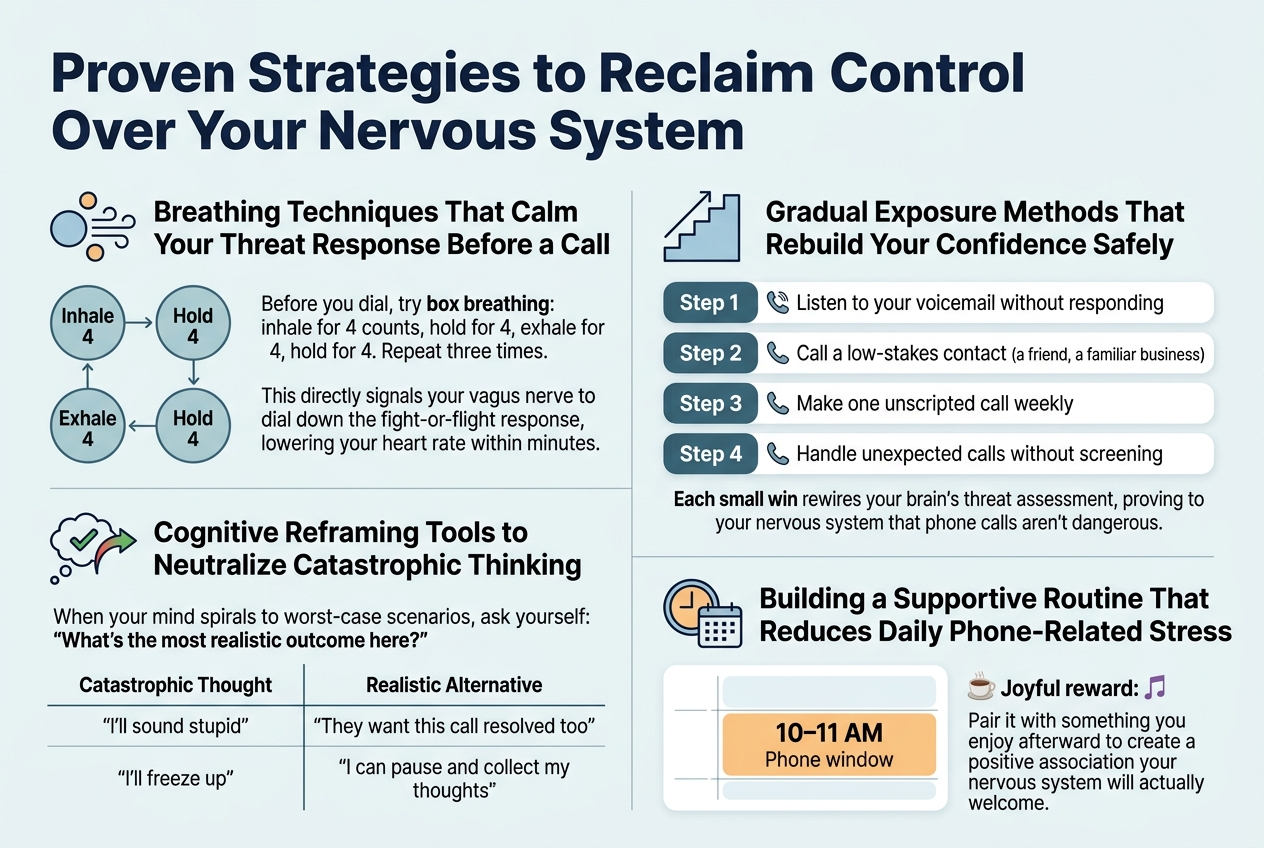
Proven Strategies to Reclaim Control Over Your Nervous System
Create a clean, professional full-bleed infographic in 3:2 aspect ratio with a light background, modern sans-serif fonts, and a calm color palette of deep navy, teal, soft blue, and warm accent orange. Place a bold title across the top: "Proven Strategies to Reclaim Control Over Your Nervous System". Use a wide horizontal layout with four main sections arranged in a 2x2 grid across the page, each section with a clear icon, bold subheading, and concise body text.

Top section, left: a breathing icon with circles and airflow lines. Heading: "Breathing Techniques That Calm Your Threat Response Before a Call". Add a small numbered breathing cycle graphic with four connected circles labeled "Inhale 4", "Hold 4", "Exhale 4", "Hold 4". Below, include the text: "Before you dial, try box breathing: inhale for 4 counts, hold for 4, exhale for 4, hold for 4. Repeat three times. This directly signals your vagus nerve to dial down the fight-or-flight response, lowering your heart rate within minutes."

Top section, right: a staircase icon with four steps. Heading: "Gradual Exposure Methods That Rebuild Your Confidence Safely". Show a vertical step list with numbered badges and small phone icons:
"Step 1: Listen to your voicemail without responding"
"Step 2: Call a low-stakes contact (a friend, a familiar business)"
"Step 3: Make one unscripted call weekly"
"Step 4: Handle unexpected calls without screening"
Add a small footer line under the steps: "Each small win rewires your brain's threat assessment, proving to your nervous system that phone calls aren't dangerous."

Bottom section, left: a thought bubble icon with a checkmark and arrow turning from red to green. Heading: "Cognitive Reframing Tools to Neutralize Catastrophic Thinking". Include a two-column mini table with thin lines and bold column headers:
"Catastrophic Thought" | "Realistic Alternative"
Rows:
"\"I'll sound stupid\"" | "\"They want this call resolved too\""
"\"I'll freeze up\"" | "\"I can pause and collect my thoughts\""
Add a small prompt line above the table: "When your mind spirals to worst-case scenarios, ask yourself: \"What's the most realistic outcome here?\""

Bottom section, right: a clock icon and calendar icon. Heading: "Building a Supportive Routine That Reduces Daily Phone-Related Stress". Show a simple schedule block with a highlighted time bar reading "10–11 AM" and the label "Phone window". Add a small joyful reward icon beside it, such as a coffee cup or music note, with the text: "Pair it with something you enjoy afterward to create a positive association your nervous system will actually welcome."

Use strong visual hierarchy, bold section headers, clean spacing, subtle dividers, rounded boxes, and simple line icons. Keep the layout balanced and wide, with each section clearly separated and easy to scan.

Breathing Techniques That Calm Your Threat Response Before a Call

Before you dial, try box breathing: inhale for 4 counts, hold for 4, exhale for 4, hold for 4. Repeat three times. This directly signals your vagus nerve to dial down the fight-or-flight response, lowering your heart rate within minutes.

Gradual Exposure Methods That Rebuild Your Confidence Safely

Work up a personal exposure ladder:

  • Step 1: Listen to your voicemail without responding
  • Step 2: Call a low-stakes contact (a friend, a familiar business)
  • Step 3: Make one unscripted call weekly
  • Step 4: Handle unexpected calls without screening

Each small win rewires your brain’s threat assessment, proving to your nervous system that phone calls aren’t dangerous.

Cognitive Reframing Tools to Neutralize Catastrophic Thinking

When your mind spirals to worst-case scenarios, ask yourself: “What’s the most realistic outcome here?” Keep a quick mental checklist:

Catastrophic ThoughtRealistic Alternative
“I’ll sound stupid”“They want this call resolved too”
“I’ll freeze up”“I can pause and collect my thoughts”

Building a Supportive Routine That Reduces Daily Phone-Related Stress

Designate a specific “phone window” each day β€” maybe 10–11 AM β€” so calls don’t ambush you randomly. Pair it with something you enjoy afterward to create a positive association your nervous system will actually welcome.
Create a full-bleed horizontal infographic illustration in a 3:2 aspect ratio with a clean modern professional style, soft white background with subtle blue and teal gradients, bold sans-serif typography, and clear visual hierarchy.

TOP HEADER, spanning full width:
Large bold title text: "Conclusion"
Smaller subtitle text beneath: "Phone anxiety is a real physiological response"

MAIN LAYOUT: a wide 4-section horizontal infographic with connected blocks or flow panels from left to right, using icons and short text.

SECTION 1 on the left:
A red phone ringing icon with a stressed nervous system symbol and small heartbeat lines.
Heading text: "1. Real physical response"
Body text: "Phone anxiety is more than dreading a call"
Small label text: "cortisol spike"

SECTION 2 left-center:
A nervous system graphic with lightning-like stress lines, red pulse accents, and a looping alarm circle.
Heading text: "2. Fight-or-flight lingers"
Body text: "Your body stays activated long after the call ends"
Small label text: "nervous system on alert"

SECTION 3 right-center:
Three compact warning-sign cards with simple icons: a moon for sleep, two linked hearts for relationships, and a calm face fading into tension.
Heading text: "3. Hidden warning signs"
Bullets:
"Sleep disruption"
"Strained relationships"
"Less overall calm"

SECTION 4 on the right:
A blue-green shield and upward path icon with a small checkmark and growing plant motif.
Heading text: "4. You can retrain your response"
Body text: "Start small"
Bullets:
"Notice your patterns"
"Use tools that work for you"
"Give yourself grace"
Closing line in a highlighted ribbon or callout at bottom right:
"Your wellness is worth more than letting a silent buzz run the show."

Use a balanced wide composition, large readable text, strong contrast, rounded cards, subtle dividers, and simple flat medical-style icons. Keep all text exact and clearly legible.

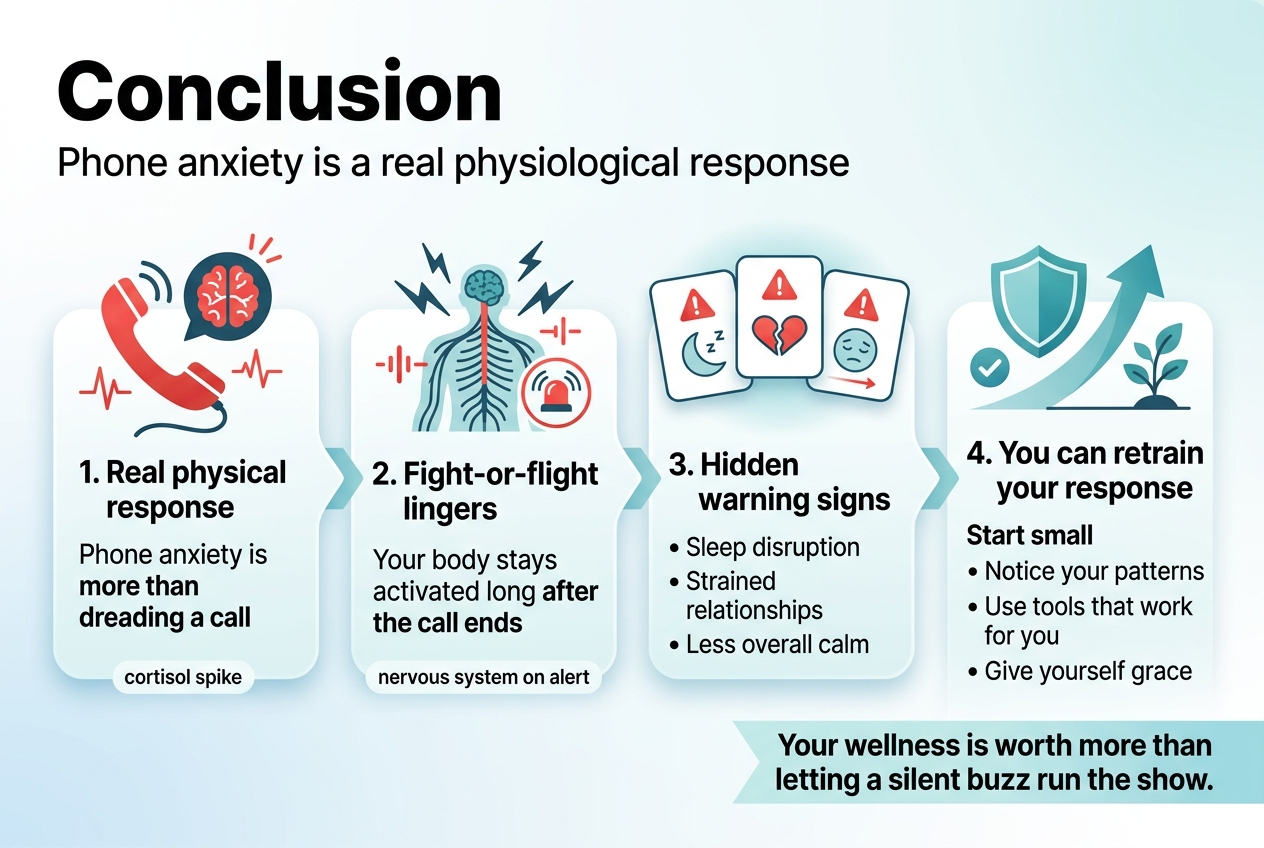
Phone anxiety is more than just dreading a call β€” it’s a real, physiological response that puts your nervous system through the wringer every time your phone rings. From cortisol spikes to staying stuck in fight-or-flight long after the call ends, the toll it takes on your mental and physical wellness adds up fast. The warning signs are easy to brush off at first, but left unchecked, they quietly chip away at your sleep, your relationships, and your overall sense of calm.

The good news is that you’re not stuck feeling this way. With the right strategies and a little self-awareness, you can start retraining your nervous system and take back control of how you respond to your phone. Start small β€” notice your patterns, use the tools that work for you, and give yourself grace through the process. Your wellness is worth more than letting a silent buzz run the show.

✨ Join The Zen Journal community β€” get fresh yoga and wellness insights straight to your inbox ✨