Jet Lag to Zen: Transform Your Travel Fatigue into a Powerful Mindfulness Journey

Jet Lag to Zen: Transform Your Travel Fatigue into a Powerful Mindfulness Journey
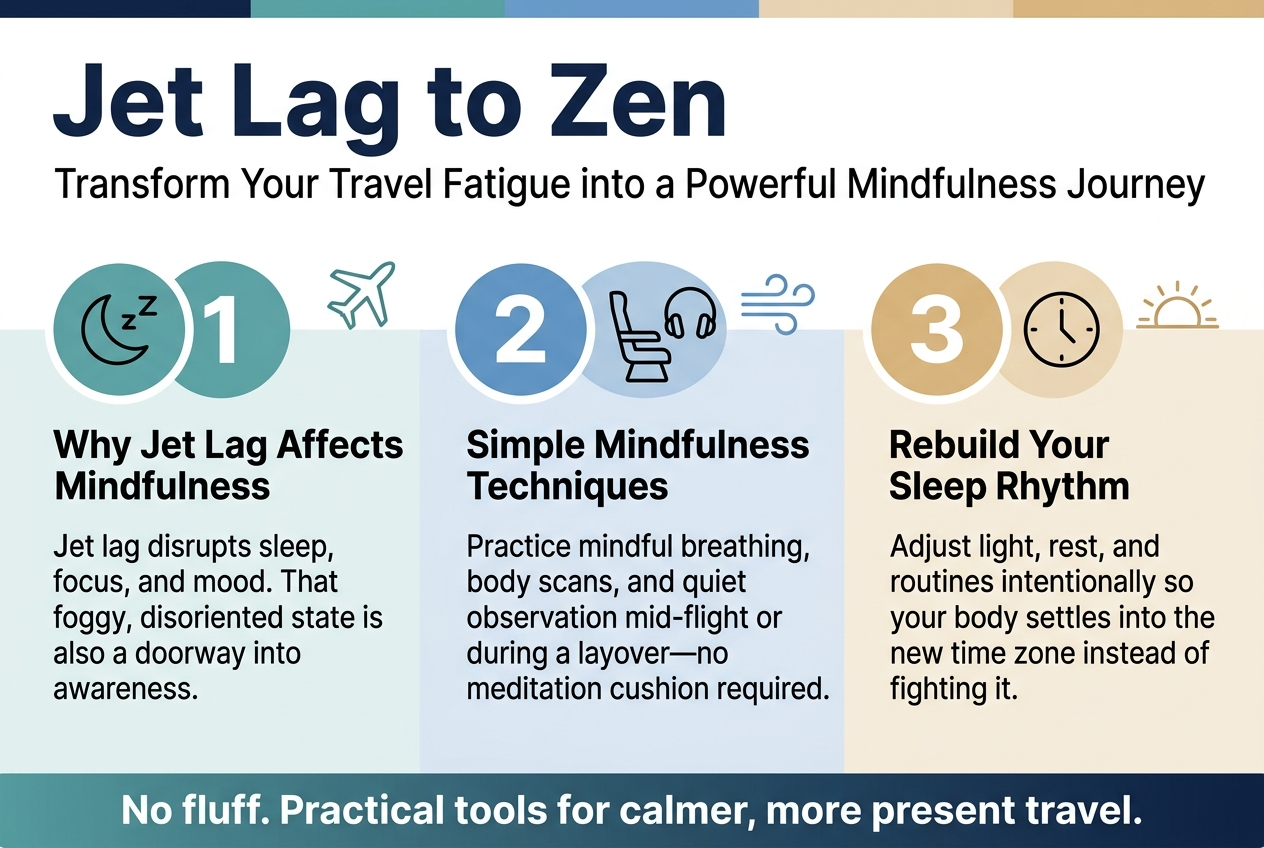
Create a clean, modern full-bleed infographic in 3:2 aspect ratio with a wide horizontal layout, no poster frame, no inset margins, using a calm travel-and-wellness palette of deep navy, teal, soft blue, warm sand, and white accents. Use bold sans-serif typography with strong hierarchy.

Top band across the full width:
Large bold title centered-left: "Jet Lag to Zen"
Smaller subtitle directly below: "Transform Your Travel Fatigue into a Powerful Mindfulness Journey"

Main body split into three wide horizontal sections or three side-by-side panels across the center, each with a numbered circle icon and a simple visual symbol:

Left panel:
Large number icon "1" in a teal circle with a moon and airplane icon.
Heading: "Why Jet Lag Affects Mindfulness"
Short body text in 2–3 lines:
"Jet lag disrupts sleep, focus, and mood. That foggy, disoriented state is also a doorway into awareness."

Middle panel:
Large number icon "2" in a blue circle with a seat, headphones, or breathing icon.
Heading: "Simple Mindfulness Techniques"
Short body text in 2–3 lines:
"Practice mindful breathing, body scans, and quiet observation mid-flight or during a layover—no meditation cushion required."

Right panel:
Large number icon "3" in a sand-colored circle with a clock and sunrise icon.
Heading: "Rebuild Your Sleep Rhythm"
Short body text in 2–3 lines:
"Adjust light, rest, and routines intentionally so your body settles into the new time zone instead of fighting it."

Add a bottom horizontal callout bar spanning the width with a subtle gradient from teal to navy:
Bold text centered:
"No fluff. Practical tools for calmer, more present travel."

Include small supporting icons near each panel: airplane, eye with sleep lines, breathing waves, clock, sunrise. Use clean line icons, minimal shadows, lots of white space, and balanced spacing. Make the layout wide and readable, with text blocks aligned neatly and visually separated by soft dividers or color blocks.

You just landed. Your body thinks it’s 3 a.m., your eyes feel like sandpaper, and the last thing on your mind is “being present.” But what if that foggy, disoriented feeling you’re trying to fight off is actually the perfect doorway into mindfulness?

This guide is for frequent flyers, digital nomads, and anyone who travels enough to know that jet lag is more than just tiredness — it’s a full-on disruption to your mind and body. If you’ve been white-knuckling through travel fatigue with coffee and sheer willpower, there’s a better way.

Here’s what you’ll walk away with:

  • Why jet lag and mental awareness are more connected than you think — and how that connection works in your favor
  • Simple, real mindfulness techniques you can practice mid-flight or mid-layover — no meditation cushion required
  • How to rebuild your sleep rhythm intentionally so your body stops fighting the time zone and starts settling into it

No fluff, no “just breathe through it” advice. Just practical tools to help you stop surviving your travels and start actually showing up for them — tired and all.

Understanding the Hidden Connection Between Jet Lag and Mental Awareness
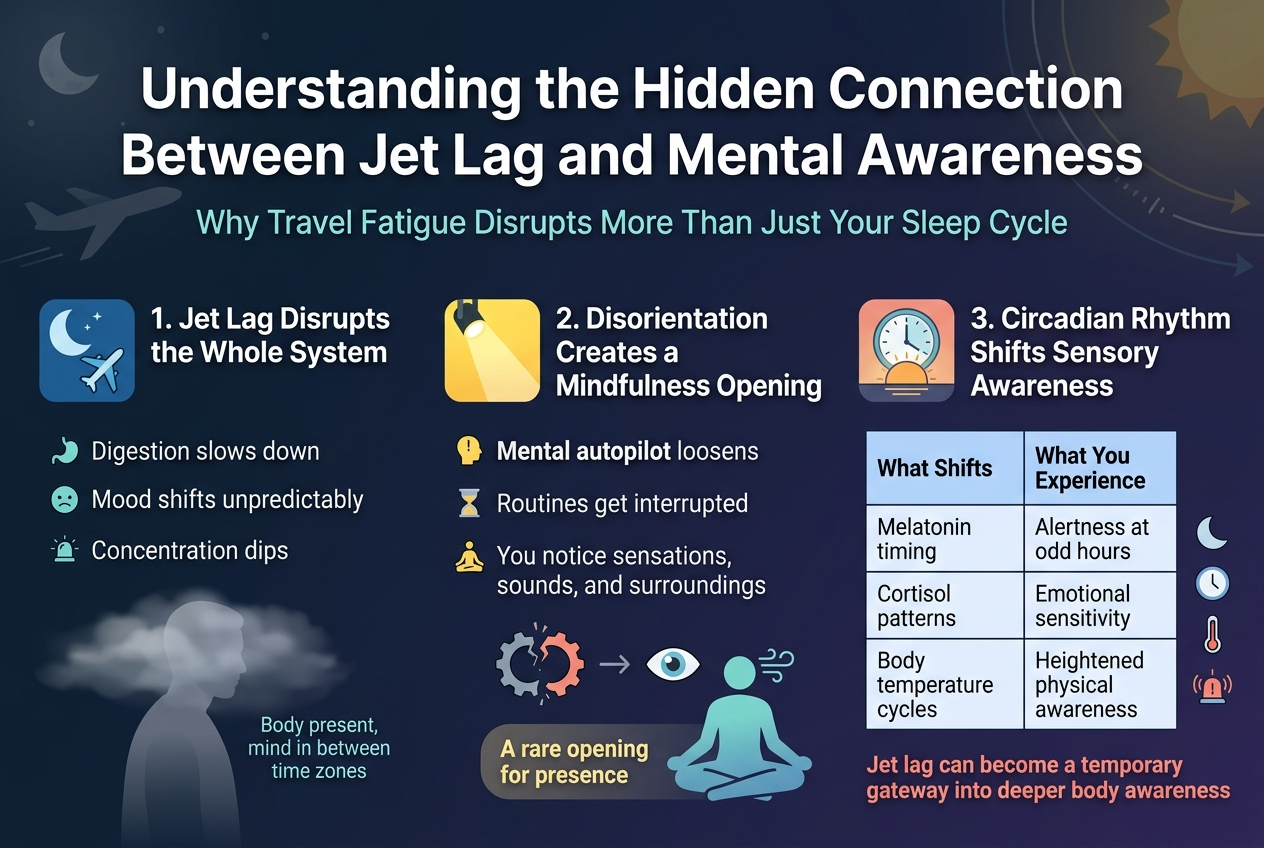
Create a full-bleed professional infographic illustration in a 3:2 aspect ratio, using a clean modern sans-serif font, with a dark navy to deep indigo background and bright accent colors in teal, cyan, warm yellow, and soft coral. Use a wide horizontal layout with three main sections across the canvas, not a narrow vertical poster. Include subtle atmospheric travel elements like a faint airplane silhouette, moon, sun, and moving time-zone lines in the background.

Top across the full width: large bold white heading text, centered and highly legible: "Understanding the Hidden Connection Between Jet Lag and Mental Awareness"
Directly below the heading, smaller subtitle text in light teal: "Why Travel Fatigue Disrupts More Than Just Your Sleep Cycle"

Left third section: a numbered block with a blue crescent-moon and airplane icon. Title text: "1. Jet Lag Disrupts the Whole System" Include three short bullet points with small icons:
- "Digestion slows down"
- "Mood shifts unpredictably"
- "Concentration dips"
Add a faded silhouette of a person with a cloudy fog overlay, and a small label near the figure: "Body present, mind in between time zones"

Center third section: a numbered block with a bright yellow spotlight icon and a person meditating icon. Title text: "2. Disorientation Creates a Mindfulness Opening" Include three short bullet points:
- "Mental autopilot loosens"
- "Routines get interrupted"
- "You notice sensations, sounds, and surroundings"
Add a visual of a broken gear or disrupted loop transforming into an open eye and a calm breathing figure. Include a short highlighted callout in a rounded box: "A rare opening for presence"

Right third section: a numbered block with a circular clock and sunrise/sunset icon. Title text: "3. Circadian Rhythm Shifts Sensory Awareness" Place a clean 2-column mini table beneath it with a thin white grid and alternating soft blue rows. Table header text:
"What Shifts" and "What You Experience"
Table rows:
"Melatonin timing" — "Alertness at odd hours"
"Cortisol patterns" — "Emotional sensitivity"
"Body temperature cycles" — "Heightened physical awareness"
Add a small icon row beside the table showing a moon, a clock, a thermometer, and an alert signal. At the bottom of this section, include a highlighted concluding line in coral text: "Jet lag can become a temporary gateway into deeper body awareness"

Use crisp white body text, bold section headings, colorful icon accents, strong visual hierarchy, and clean spacing. Keep all text sharp, readable, and exactly as written.

Why Travel Fatigue Disrupts More Than Just Your Sleep Cycle

Jet lag doesn’t just make you tired — it throws your entire system off balance. Your digestion slows down, your mood shifts unpredictably, your concentration dips, and your emotional resilience drops. You’re essentially operating in a kind of fog where your body is physically present but mentally somewhere between two time zones.

How Your Body’s Confusion Becomes a Doorway to Mindfulness

Here’s something worth sitting with: that disorientation you feel? It actually loosens your mental autopilot. Your usual routines and thought patterns get interrupted, which creates a rare opening. When your default mode breaks down, you become more present — noticing sensations, sounds, and surroundings you’d normally filter out. Your body’s confusion quietly invites your mind to pay attention.

The Science Behind Circadian Rhythms and Heightened Sensory Awareness

Your circadian rhythm is your internal 24-hour clock, regulated by light, temperature, and melatonin. When you cross time zones, this clock desynchronizes, triggering:

What ShiftsWhat You Experience
Melatonin timingAlertness at odd hours
Cortisol patternsEmotional sensitivity
Body temperature cyclesHeightened physical awareness

This biological resetting temporarily sharpens your senses — making jet lag an unexpected gateway into deeper awareness of your own body.

Reframing Exhaustion as a Mindfulness Opportunity
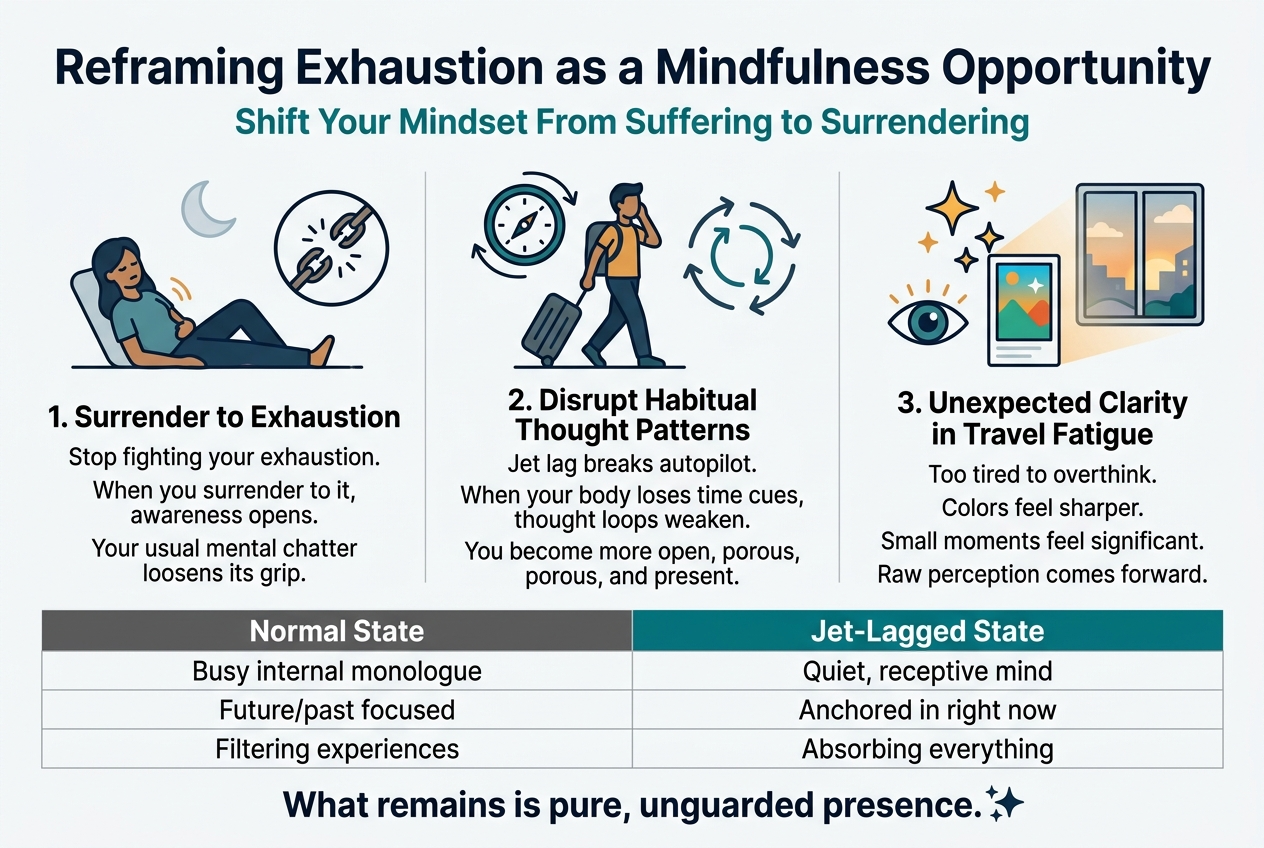
Create a clean, modern infographic illustration in a 3:2 aspect ratio with a full-bleed layout, white background, deep navy and teal accents, warm amber highlights, and crisp sans-serif typography. Place a bold headline across the top center: "Reframing Exhaustion as a Mindfulness Opportunity". Directly below, place a smaller subtitle in teal: "Shift Your Mindset From Suffering to Surrendering".

Use a wide horizontal 3-panel layout across the middle, with clear section dividers and simple icons.

Left panel: a calm tired person reclining with a soft moon icon and lowered shoulders. Add a circular icon of a broken chain or released hands. Title text: "1. Surrender to Exhaustion". Add body text in short lines: "Stop fighting your exhaustion." "When you surrender to it, awareness opens." "Your usual mental chatter loosens its grip."

Center panel: a traveler with a suitcase and a swirling clock/compass icon showing disorientation. Add a disrupted thought-loop graphic with broken circular arrows. Title text: "2. Disrupt Habitual Thought Patterns". Add body text: "Jet lag breaks autopilot." "When your body loses time cues, thought loops weaken." "You become more open, porous, and present."

Right panel: a bright sensory scene with vivid colors, glowing stars, and sharpened edges around objects. Add an eye icon and a softly lit landscape or city window view. Title text: "3. Unexpected Clarity in Travel Fatigue". Add body text: "Too tired to overthink." "Colors feel sharper." "Small moments feel significant." "Raw perception comes forward."

Along the bottom, create a wide comparison table with two columns and subtle gray row lines. Left column header in dark gray: "Normal State". Right column header in teal: "Jet-Lagged State". Use three rows with paired text:
"Busy internal monologue" | "Quiet, receptive mind"
"Future/past focused" | "Anchored in right now"
"Filtering experiences" | "Absorbing everything"

Place a final bold closing line centered at the bottom in navy with a small sparkle icon: "What remains is pure, unguarded presence."

Use simple line icons, strong visual hierarchy, generous spacing, and a professional editorial infographic style. No borders around the entire image. No watermark.

Shift Your Mindset From Suffering to Surrendering

Stop fighting your exhaustion. When you surrender to it instead, something shifts. Your body’s depleted state actually loosens the grip your usual mental chatter holds over you, creating a rare opening for genuine awareness.

Use Physical Disorientation to Break Habitual Thought Patterns

Your brain runs on autopilot at home. Jet lag disrupts that completely. When your body doesn’t know if it’s 3 AM or noon, your habitual thought loops struggle to maintain their usual rhythm. That disruption is your advantage — you’re suddenly more open, more porous, more available to what’s actually happening around you.

Discover the Unexpected Clarity That Comes With Travel Fatigue

There’s a strange sweetness that appears when you’re too tired to overthink. Colors look sharper. Small moments feel oddly significant. Your sensory experience expands precisely because your analytical mind has temporarily stepped back. Lean into that raw, unfiltered perception.

Why Jet Lag Strips Away Distractions and Sharpens Presence

Normal StateJet-Lagged State
Busy internal monologueQuiet, receptive mind
Future/past focusedAnchored in right now
Filtering experiencesAbsorbing everything

Your tired mind stops editing your experience. What remains is pure, unguarded presence.

Practical Mindfulness Techniques to Practice Mid-Travel
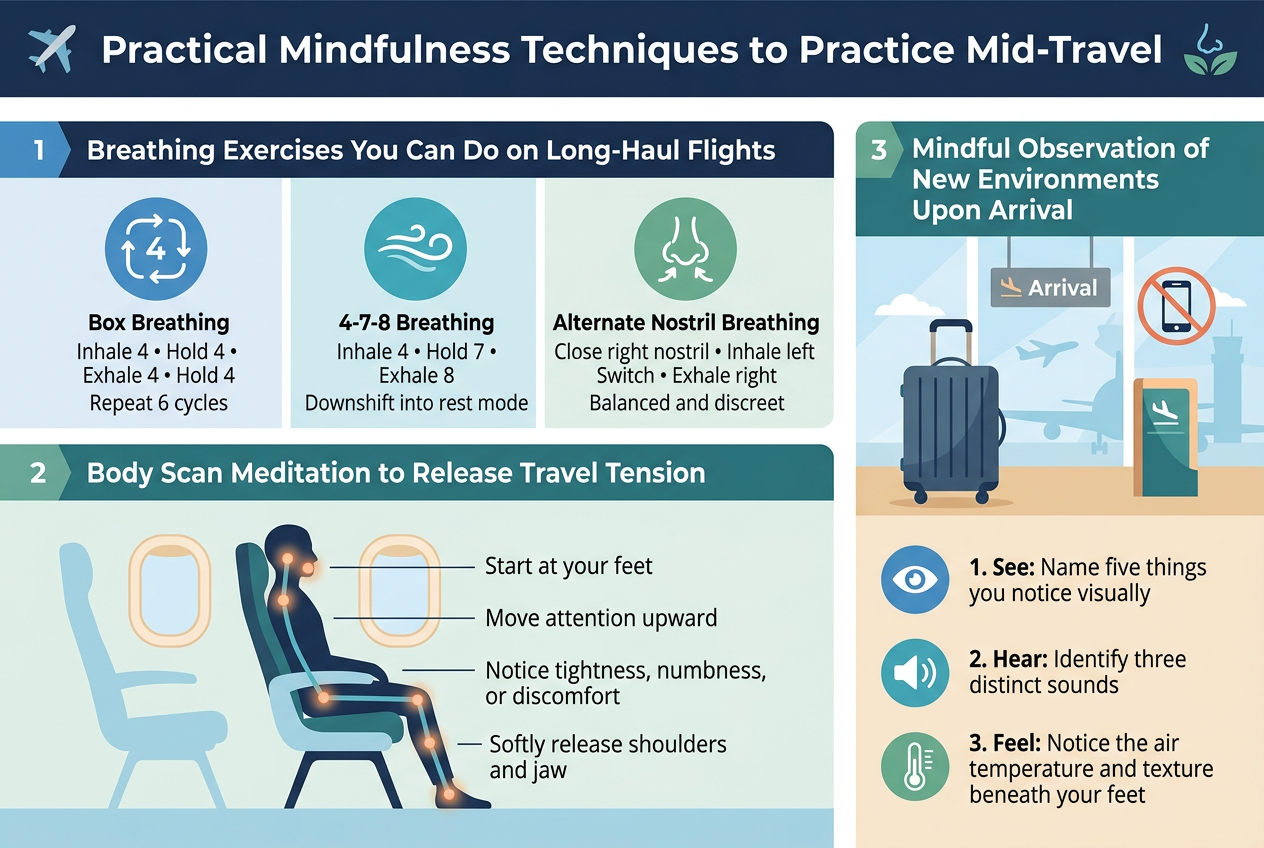
Create a clean, professional infographic in a 3:2 landscape full-bleed layout with no frame or inset margins. Use a calm travel-and-wellness color palette of deep navy, teal, sky blue, soft sand, and white, with subtle accent orange. Use modern sans-serif fonts with a bold title at the top and clear section headers. 

Top header across the full width:
"Practical Mindfulness Techniques to Practice Mid-Travel"
Add a small airplane icon and a calm breathing/leaf icon near the title.

Main layout: three wide horizontal sections across the page, each in a distinct colored block with simple illustrated icons and short bullet text.

Section 1 on the left/middle top:
Header text: "Breathing Exercises You Can Do on Long-Haul Flights"
Show three side-by-side mini panels with circular icons and step counts.
Panel 1: blue circle icon with 4-count breathing arrows and text:
"Box Breathing"
"Inhale 4 • Hold 4 • Exhale 4 • Hold 4"
"Repeat 6 cycles"
Panel 2: teal circle icon with a slow exhale wave and text:
"4-7-8 Breathing"
"Inhale 4 • Hold 7 • Exhale 8"
"Downshift into rest mode"
Panel 3: green circle icon with a balanced nose/airflow symbol and text:
"Alternate Nostril Breathing"
"Close right nostril • Inhale left • Switch • Exhale right"
"Balanced and discreet"

Section 2 across the lower left and center:
Header text: "Body Scan Meditation to Release Travel Tension"
Show a seated person silhouette in an airplane seat with a vertical body highlight from feet to head, plus small glow points at feet, calves, knees, hips, shoulders, and jaw.
Include short text beside the figure:
"Start at your feet"
"Move attention upward"
"Notice tightness, numbness, or discomfort"
"Softly release shoulders and jaw"

Section 3 on the right side:
Header text: "Mindful Observation of New Environments Upon Arrival"
Show a travel arrival scene with a suitcase, airport/arrival background, and a phone icon crossed out.
Use three numbered observation bullets with matching icons:
"1. See: Name five things you notice visually"
"2. Hear: Identify three distinct sounds"
"3. Feel: Notice the air temperature and texture beneath your feet"

Add small numbered markers for the three main sections, subtle divider lines, and balanced spacing. Keep all text crisp, legible, and minimal. Use clean vector-style illustration, flat design with soft shadows, and strong visual hierarchy.

Breathing Exercises You Can Do on Long-Haul Flights

Your seat becomes a meditation cushion when you know how to breathe intentionally. Try these mid-flight techniques:

  • Box Breathing: Inhale for 4 counts, hold for 4, exhale for 4, hold for 4. Repeat 6 cycles to calm your nervous system.
  • 4-7-8 Breathing: Inhale for 4 counts, hold for 7, exhale slowly for 8. This signals your body to downshift into rest mode.
  • Alternate Nostril Breathing: Close your right nostril, inhale left, switch, exhale right. This balances your energy without drawing attention from fellow passengers.

Body Scan Meditation to Release Travel Tension

Sitting for hours quietly wrecks your body. A body scan helps you locate and release that hidden tension.

Starting at your feet, slowly move your attention upward — noticing tightness, numbness, or discomfort without judging it. Soften each area consciously before moving on. Your shoulders and jaw typically hold the most tension during travel, so spend extra time there.

Mindful Observation of New Environments Upon Arrival

When you land, resist the urge to immediately check your phone. Instead:

  • See: Name five things you notice visually
  • Hear: Identify three distinct sounds
  • Feel: Notice the air temperature, texture beneath your feet

This grounds you instantly and makes your arrival feel like a genuine experience rather than just another location change.

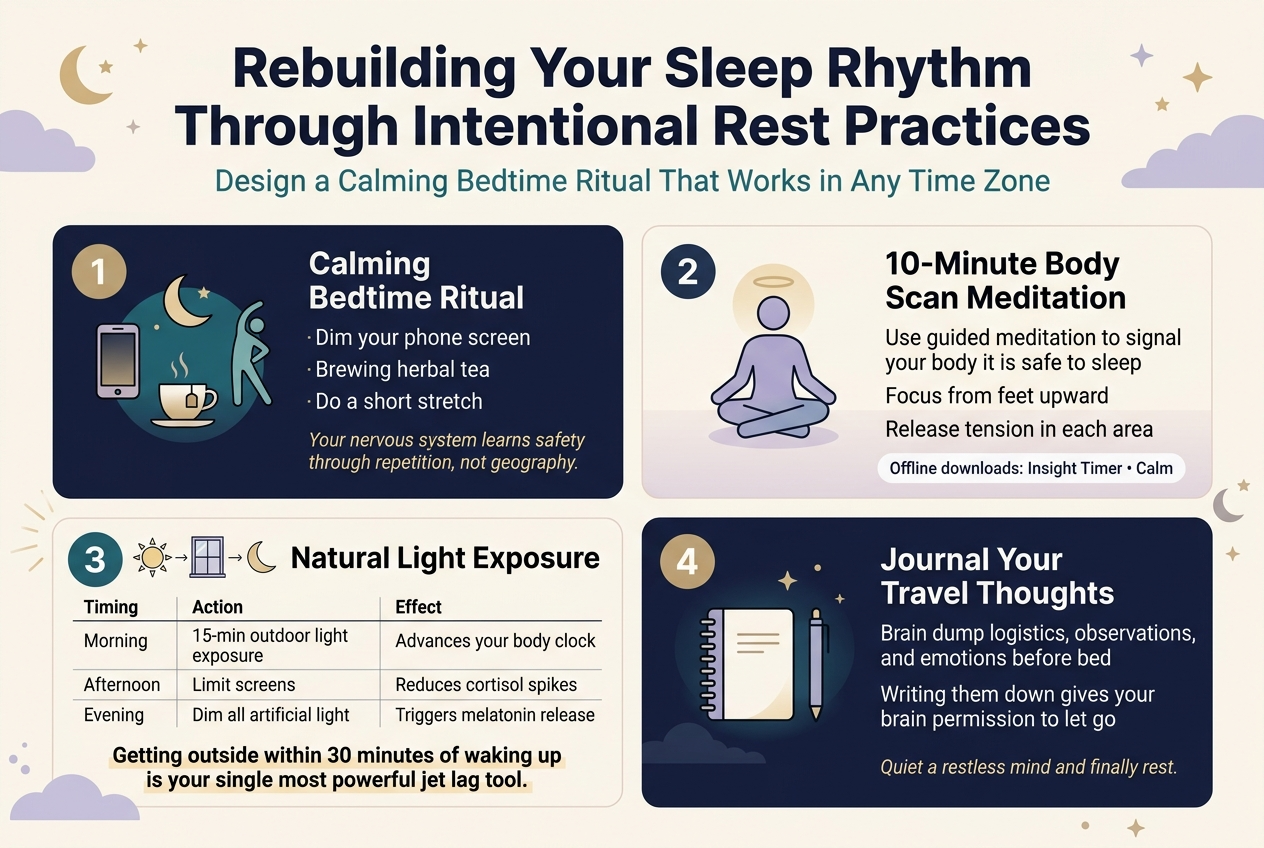
Rebuilding Your Sleep Rhythm Through Intentional Rest Practices
Aspect ratio 3:2, full-bleed infographic illustration in a calming modern editorial style, soft deep navy, teal, lavender, warm cream, and muted gold color palette, clean sans-serif typography with bold hierarchy, subtle gradients, simple line icons, spacious wide layout, no poster frame, no inset border.

Top center: large bold heading in dark navy text, exact title: "Rebuilding Your Sleep Rhythm Through Intentional Rest Practices"
Directly below the title, smaller subtitle in teal: "Design a Calming Bedtime Ritual That Works in Any Time Zone"

Use a 2x2 grid of wide content blocks across the canvas, each with a numbered circle icon and a matching illustration.

Top left block:
Large number circle "1" with a phone, tea cup, and stretching figure icon.
Heading: "Calming Bedtime Ritual"
Body text in short lines:
"Dim your phone screen"
"Brewing herbal tea"
"Do a short stretch"
Small caption below in italic style: "Your nervous system learns safety through repetition, not geography."

Top right block:
Large number circle "2" with a meditation figure and soft halo icon.
Heading: "10-Minute Body Scan Meditation"
Body text:
"Use guided meditation to signal your body it is safe to sleep"
"Focus from feet upward"
"Release tension in each area"
Small callout badge: "Offline downloads: Insight Timer • Calm"

Bottom left wide block:
Large number circle "3" with sun, window, and moon icons arranged in a timeline.
Heading: "Natural Light Exposure"
Include a clean mini-table with three rows and three columns, exact text:
"Timing | Action | Effect"
"Morning | 15-min outdoor light exposure | Advances your body clock"
"Afternoon | Limit screens | Reduces cortisol spikes"
"Evening | Dim all artificial light | Triggers melatonin release"
Bold highlighted note beneath the table: "Getting outside within 30 minutes of waking up is your single most powerful jet lag tool."

Bottom right block:
Large number circle "4" with a notebook and pen icon.
Heading: "Journal Your Travel Thoughts"
Body text:
"Brain dump logistics, observations, and emotions before bed"
"Writing them down gives your brain permission to let go"
Small closing line in soft gold: "Quiet a restless mind and finally rest."

Add small decorative sleep-themed icons around the edges: crescent moon, stars, soft cloud shapes, and subtle light rays, all minimal and tasteful. Maintain strong visual hierarchy, clear section spacing, and a polished infographic layout with readable text throughout.

Design a Calming Bedtime Ritual That Works in Any Time Zone

Pick three simple actions you’ll repeat every night regardless of location — dimming your phone screen, brewing herbal tea, and doing a short stretch. Your nervous system learns safety through repetition, not geography.

Use Guided Meditation to Signal Your Body It Is Safe to Sleep

A 10-minute body scan meditation tells your brain the day is genuinely over. Apps like Insight Timer or Calm offer offline downloads so you’re covered even without Wi-Fi. Focus your attention slowly from your feet upward, consciously releasing tension in each area.

Harness Natural Light Exposure to Reset Your Internal Clock

TimingActionEffect
Morning15-min outdoor light exposureAdvances your body clock
AfternoonLimit screensReduces cortisol spikes
EveningDim all artificial lightTriggers melatonin release

Getting outside within 30 minutes of waking up is your single most powerful jet lag tool.

Journal Your Travel Thoughts to Quiet a Restless Mind

Brain dump everything swirling in your head onto paper before bed — logistics, observations, emotions. Your mind stays “awake” trying to hold onto unprocessed thoughts. Writing them down essentially gives your brain permission to let go and finally rest.

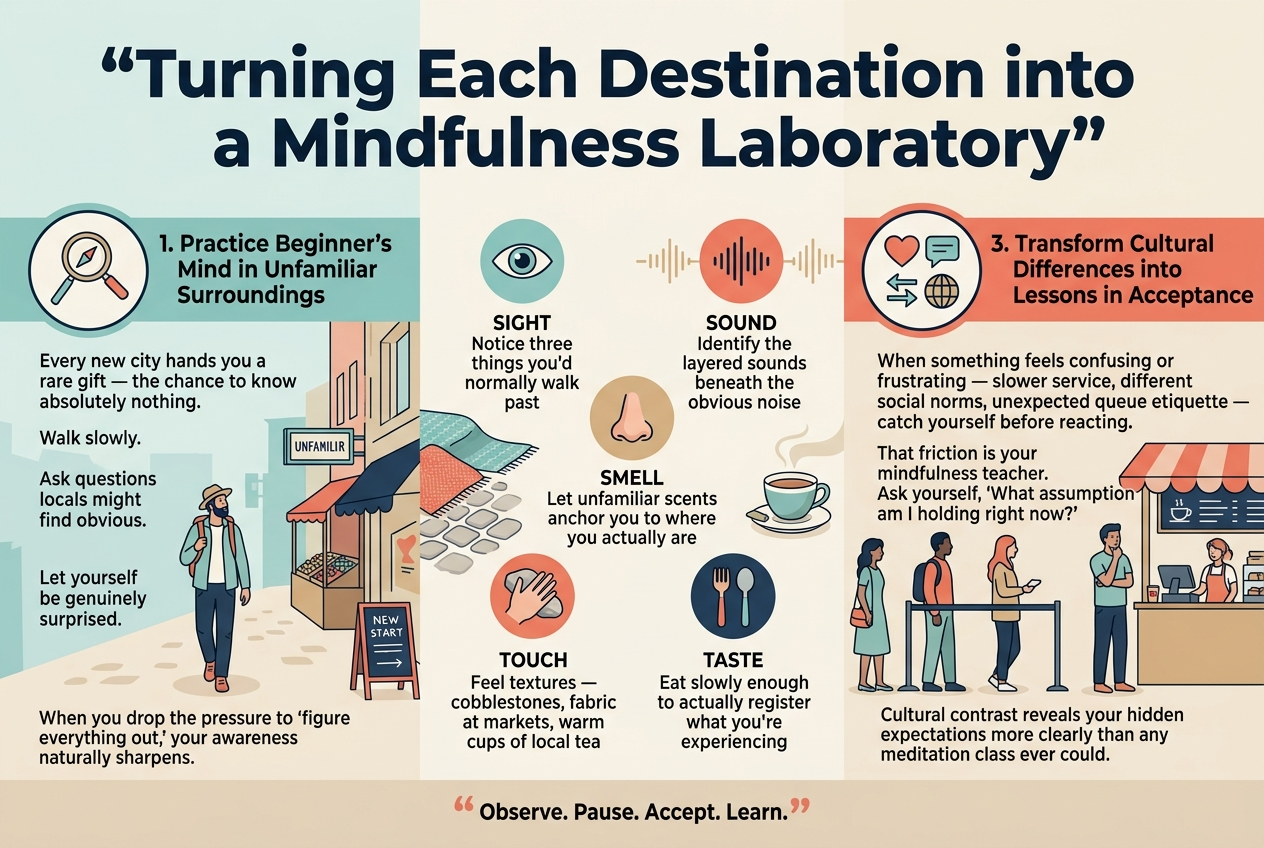
Turning Each Destination into a Mindfulness Laboratory
Create a clean, professional infographic illustration in a 3:2 aspect ratio with a full-bleed layout and no outer frame. Use a modern travel-and-wellness aesthetic with soft teal, warm coral, deep navy, sand beige, and white. Use bold sans-serif typography for the heading and clear readable sans-serif body text. Place a large bold title across the top: “Turning Each Destination into a Mindfulness Laboratory”.

Below the title, organize the infographic into three wide horizontal sections or side-by-side panels, with icons and numbered labels:

Left section:
A circular icon of a magnifying glass and compass. Heading text: “1. Practice Beginner’s Mind in Unfamiliar Surroundings”
Include short body text in a neat text block:
“Every new city hands you a rare gift — the chance to know absolutely nothing.”
“Walk slowly.”
“Ask questions locals might find obvious.”
“Let yourself be genuinely surprised.”
“When you drop the pressure to ‘figure everything out,’ your awareness naturally sharpens.”
Show a traveler walking slowly through a new city street with market stalls and unfamiliar signs.

Center section:
A five-part sensory grid with five small colored icon circles arranged in a row or 2x3 cluster, each with a label and one short line of text.
Use these exact labels and text:
“SIGHT: Notice three things you’d normally walk past”
“SOUND: Identify the layered sounds beneath the obvious noise”
“SMELL: Let unfamiliar scents anchor you to where you actually are”
“TOUCH: Feel textures — cobblestones, fabric at markets, warm cups of local tea”
“TASTE: Eat slowly enough to actually register what you’re experiencing”
Add matching icons: an eye, sound waves, a nose, a hand touching fabric or stone, and a fork/spoon with a small dish or tea cup. Include subtle illustrations of cobblestones, market fabric, tea cup, and street sounds around the icons.

Right section:
A circular icon of a heart, chat bubble, and cultural exchange symbols. Heading text: “3. Transform Cultural Differences into Lessons in Acceptance”
Include short body text in a clear block:
“When something feels confusing or frustrating — slower service, different social norms, unexpected queue etiquette — catch yourself before reacting.”
“That friction is your mindfulness teacher.”
“Ask yourself, ‘What assumption am I holding right now?’”
“Cultural contrast reveals your hidden expectations more clearly than any meditation class ever could.”
Show a scene of a small queue, a cafĂŠ or market counter, and one person pausing calmly before reacting.

Add a subtle bottom strip or footer band with a small quote-style callout in bold accent color:
“Observe. Pause. Accept. Learn.”

Use balanced spacing, strong visual hierarchy, and wide horizontal composition. Keep all text crisp, legible, and correctly spelled.

Practice Beginner’s Mind in Unfamiliar Surroundings

Every new city hands you a rare gift — the chance to know absolutely nothing. Your usual routines don’t apply here. Lean into that. Walk slowly. Ask questions locals might find obvious. Let yourself be genuinely surprised by how a marketplace smells or how traffic flows differently. When you drop the pressure to “figure everything out,” your awareness naturally sharpens.

Engage All Five Senses to Stay Fully Present

Your senses are your fastest route back to the present moment. Try this simple practice at each new destination:

  • Sight: Notice three things you’d normally walk past
  • Sound: Identify the layered sounds beneath the obvious noise
  • Smell: Let unfamiliar scents anchor you to where you actually are
  • Touch: Feel textures — cobblestones, fabric at markets, warm cups of local tea
  • Taste: Eat slowly enough to actually register what you’re experiencing

Transform Cultural Differences into Lessons in Acceptance

When something feels confusing or frustrating — slower service, different social norms, unexpected queue etiquette — catch yourself before reacting. That friction is your mindfulness teacher. Ask yourself, “What assumption am I holding right now?” Cultural contrast reveals your hidden expectations more clearly than any meditation class ever could.

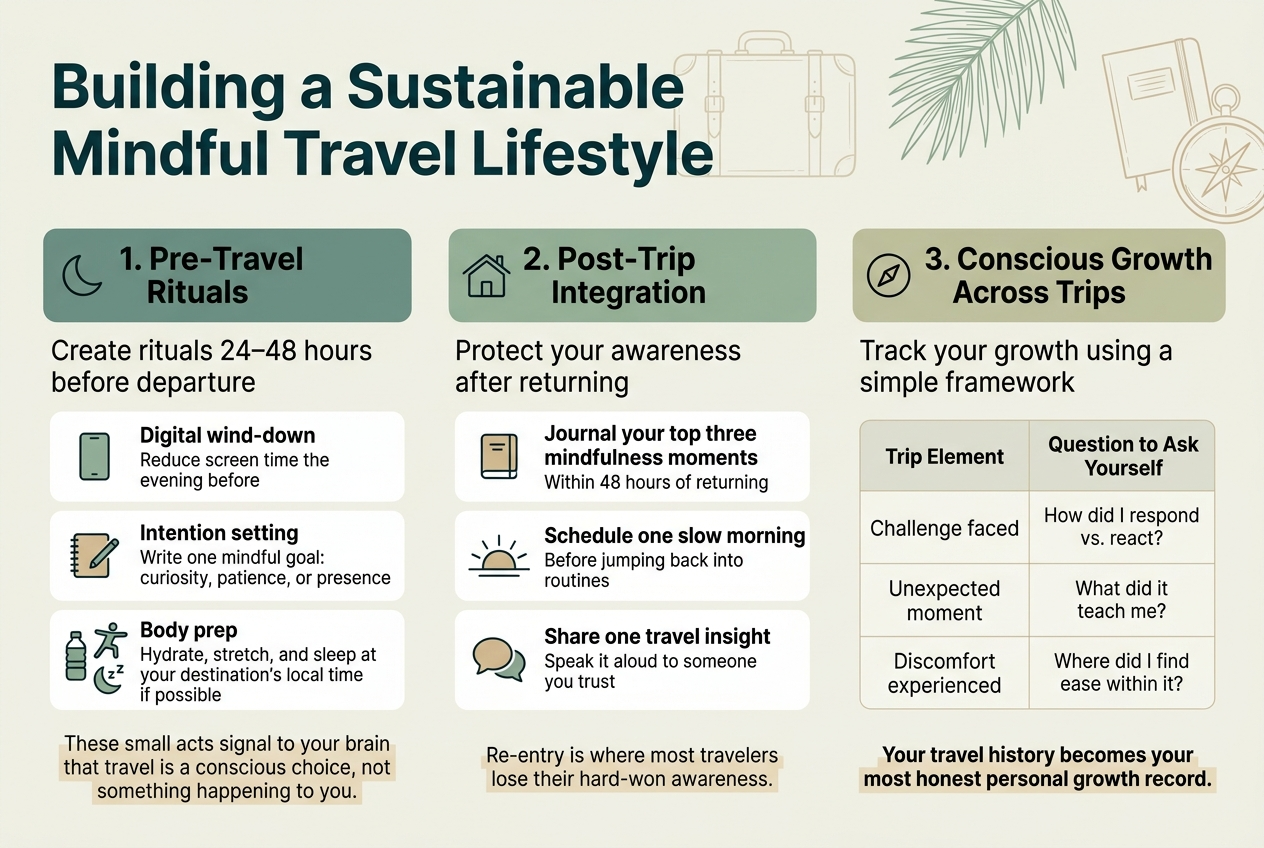
Building a Sustainable Mindful Travel Lifestyle
Create a clean, professional full-bleed infographic in a 3:2 aspect ratio with a wide horizontal layout, soft nature-inspired color palette of deep teal, sage green, warm sand, and off-white, with dark charcoal text. Use modern sans-serif typography with a bold headline at the top left and clear section dividers. Include travel, mindfulness, and growth-themed flat icons.

Top banner: large bold title centered or slightly left-aligned in dark teal:
“Building a Sustainable Mindful Travel Lifestyle”

Below the title, arrange three wide horizontal sections across the canvas in a balanced multi-column layout, not a narrow vertical stack.

Section 1 on the left: heading with a small moon or wind-down icon:
“1. Pre-Travel Rituals”
Subheading beneath in smaller text:
“Create rituals 24–48 hours before departure”
Under it, place three compact bullet blocks with icons:
- phone/screen icon with the text “Digital wind-down” and smaller line “Reduce screen time the evening before”
- notebook or pen icon with the text “Intention setting” and smaller line “Write one mindful goal: curiosity, patience, or presence”
- water bottle, stretching figure, and sleep icon grouped together with the text “Body prep” and smaller line “Hydrate, stretch, and sleep at your destination’s local time if possible”
Add a small footer sentence in a highlighted callout box:
“These small acts signal to your brain that travel is a conscious choice, not something happening to you.”

Section 2 in the center: heading with a journal or home icon:
“2. Post-Trip Integration”
Subheading beneath:
“Protect your awareness after returning”
Under it, place three bullet blocks with icons:
- journal icon with the text “Journal your top three mindfulness moments” and smaller line “Within 48 hours of returning”
- sunrise or slow coffee icon with the text “Schedule one slow morning” and smaller line “Before jumping back into routines”
- speech bubble icon with the text “Share one travel insight” and smaller line “Speak it aloud to someone you trust”
Add a small footer sentence in a highlighted callout box:
“Re-entry is where most travelers lose their hard-won awareness.”

Section 3 on the right: heading with a compass or growth arrow icon:
“3. Conscious Growth Across Trips”
Subheading beneath:
“Track your growth using a simple framework”
Create a clean three-row table or card grid with two columns labeled:
“Trip Element” and “Question to Ask Yourself”
Rows:
- “Challenge faced” | “How did I respond vs. react?”
- “Unexpected moment” | “What did it teach me?”
- “Discomfort experienced” | “Where did I find ease within it?”
Add a closing statement in a strong emphasized box at the bottom right:
“Your travel history becomes your most honest personal growth record.”

Use subtle line art of a suitcase, palm leaf, journal, and compass as decorative accents in the background. Keep the layout airy, highly readable, and evenly spaced with clear visual hierarchy, bold section headings, small supporting text, and clean icon labels.

Create Pre-Travel Rituals That Prepare Your Mind and Body

Your journey begins long before boarding. Build a simple ritual 24–48 hours before departure:

  • Digital wind-down: Reduce screen time the evening before to calm your nervous system
  • Intention setting: Write one mindful goal for your trip — curiosity, patience, or presence
  • Body prep: Hydrate aggressively, stretch, and sleep at your destination’s local time if possible

These small acts signal to your brain that travel is a conscious choice, not something happening to you.

Develop Post-Trip Integration Habits to Preserve Your Insights

Re-entry is where most travelers lose their hard-won awareness. Protect it:

  • Journal your top three mindfulness moments within 48 hours of returning
  • Schedule one “slow morning” before jumping back into routines
  • Share one travel insight with someone you trust — speaking it makes it stick

Make Every Journey a Conscious Step Toward Personal Growth

Track your growth across trips using a simple framework:

Trip ElementQuestion to Ask Yourself
Challenge facedHow did I respond vs. react?
Unexpected momentWhat did it teach me?
Discomfort experiencedWhere did I find ease within it?

Your travel history becomes your most honest record of personal growth.

Travel fatigue doesn’t have to be the enemy of a great trip. Shift your perspective, and that groggy, disoriented feeling becomes an unexpected doorway into deeper self-awareness. You’ve explored how jet lag and mental clarity are more connected than you’d think, how exhaustion can actually slow you down in a good way, and how simple mindfulness practices mid-flight or mid-layover can completely change how you arrive at your destination. You’ve also seen how rebuilding your sleep rhythm with intention, treating every new city as a mindfulness playground, and creating sustainable travel habits can turn every journey into something that feeds your mind and body rather than draining them.

The next time you land feeling wiped out and disoriented, don’t just reach for caffeine and push through. Pause, breathe, and treat that moment as the start of something intentional. Your travel experiences can be so much richer when you stop fighting how you feel and start working with it. Start small — pick one technique from your next trip and see what shifts. You might be surprised by how quickly jet lag stops feeling like a problem and starts feeling like the start of your best trip yet.

🙏 “Subscribe to The Zen Journal and receive gentle mindfulness tips and travel inspiration straight to your inbox.”