The 2-Minute Gratitude Practice That Rewires Your Brain for Positivity

Create a clean, professional full-bleed infographic in a 3:2 aspect ratio with a modern white background, deep navy and teal accents, soft gray dividers, and warm yellow highlight details. Use a bold sans-serif font for headings and a clean sans-serif font for body text. Wide horizontal layout, not a vertical poster.

Top header across the full width:
Large bold title centered at top: "Introduction"
Subtitle directly below in smaller bold text: "You're Two Minutes Away From Training Your Brain to Default to Positive"

Main layout: three wide horizontal sections across the middle and lower half, arranged left to right in three equal columns with clear spacing.

Left section:
Blue circular icon with a brain and looping arrow.
Heading: "1. Why Negativity Sticks"
Body text in short lines:
"Most brains are wired by default"
"Stress"
"Worst-case scenarios"
"Everything that went wrong today"
"Not a character flaw"

Center section:
Teal circular icon with a stopwatch and small sparkles.
Heading: "2. A Simple 2-Minute Practice"
Body text in short lines:
"Not hours of meditation"
"Not a complete lifestyle overhaul"
"Step-by-step gratitude practice"
"Start today"

Right section:
Yellow circular icon with a growing upward line chart and heart.
Heading: "3. What to Expect"
Body text in short lines:
"Less mentally drained"
"More grounded"
"Genuinely optimistic"
"Real, consistent results over time"

Bottom banner spanning the width with a soft light-gray background and small checkmark icon:
Bold text: "No fluff, no toxic positivity."
Smaller text beneath: "A small, research-backed practice that fits into your day — brushing your teeth or waiting for your coffee to brew."

Use clear section dividers, subtle shadowed cards, and strong visual hierarchy with the title largest, section headings medium bold, and body text smaller. Keep the design minimal, polished, and easy to scan.

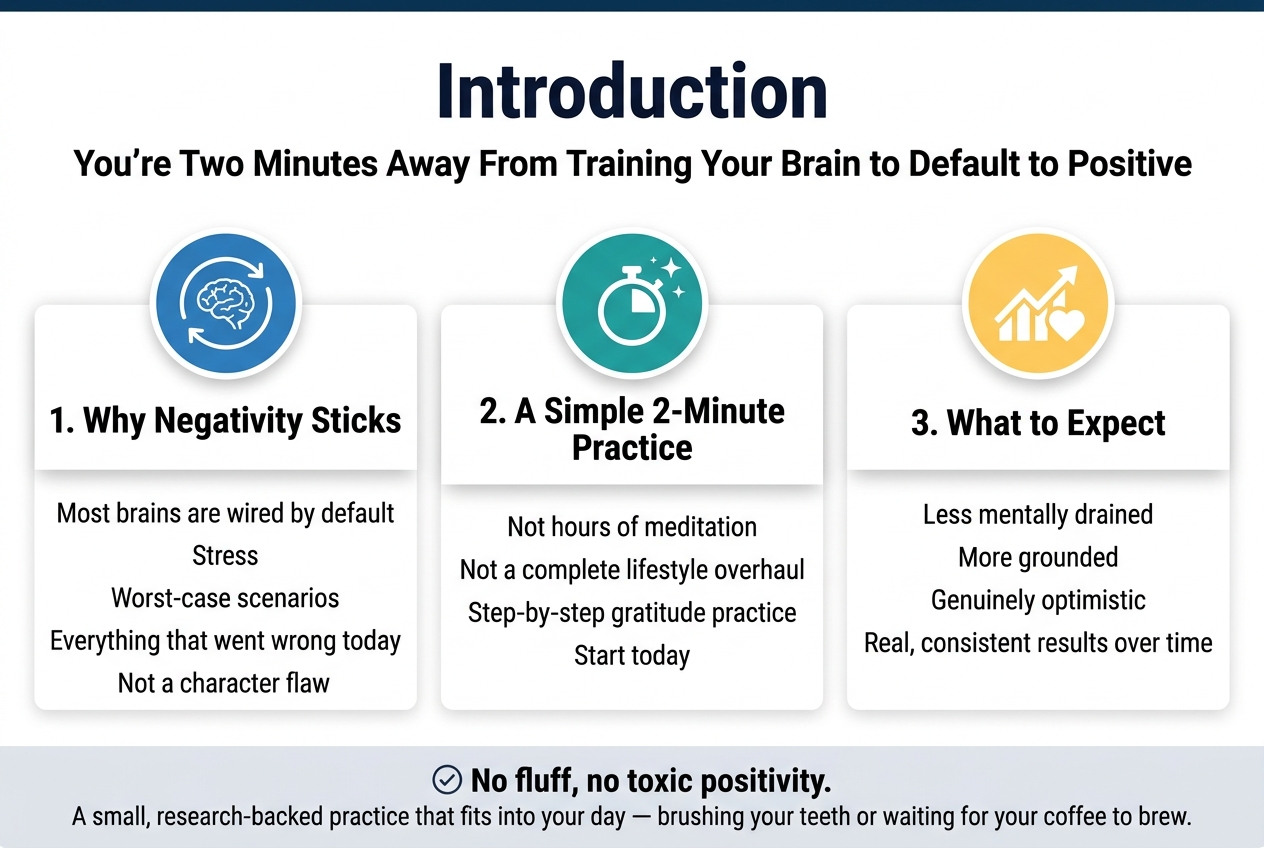
You’re Two Minutes Away From Training Your Brain to Default to Positive

There have been seasons in my life when it felt easier to focus on what was missing or uncertain than on what was going well. During those times, gratitude sometimes felt like the last thing on my mind. Yet I found that taking just a couple of minutes each day to notice small things I appreciated helped create a sense of balance. It didn’t erase stressful situations, but it stopped them from becoming the whole story. Over time, that small shift changed how I approached both good days and difficult ones.

This post is for you if you want to feel less mentally drained, more grounded, and genuinely optimistic—but you’ve tried journaling or positive thinking before, and it felt hollow or forced.

Here’s what you’ll walk away with:

  • Why your brain gets stuck in negativity and what the science of gratitude brain rewiring actually says about breaking that pattern
  • A simple, specific 2-minute gratitude practice you can start today — not a vague “just be thankful” suggestion, but a step-by-step method that works
  • What real, consistent results look like so you know what to expect as you build the habit over time

No fluff, no toxic positivity. Just a small, research-backed practice that fits into your day whether you’re brushing your teeth or waiting for your coffee to brew.

The Science Behind Gratitude and Brain Rewiring
Create a full-bleed 3:2 wide infographic with a clean modern scientific style, soft white background with subtle light-blue gradient accents, dark navy text, teal and gold highlights, and crisp sans-serif fonts.

Top header spanning the full width:
Bold title text centered at the top: "The Science Behind Gratitude and Brain Rewiring"
Add a thin underline with a small gold spark icon in the center.

Main layout in four wide horizontal sections across the canvas, using clear blocks and icons:

Section 1 on the upper left:
Heading: "1. Gratitude Activates the Reward System"
Show a stylized brain icon with glowing nodes, dopamine and serotonin molecule icons, and a highlighted prefrontal cortex area.
Include short supporting text:
"Gratitude triggers dopamine and serotonin"
"Prefrontal cortex lights up"
"Brain learns to want more of the feeling"

Section 2 on the upper right:
Heading: "2. Neuroplasticity Builds a Positive Mindset"
Show a brain with glowing pathways strengthening over time, with repeated pathway lines becoming thicker and brighter.
Include short supporting text:
"Repeated gratitude strengthens neural pathways"
"Positive emotion becomes the brain's go-to route"
"Brain defaults to noticing good things"

Section 3 across the middle, wide and visually emphasized:
Heading: "3. Just 2 Minutes a Day"
Show a simple comparison visual with a small clock icon labeled "2 minutes" beside a larger faded hourglass labeled "sporadic long sessions".
Use a checkmark badge and daily calendar icon.
Include short supporting text:
"Consistency beats duration"
"Focused daily practice activates rewiring"
"Daily 2-minute practice outperforms occasional long sessions"

Section 4 along the bottom as a research timeline with four evenly spaced columns:
Heading: "4. Research-Backed Benefits"
Use four connected milestone cards with small icons:
Card 1 with moon and stars icon:
"Better sleep quality"
"1–2 weeks"
Card 2 with calming wave icon:
"Reduced anxiety levels"
"3–4 weeks"
Card 3 with upward arrow icon:
"Increased optimism"
"4–6 weeks"
Card 4 with heart and people icon:
"Stronger relationships"
"6–8 weeks"

Bottom closing line centered beneath the timeline:
"Your brain responds faster than you'd expect — you just have to show up daily."

Design details:
Use bold section numbers, clear visual hierarchy, rounded cards, thin dividers, subtle glow effects around brain graphics, and small scientific line-art accents. Keep all text legible, balanced, and aligned in a clean editorial infographic layout with no extra text.

How Gratitude Activates the Brain’s Reward System

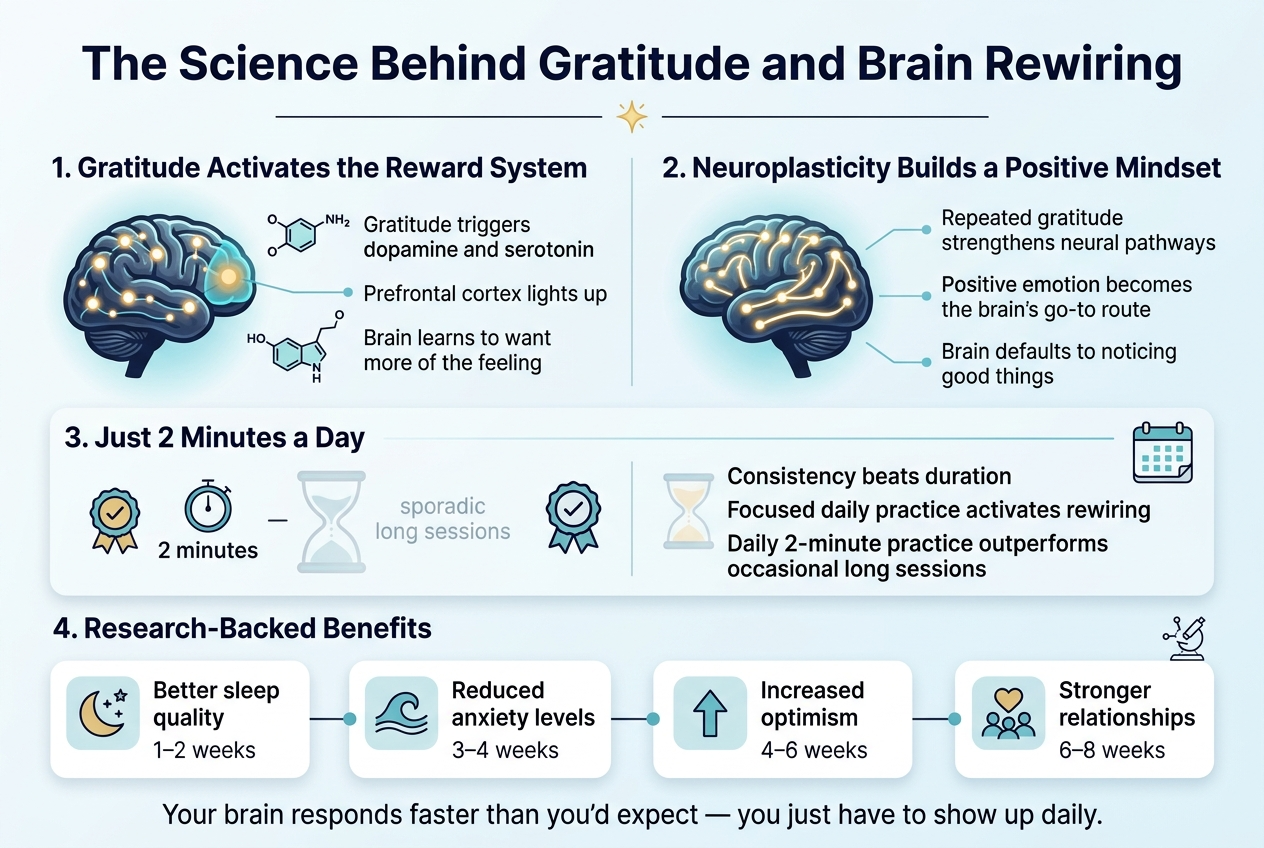
When you feel genuine gratitude, your brain releases dopamine and serotonin — the same chemicals triggered by rewarding experiences. Your prefrontal cortex lights up, and your brain essentially learns to want more of that feeling.

The Role of Neuroplasticity in Building a Positive Mindset

Your brain physically changes based on what you repeatedly think and feel. Every time you practice gratitude, you strengthen neural pathways connected to positive emotion. Over time, your brain defaults to noticing good things — not because you forced it, but because those pathways became your brain’s go-to route.

Why Just 2 Minutes Is Enough to Trigger Lasting Change

Consistency beats duration every time. A focused 2-minute practice done daily repeatedly activates your reward system, which is what actually drives rewiring. Sporadic hour-long sessions don’t come close to matching that effect.

Research-Backed Benefits of a Consistent Gratitude Practice

Studies consistently show that regular gratitude practice delivers real, measurable results:

BenefitTimeline
Better sleep quality1–2 weeks
Reduced anxiety levels3–4 weeks
Increased optimism4–6 weeks
Stronger relationships6–8 weeks

Your brain responds faster than you’d expect — you just have to show up daily.

Signs Your Brain Is Stuck in a Negativity Bias
Create a clean, professional full-bleed infographic in a 3:2 landscape aspect ratio with a modern psychological wellness style, soft blue, teal, gray, and muted red palette, crisp sans-serif typography, strong visual hierarchy, and wide horizontal sections instead of a vertical poster layout.

Top header spanning full width:
Large bold title text: "Signs Your Brain Is Stuck in a Negativity Bias"
Small subtitle beneath: "How the Negativity Bias Develops Over Time"

Main layout: three wide sections across the canvas with clear dividers and subtle rounded panels.

Left section:
Heading text: "1. Why It Develops"
Include a brain icon with neural pathways, a threat alert symbol, and a small stress cloud.
Body text in short lines:
"Your brain didn't become negative overnight."
"Thousands of years of evolution wired it to scan for threats constantly."
"In modern life, a harsh email or a bad commute can feel like a lion chasing you."
"Repeated stress, criticism, or disappointment strengthens these neural pathways."
"Negativity becomes the brain's default setting."

Center section:
Heading text: "2. Common Thought Patterns"
Arrange five stacked mini-cards with matching icons and bold labels.
Card 1: warning triangle icon, text: "Catastrophizing — assuming the worst outcome before anything happens"
Card 2: funnel icon, text: "Mental filtering — fixating on the one thing that went wrong while ignoring ten things that went right"
Card 3: loop arrow icon, text: "Rumination — replaying painful moments on a mental loop"
Card 4: split comparison icon with two profiles, text: "Comparison spiraling — measuring your behind-the-scenes against everyone else's highlight reel"
Card 5: divided circle icon, text: "All-or-nothing thinking — seeing situations as total failures if they're not perfect"

Right section:
Heading text: "3. The Cost"
Use a darker, slightly urgent color accent with icons for body, sleep, focus, and relationships.
Short bullet list with icons:
"Chronic negativity raises cortisol levels"
"Weakens your immune system"
"Disrupts sleep"
"Chips away at your relationships"
"Focus narrows"
"Creativity drops"
"Small challenges start feeling overwhelming"
"The longer you ignore it, the deeper those mental grooves get"

Add subtle visual details: an upward stress graph, a sleeping moon, a shield with cracks, and a relationship heart icon. Use clean spacing, balanced composition, readable bold headings, and vivid but restrained infographic styling.

How the Negativity Bias Develops Over Time

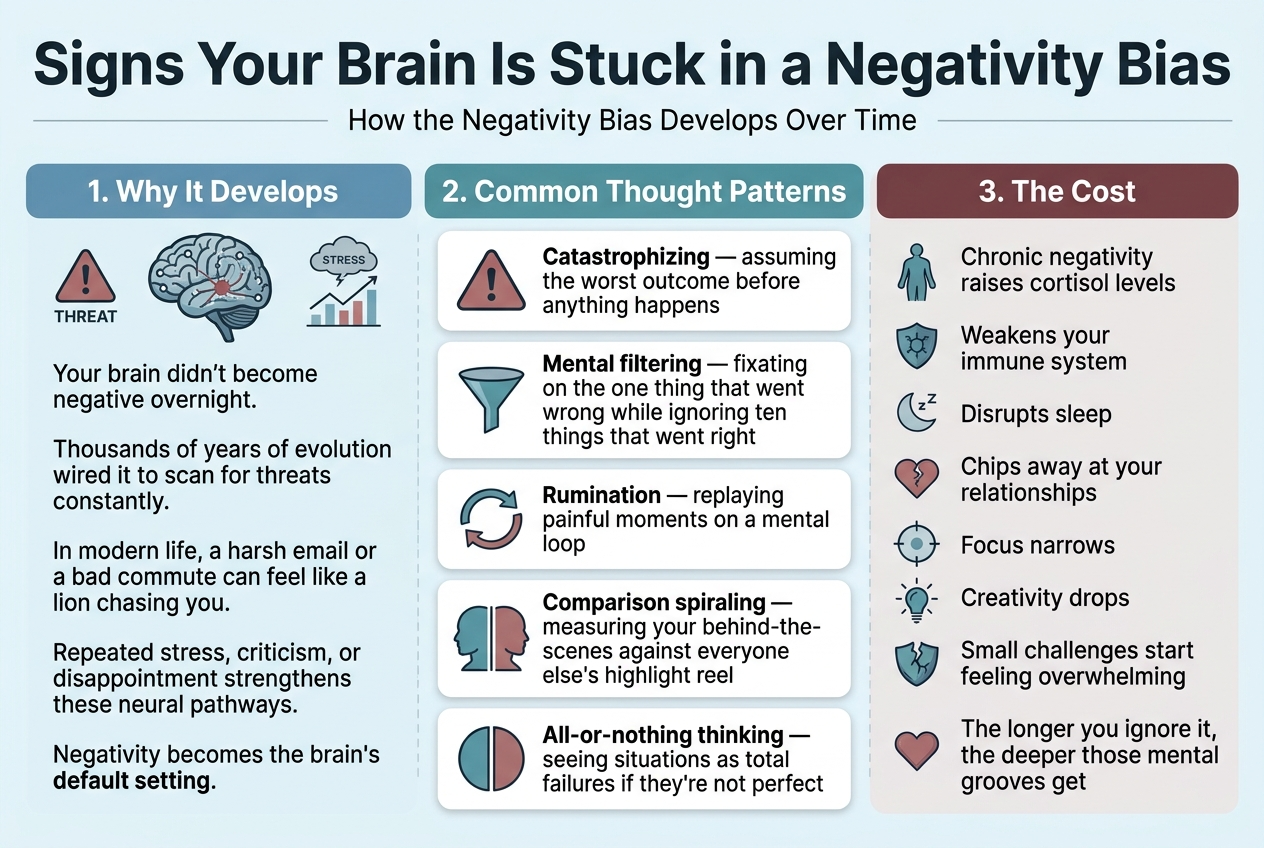
Your brain didn’t become negative overnight. Thousands of years of evolution wired it to constantly scan for threats —it was a survival tool. But in modern life, that same wiring treats a harsh email or a bad commute like a lion chasing you. Over time, repeated stress, criticism, or disappointment strengthens these neural pathways, making negativity your brain’s default setting.

Common Thought Patterns That Keep You Feeling Stressed and Drained

Watch out for these mental habits that signal your brain is stuck:

  • Catastrophizing — assuming the worst outcome before anything happens
  • Mental filtering — fixating on the one thing that went wrong while ignoring ten things that went right
  • Rumination — replaying painful moments on a mental loop
  • Comparison spiraling — measuring your behind-the-scenes against everyone else’s highlight reel
  • All-or-nothing thinking — seeing situations as total failures if they’re not perfect

The Cost of Ignoring Your Mental Well-Being

Staying in this pattern isn’t harmless. Chronic negativity raises cortisol levels, weakens your immune system, disrupts sleep, and chips away at your relationships. Your focus narrows, creativity drops, and even small challenges start feeling overwhelming. The longer you ignore it, the deeper those mental grooves get.

The Exact 2-Minute Gratitude Practice Explained
Create a clean, professional full-bleed infographic illustration in a 3:2 landscape aspect ratio with a modern editorial style, crisp typography, soft white background, deep navy text, teal and warm gold accent colors, subtle rounded rectangles, and simple flat vector icons.

Top header across the full width: bold large title text, centered, "The Exact 2-Minute Gratitude Practice Explained". Add a small subtitle beneath in lighter text: "A simple daily routine, timing tips, and easy formats".

Main layout: wide horizontal infographic with four equal step blocks across the upper-middle section, each inside a rounded rectangle with a numbered circle and a clear icon.

Section 1 on the left: a blue circle with "1" and a small pause icon. Title text: "Pause". Body text: "Put down your phone, close your eyes for five seconds, and breathe."

Section 2 next to it: a gold circle with "2" and a journal or pen icon. Title text: "Write three things you're grateful for". Body text: "Be specific."

Section 3 next: a teal circle with "3" and a small note or thought bubble icon. Title text: "Add one 'why'". Body text: "For each item, write one sentence explaining why it matters to you."

Section 4 on the right: a green circle with "4" and a sunrise or spark icon. Title text: "Close with intention". Body text: "Write one thing you're looking forward to today."

Below the four steps, place a wide horizontal banner with a clock icon and bold text: "That's it. Clock it — you'll finish well under two minutes."

Lower left section in a split-panel layout: a morning icon on the left and a moon icon on the right. Heading: "The Best Time of Day to Practice for Maximum Impact". Under the morning side, text: "Morning practice sets a positive filter for your day." Under the evening side, text: "Evening practice helps your brain consolidate positive memories while you sleep, strengthening neural pathways tied to gratitude."

Lower center section: a magnifying glass icon beside a handwriting note. Heading: "How to Make Your Gratitude Entries Specific and Meaningful". Show two example text lines in contrasting boxes:
Generic: "I'm grateful for my family"
Specific: "I'm grateful my partner made coffee without being asked."
Add a small emphasis note: "Specificity triggers genuine emotion, which is what actually rewires your brain."

Lower right section: a clean 2-column mini table with icons and labels under the heading "Simple Tools and Formats to Record Your Practice". Include four rows:
"Dedicated journal" — "Deep reflection"
"Notes app" — "Quick, on-the-go entries"
"Voice memo" — "Hands-free mornings"
"Habit-tracking app" — "Streak motivation"

At the bottom, add a short footer line in small text: "Pick whatever removes friction from your routine."

Use strong visual hierarchy, ample spacing, aligned text blocks, and colorful icons for each section. No people, no photos, no 3D effects, only polished vector infographic elements.

Step-by-Step Breakdown of the Daily Routine

Here’s your two-minute framework — simple, structured, and powerful:

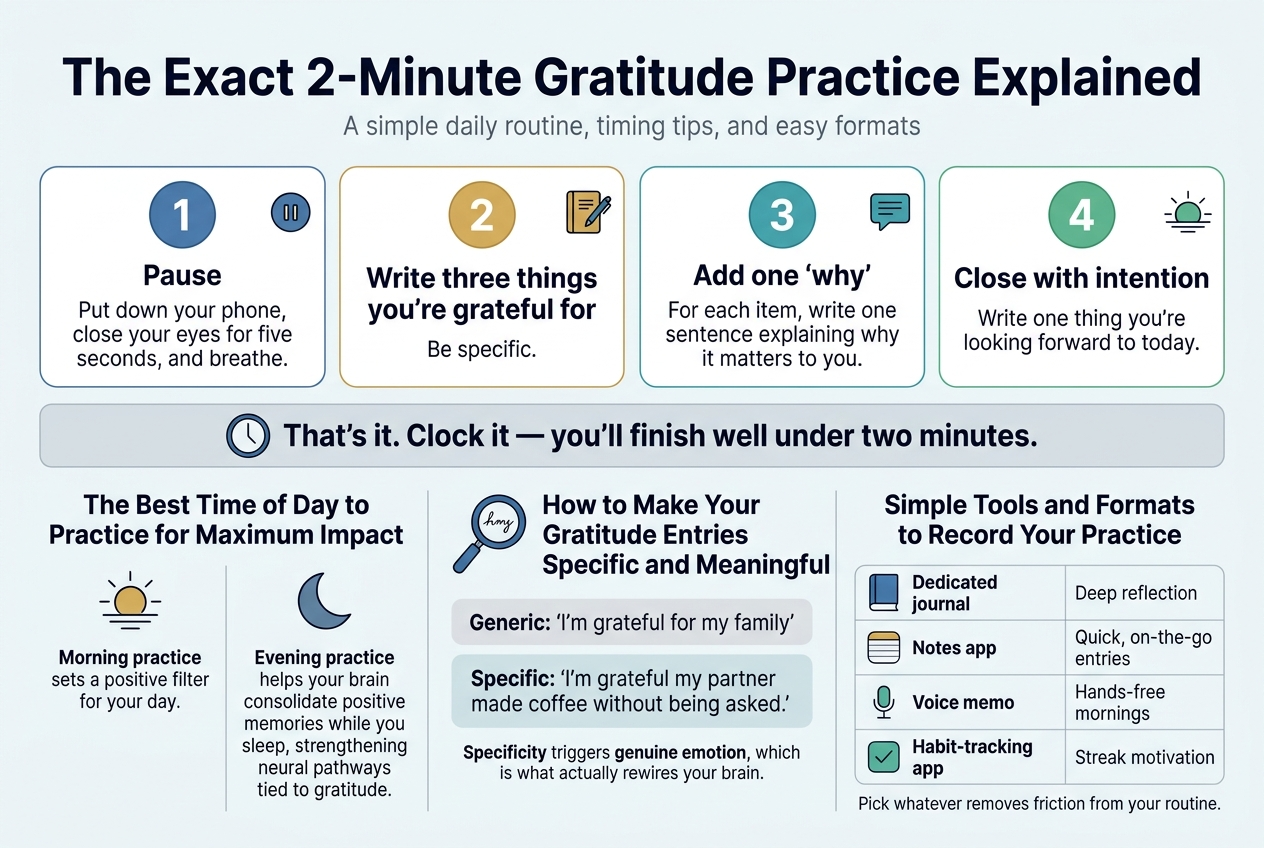
  1. Pause — Put down your phone, close your eyes for five seconds, and breathe.
  2. Write three things you’re grateful for — Be specific (more on this below).
  3. Add one “why” — For each item, write one sentence explaining why it matters to you.
  4. Close with intention — Write one thing you’re looking forward to today.

That’s it. Clock it — you’ll finish well under two minutes.


The Best Time of Day to Practice for Maximum Impact

Your brain is most receptive first thing in the morning or right before sleep. Morning practice sets a positive filter for your day. Evening practice helps your brain consolidate positive memories while you sleep, strengthening neural pathways tied to gratitude.


How to Make Your Gratitude Entries Specific and Meaningful

Generic entries like “I’m grateful for my family” lose their punch fast. Instead, try: “I’m grateful my partner made coffee without being asked.” Specificity triggers genuine emotion, which is what actually rewires your brain.


Simple Tools and Formats to Record Your Practice

FormatBest For
Dedicated journalDeep reflection
Notes appQuick, on-the-go entries
Voice memoHands-free mornings
Habit-tracking appStreak motivation

Pick whatever removes friction from your routine.

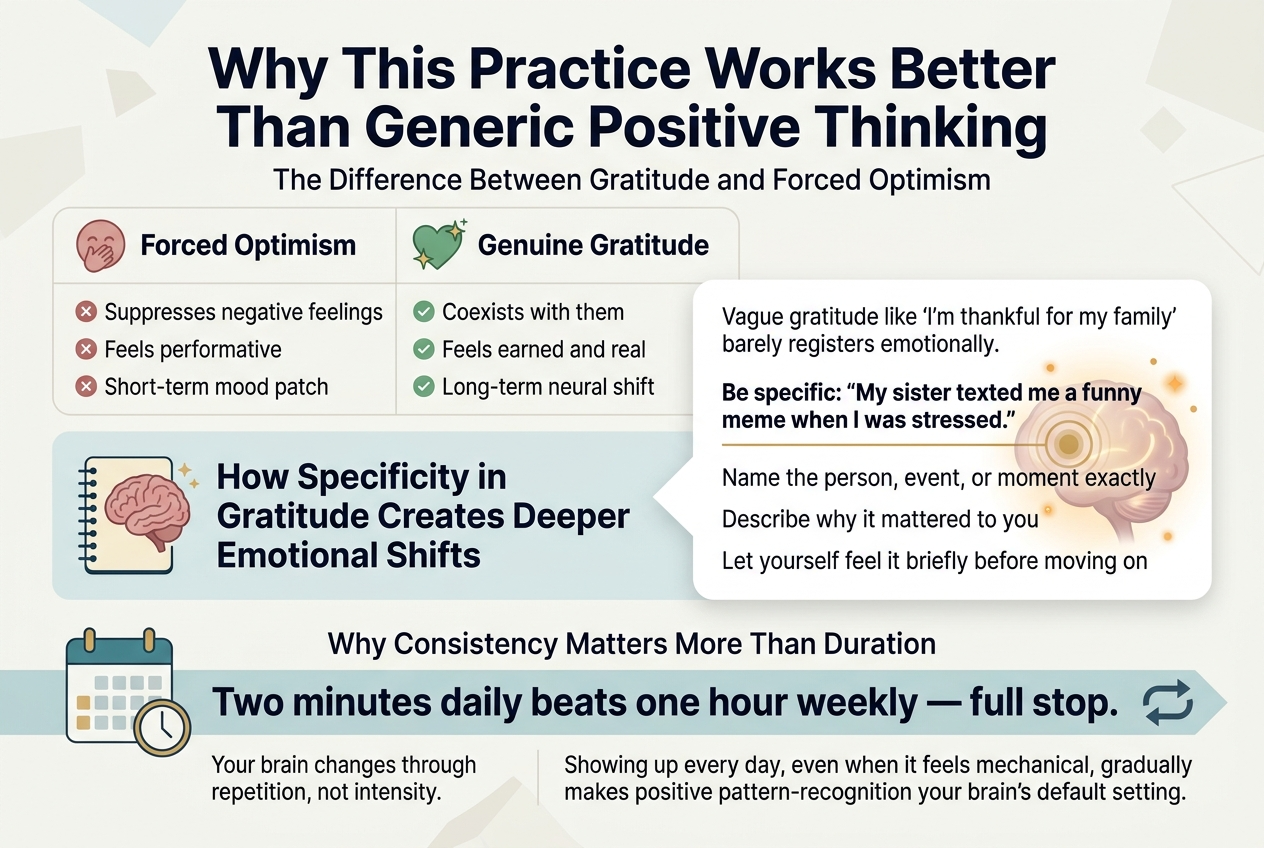
Why This Practice Works Better Than Generic Positive Thinking
Create a clean professional infographic illustration in a 3:2 aspect ratio, full-bleed layout with no frame, no inset margins, and a wide horizontal composition. Use a modern sans-serif font with strong hierarchy, bold title at the top, dark navy text, teal and warm gold accents, and light off-white background with subtle geometric shapes.

Top center headline in large bold text:
"Why This Practice Works Better Than Generic Positive Thinking"

Directly below the title, a smaller subtitle:
"The Difference Between Gratitude and Forced Optimism"

Section 1 on the upper left and upper right as a side-by-side comparison block with two columns and simple icons:
Left column header with a muted red icon of a face covering its mouth:
"Forced Optimism"
Right column header with a green heart-and-sparkles icon:
"Genuine Gratitude"

Under Forced Optimism, three short bullet points with red X markers:
"Suppresses negative feelings"
"Feels performative"
"Short-term mood patch"

Under Genuine Gratitude, three short bullet points with green check markers:
"Coexists with them"
"Feels earned and real"
"Long-term neural shift"

Section 2 across the middle as a wide visual block with a notebook and brain icon on the left, then a callout card on the right. Title for the section:
"How Specificity in Gratitude Creates Deeper Emotional Shifts"

Inside the callout card, include these lines exactly:
"Vague gratitude like 'I'm thankful for my family' barely registers emotionally."
"Be specific: 'My sister texted me a funny meme when I was stressed.'"
"Name the person, event, or moment exactly"
"Describe why it mattered to you"
"Let yourself feel it briefly before moving on"

Add a soft glowing brain/limbic-system illustration behind the specific example, with small warm light effects and a subtle pulse ring around the detailed sentence.

Section 3 across the bottom as a wide timeline or habit loop strip with a calendar icon, small clock icon, and repetition arrows:
Title:
"Why Consistency Matters More Than Duration"

Large emphasized statement in bold:
"Two minutes daily beats one hour weekly — full stop."

Supporting text beneath:
"Your brain changes through repetition, not intensity."
"Showing up every day, even when it feels mechanical, gradually makes positive pattern-recognition your brain's default setting."

Use clear section dividers, rounded cards, balanced spacing, and a polished editorial infographic style. Include small visual symbols next to each major point: X marks, check marks, sparkles, brain, notebook, calendar, clock, and repeat arrows. Ensure all text is readable and exactly spelled as written.

The Difference Between Gratitude and Forced Optimism

Telling yourself “everything is fine” when it isn’t doesn’t fool your brain — it actually creates internal resistance. Gratitude works differently. You’re not denying reality; you’re training your attention to also notice what’s genuinely good alongside what’s hard. That honesty is what makes it neurologically effective.

Forced OptimismGenuine Gratitude
Suppresses negative feelingsCoexists with them
Feels performativeFeels earned and real
Short-term mood patchLong-term neural shift

How Specificity in Gratitude Creates Deeper Emotional Shifts

Vague gratitude like “I’m thankful for my family” barely registers emotionally. Your brain needs detail to generate a real response. When you write “My sister texted me a funny meme when I was stressed,” your brain relives the warmth of that moment. That specificity activates your limbic system more powerfully, creating a stronger emotional imprint.

  • Name the person, event, or moment exactly
  • Describe why it mattered to you
  • Let yourself feel it briefly before moving on

Why Consistency Matters More Than Duration

Two minutes daily beats one hour weekly — full stop. Your brain changes through repetition, not intensity. Showing up every day, even when it feels mechanical, gradually makes positive pattern-recognition your brain’s default setting.

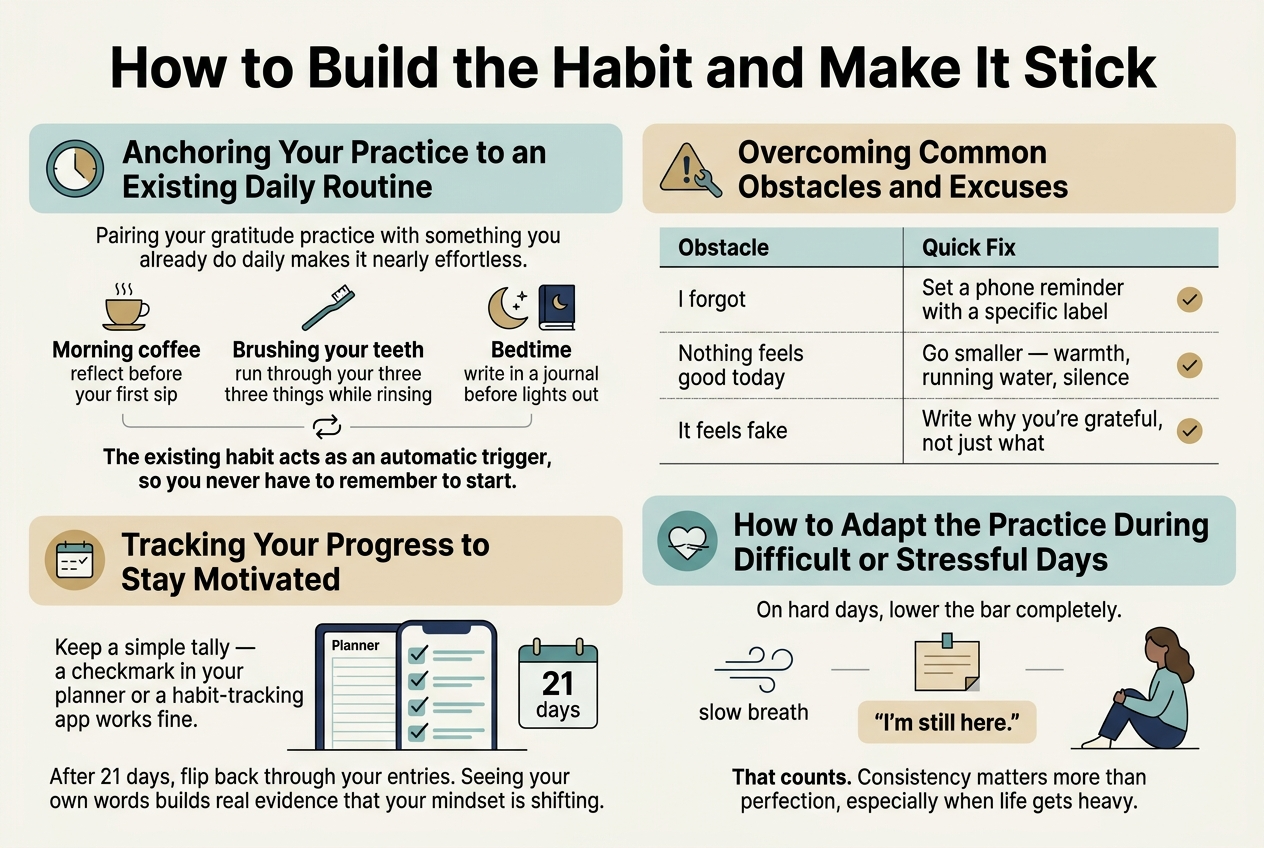
How to Build the Habit and Make It Stick
Create a clean professional infographic illustration in a 3:2 aspect ratio, full-bleed, wide horizontal layout with no poster frame and no large empty margins. Use a modern sans-serif font, bold heading, soft calming colors like teal, navy, warm beige, and muted gold, with crisp icons and clear section spacing.

TOP BANNER: Large bold title centered across the top:
"How to Build the Habit and Make It Stick"

Below the title, divide the infographic into 4 wide horizontal sections with subtle colored panels and simple icons.

SECTION 1, left side, heading with a clock or coffee icon:
"Anchoring Your Practice to an Existing Daily Routine"
Include a short supporting line beneath the heading:
"Pairing your gratitude practice with something you already do daily makes it nearly effortless."

Show three evenly spaced habit pairings with small icons:
- Coffee cup icon next to "Morning coffee" with subtext "reflect before your first sip"
- Toothbrush icon next to "Brushing your teeth" with subtext "run through your three things while rinsing"
- Moon and journal icon next to "Bedtime" with subtext "write in a journal before lights out"

Add a small arrow or loop symbol and a final line at the bottom of this section:
"The existing habit acts as an automatic trigger, so you never have to remember to start."

SECTION 2, upper right or directly below section 1 in a two-column block, heading with a warning triangle or wrench icon:
"Overcoming Common Obstacles and Excuses"
Display a clean two-column table with headers:
"Obstacle" and "Quick Fix"

Table rows:
"I forgot" | "Set a phone reminder with a specific label"
"Nothing feels good today" | "Go smaller — warmth, running water, silence"
"It feels fake" | "Write why you're grateful, not just what"

Use subtle line separators and small check icons beside each quick fix.

SECTION 3, lower left, heading with a calendar or checklist icon:
"Tracking Your Progress to Stay Motivated"
Include supporting text:
"Keep a simple tally — a checkmark in your planner or a habit-tracking app works fine."

Show a planner page, habit-tracking app screen, or checklist graphic with multiple checkmarks, and a small calendar labeled:
"21 days"

Add a final line under the visual:
"After 21 days, flip back through your entries. Seeing your own words builds real evidence that your mindset is shifting."

SECTION 4, lower right, heading with a calm breath or heart icon:
"How to Adapt the Practice During Difficult or Stressful Days"
Include supporting text:
"On hard days, lower the bar completely."

Show a simple minimal visual of one slow breath, a small note card, and a person sitting calmly. Add the quote in a highlighted box:
"\"I'm still here.\""

Add a final bold line:
"That counts. Consistency matters more than perfection, especially when life gets heavy."

Use clear hierarchy: bold headings, medium subheads, smaller body text. Add small icons next to each major point. Keep the layout balanced, readable, and visually structured with a polished editorial infographic style.

Anchoring Your Practice to an Existing Daily Routine

Pairing your gratitude practice with something you already do daily makes it nearly effortless. Try attaching it to:

  • Morning coffee – reflect before your first sip
  • Brushing your teeth – run through your three things while rinsing
  • Bedtime – write in a journal before lights out

The existing habit acts as an automatic trigger, so you never have to remember to start.

Overcoming Common Obstacles and Excuses

ObstacleQuick Fix
“I forgot”Set a phone reminder with a specific label
“Nothing feels good today”Go smaller — warmth, running water, silence
“It feels fake”Write why you’re grateful, not just what

Tracking Your Progress to Stay Motivated

Keep a simple tally — a checkmark in your planner or a habit-tracking app works fine. After 21 days, flip back through your entries. Seeing your own words builds real evidence that your mindset is shifting.

How to Adapt the Practice During Difficult or Stressful Days

On hard days, lower the bar completely. Your two minutes might just be one slow breath and one honest thought — “I’m still here.” That counts. Consistency matters more than perfection, especially when life gets heavy.

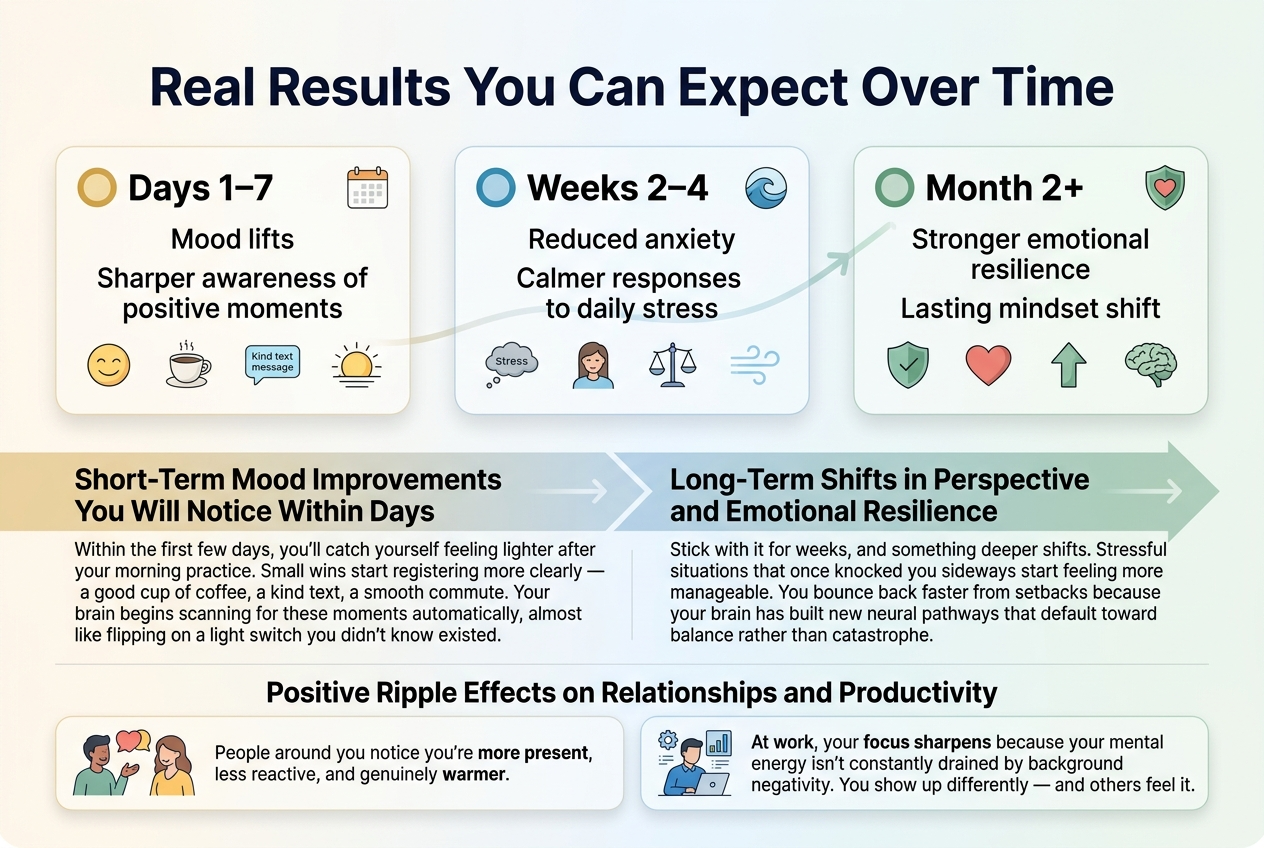
Real Results You Can Expect Over Time
Create a clean, professional infographic illustration in a 3:2 aspect ratio with a full-bleed layout, wide horizontal composition, and no poster frame. Use a modern sans-serif font, bold title, soft white background with subtle light gradient, and accent colors in teal, gold, blue, and muted green.

Top center: large bold heading in dark navy text: "Real Results You Can Expect Over Time"

Below the title, arrange the content in three wide horizontal sections with icons and clear visual hierarchy.

Left section, labeled with a gold circle icon and small calendar symbol:
"Days 1–7"
"Mood lifts"
"Sharper awareness of positive moments"
Add small visual icons: smiling face, coffee cup, kind text message, morning sun.

Center section, labeled with a blue circle icon and calm wave symbol:
"Weeks 2–4"
"Reduced anxiety"
"Calmer responses to daily stress"
Add small visual icons: stress cloud fading, relaxed person, balanced scales, gentle breathing lines.

Right section, labeled with a green circle icon and shield/heart symbol:
"Month 2+"
"Stronger emotional resilience"
"Lasting mindset shift"
Add small visual icons: shield, heart, upward arrow, steady brain pathways.

Across the lower half, include a wide two-part band with subtle arrows showing progression from left to right:
Left block title in bold: "Short-Term Mood Improvements You Will Notice Within Days"
Body text in smaller readable type:
"Within the first few days, you'll catch yourself feeling lighter after your morning practice. Small wins start registering more clearly — a good cup of coffee, a kind text, a smooth commute. Your brain begins scanning for these moments automatically, almost like flipping on a light switch you didn't know existed."

Right block title in bold: "Long-Term Shifts in Perspective and Emotional Resilience"
Body text in smaller readable type:
"Stick with it for weeks, and something deeper shifts. Stressful situations that once knocked you sideways start feeling more manageable. You bounce back faster from setbacks because your brain has built new neural pathways that default toward balance rather than catastrophe."

Bottom band spanning the width: "Positive Ripple Effects on Relationships and Productivity"
Use two illustrated sub-panels side by side:
Left sub-panel with people/relationship icons and warm colors, text:
"People around you notice you're more present, less reactive, and genuinely warmer."
Right sub-panel with work/productivity icons and cool colors, text:
"At work, your focus sharpens because your mental energy isn't constantly drained by background negativity. You show up differently — and others feel it."

Use subtle arrows or a gentle upward line connecting the timeline sections from left to right. Keep spacing open, balanced, and easy to read. Emphasize key phrases in bold. Include clean dividers between sections, rounded rectangular cards, and soft shadows for depth.

Short-Term Mood Improvements You Will Notice Within Days

Within the first few days, you’ll catch yourself feeling lighter after your morning practice. Small wins start registering more clearly — a good cup of coffee, a kind text, a smooth commute. Your brain begins scanning for these moments automatically, almost like flipping on a light switch you didn’t know existed.

Long-Term Shifts in Perspective and Emotional Resilience

Stick with it for weeks, and something deeper shifts. Stressful situations that once knocked you sideways start feeling more manageable. You bounce back faster from setbacks because your brain has built new neural pathways that default toward balance rather than catastrophe.

TimelineWhat Changes
Days 1–7Mood lifts, sharper awareness of positive moments
Weeks 2–4Reduced anxiety, calmer responses to daily stress
Month 2+Stronger emotional resilience, lasting mindset shift

Positive Ripple Effects on Relationships and Productivity

Your gratitude practice doesn’t stay private for long. People around you notice you’re more present, less reactive, and genuinely warmer. At work, your focus sharpens because your mental energy isn’t constantly drained by background negativity. You show up differently — and others feel it.
Create a clean, modern infographic in a 3:2 aspect ratio with a full-bleed background, no frame, no inset margins, and a wide horizontal layout. Use a soft calming palette of deep navy, teal, warm gold, and white with subtle light-gray accents. Use bold sans-serif typography for the heading and clear readable sans-serif body text.

Top center: large bold heading in white text on a dark navy banner: "Conclusion"

Below the heading, arrange three wide horizontal sections across the page in a 3-column layout with rounded cards and simple icons:

Left card: a small stopwatch icon and a notebook icon. Title text: "1. Two Minutes a Day" Body text: "Just 2 minutes daily can shift how your brain processes the world."

Middle card: a brain icon with a small alert symbol and a checkmark. Title text: "2. Notice Negativity Bias" Body text: "Recognize when negativity bias is running the show, then reset with gratitude."

Right card: a growing upward arrow, a heart, and a small sun icon. Title text: "3. Real Change Takes Time" Body text: "Results build gradually: mood, mindset, and resilience improve over time."

Across the lower third, include a wide highlighted callout band with a notebook and timer illustration on the left and bold text on the right: "Grab a notebook. Set a 2-minute timer. Start today."

Bottom footer line in smaller text: "Not fake positivity — trained attention toward what is already good."

Add subtle background elements: faint abstract brain circuit lines, gentle glow gradients, and small spark icons. Keep spacing balanced, modern, and uncluttered. Use strong visual hierarchy with the heading largest, section titles medium, and body text smaller but legible.

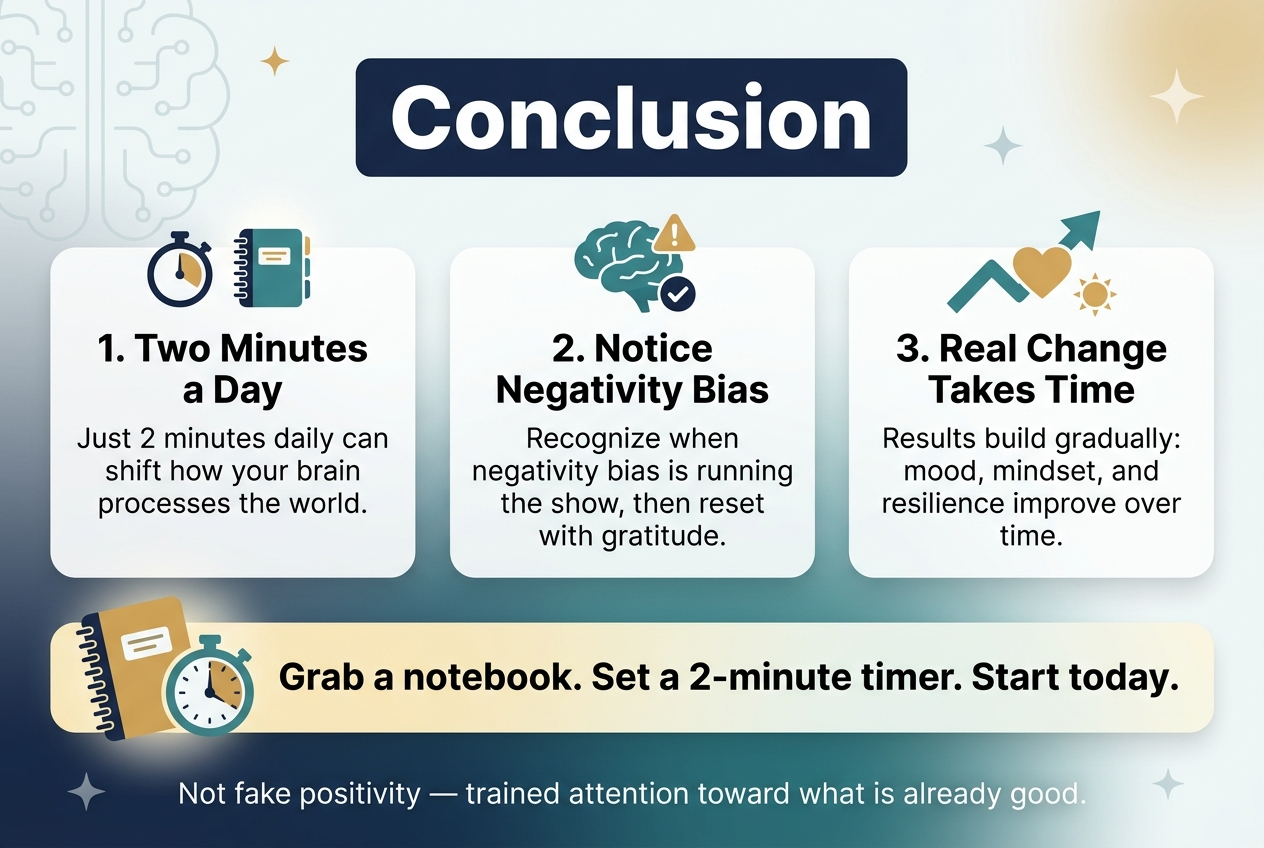
Just two minutes a day can genuinely shift the way your brain processes the world around you. By understanding why negativity bias happens, recognizing when it’s running the show, and committing to this simple gratitude practice, you’re giving your mind a real chance to reset. It’s not about forcing fake positivity or pretending life is perfect — it’s about training your brain to notice what’s already good, consistently and intentionally.

The results won’t show up overnight, but stick with it and you’ll start to notice the difference — in your mood, your mindset, and even how you handle tough days. So grab a notebook, set a two-minute timer, and start today. Your brain is more flexible than you think, and this tiny habit might just be the thing that changes everything.

✨ Join The Zen Journal community — get fresh yoga and wellness insights straight to your inbox ✨