
Ikigai by Héctor García & Francesc Miralles – The Japanese Secret to a Long, Purposeful Life
Ikigai by Héctor García & Francesc Miralles – The Japanese Secret to a Long, Purposeful Life
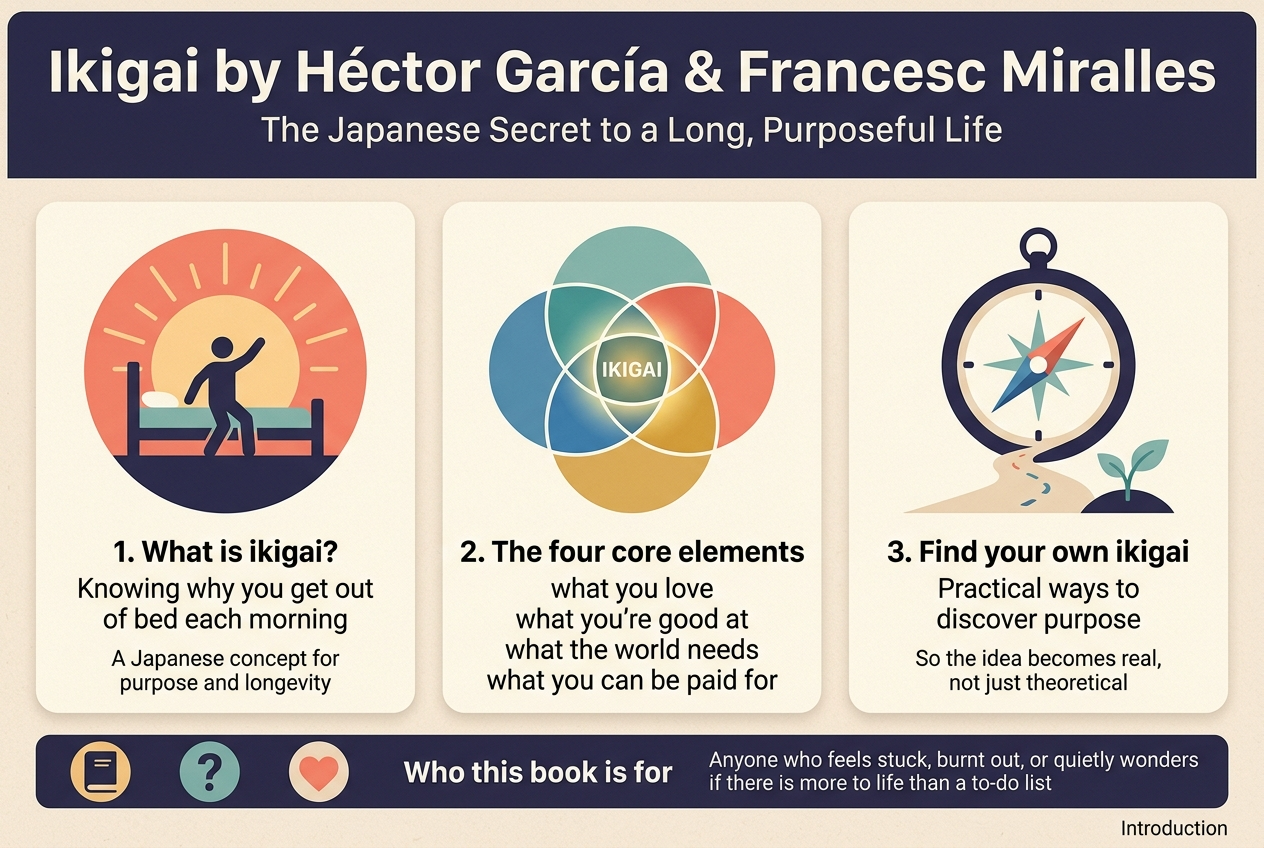
What if the secret to living longer had less to do with diet or exercise and more to do with knowing why you get out of bed each morning? That’s the core idea behind Ikigai, the Japanese concept authors Héctor García and Francesc Miralles brought to a global audience—and it’s surprisingly simple once you break it down.
This summary is for anyone who feels stuck, burnt out, or just quietly wondering if there’s more to life than checking off a to-do list. You don’t need to be a philosophy fan or a self-help junkie to get something real out of this book.
Here’s what we’ll walk through together:
- What ikigai actually means and where it comes from (hint: it’s not just a Venn diagram on Instagram)
- The four core elements García and Miralles identify as the building blocks of a purposeful life
- Practical ways to find your own ikigai, so this doesn’t stay theoretical
By the end, you’ll have a clear picture of what makes this book worth your time — and maybe a few honest questions worth sitting with.
Understanding Ikigai and Its Origins
What Ikigai Means in Japanese Culture
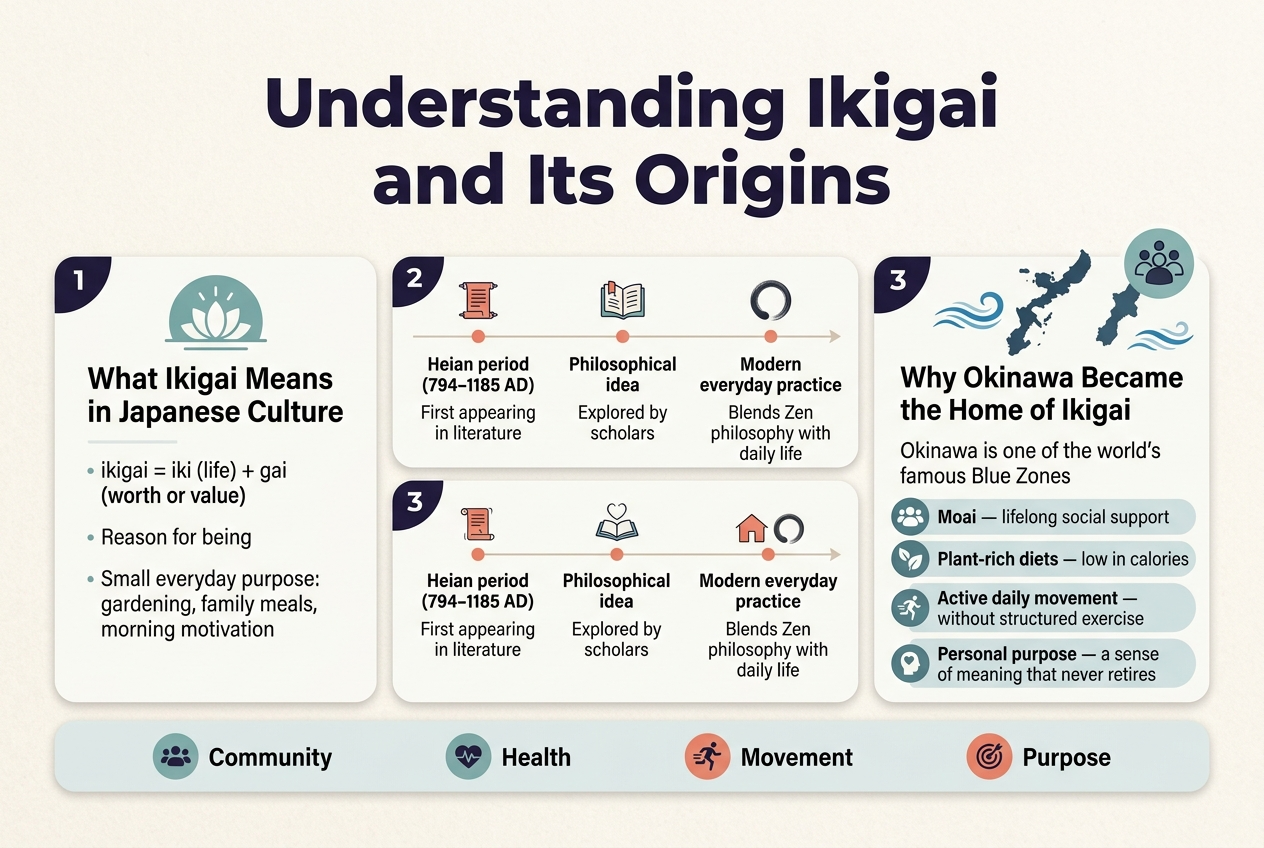
The word ikigai roughly translates to “reason for being” — combining iki (life) and gai (worth or value). But it runs deeper than a simple life motto. In Japanese culture, ikigai is the quiet, personal feeling that makes you want to get out of bed each morning. It doesn’t have to be grand or career-defining. It can be as small as tending a garden or sharing meals with family.
How the Concept Has Evolved Over Centuries
Ikigai dates back to the Heian period (794–1185 AD), when it appeared in literature as a reflection on life’s meaning. Over centuries, it shifted from a philosophical idea scholars explored to an everyday practice woven into ordinary Japanese life. Today, it blends ancient Zen philosophy with practical living.
Why Okinawa Became the Home of Ikigai
Okinawa sits within one of the world’s famous “Blue Zones” — regions where people consistently live past 100. Researchers have noted that Okinawans share strong community bonds, low-stress daily routines, and a clear personal purpose.
Key factors behind Okinawa’s connection to ikigai:
- Moai – tight social circles offering lifelong support
- Plant-rich diets low in calories
- Active daily movement without structured exercise
- A deeply held sense of personal purpose that never really retires
The Four Overlapping Elements of Ikigai
What You Love and How It Fuels Passion
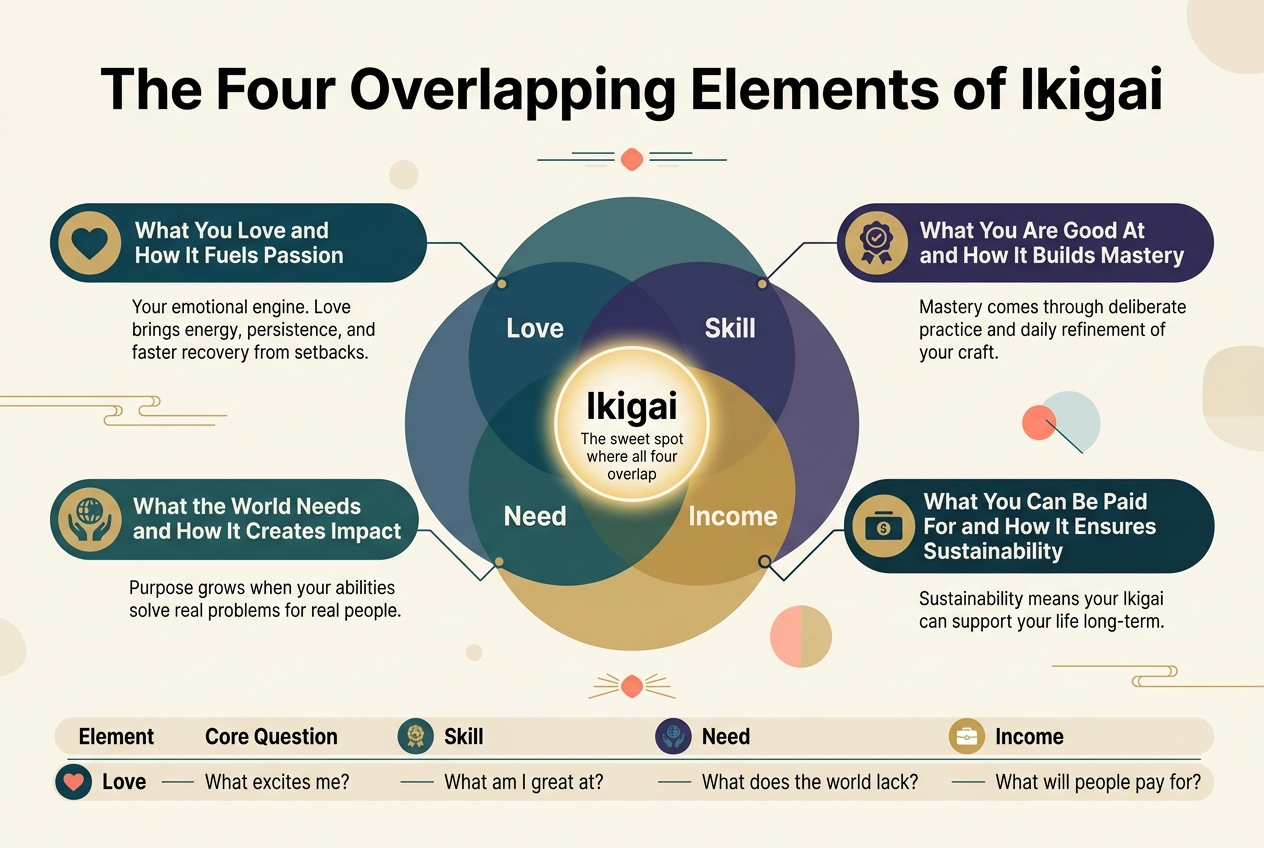
This is your emotional engine. When you genuinely love something, you naturally spend more time on it, recover faster from setbacks, and bring energy others notice. Passion without direction can feel aimless, but inside the Ikigai framework, it becomes the starting point for something much bigger.
What You Are Good At and How It Builds Mastery
Skills matter. What you love and what you excel at don’t always overlap immediately — mastery takes deliberate practice. García and Miralles draw on Japanese concepts like shokunin (artisan spirit) to show that refining your craft daily brings its own deep satisfaction.
What the World Needs and How It Creates Impact
Purpose grows when your abilities solve real problems for real people. Identifying a genuine need — big or small — transforms personal talent into meaningful contribution. Without this element, even skilled, passionate work can feel hollow over time.
What You Can Be Paid For and How It Ensures Sustainability
Passion and purpose alone won’t pay rent. Sustainability means your Ikigai can support your life long-term. The overlap of all four elements is where work stops feeling like work.
| Element | Core Question |
|---|---|
| Love | What excites me? |
| Skill | What am I great at? |
| Need | What does the world lack? |
| Income | What will people pay for? |
Key Lessons from García and Miralles
How the Authors Discovered Ikigai Through Research in Japan
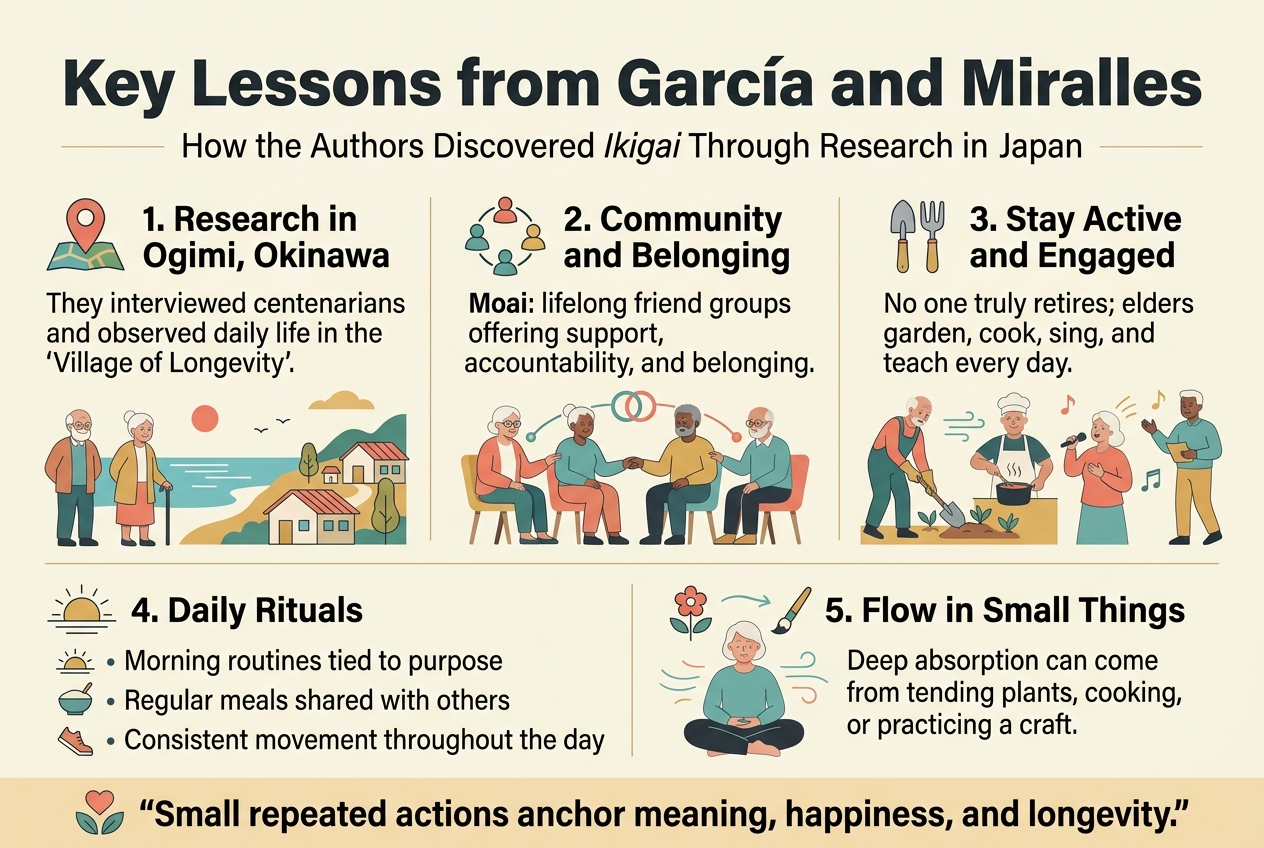
García and Miralles spent time in Ogimi, Okinawa — a village nicknamed the “Village of Longevity.” There, they interviewed centenarians and observed daily life closely, piecing together what keeps people genuinely happy and alive well into their hundreds.
The Role of Community and Belonging in a Purposeful Life
The people of Ogimi don’t chase purpose alone. Tight-knit social circles called moai — lifelong friend groups — provide emotional support, accountability, and a deep sense of belonging that turns out to be just as vital as diet or exercise.
Why Staying Active and Engaged Extends Longevity
Nobody in Ogimi truly “retires.” Elders tend gardens, cook, sing, and teach. Keeping the body and mind engaged signals to the brain that life still has work to do — and the biology responds accordingly.
How Simple Daily Rituals Reinforce a Life of Meaning
- Morning routines tied to purpose
- Regular meals shared with others
- Consistent movement throughout the day
Small, repeated actions quietly anchor a person to their reason for getting up each morning.
The Importance of Flow and Finding Joy in Small Things
Flow — that state of deep absorption in a task — doesn’t require grand ambitions. Tending plants, cooking a meal, or practicing a craft can deliver it just as powerfully as any career achievement.
How Ikigai Connects Purpose to a Longer Life
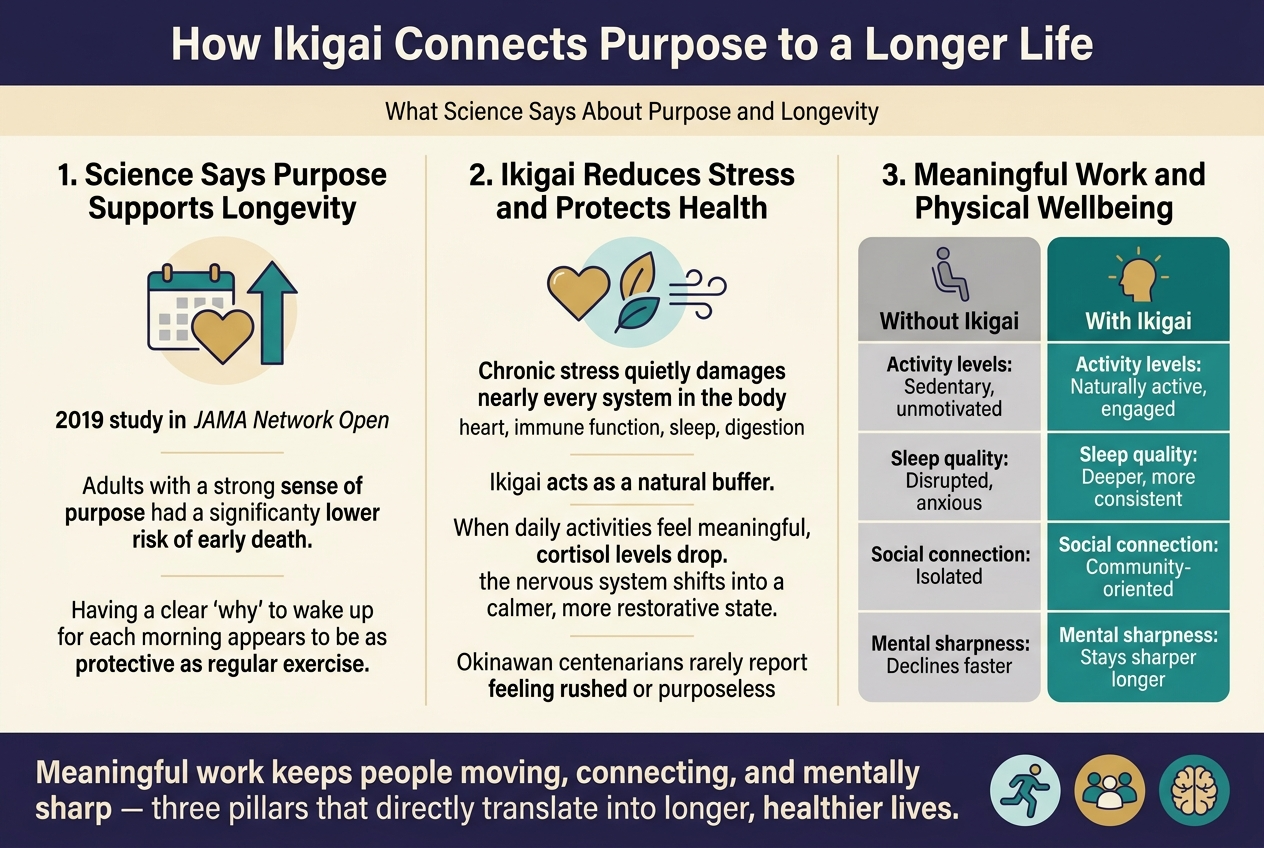
What Science Says About Purpose and Longevity
Research consistently backs what the people of Okinawa have lived for centuries. A 2019 study published in JAMA Network Open found that adults with a strong sense of purpose had a significantly lower risk of early death. Having a clear “why” to wake up for each morning appears to be as protective as regular exercise.
How Stress Reduction Through Ikigai Improves Health
Chronic stress quietly damages nearly every system in the body — heart, immune function, sleep, digestion. Ikigai acts as a natural buffer. When your daily activities feel meaningful, cortisol levels drop, and your nervous system shifts into a calmer, more restorative state. García and Miralles highlight how Okinawan centenarians rarely report feeling rushed or purposeless — two major stress triggers in modern life.
The Link Between Meaningful Work and Physical Wellbeing
| Factor | Without Ikigai | With Ikigai |
|---|---|---|
| Activity levels | Sedentary, unmotivated | Naturally active, engaged |
| Sleep quality | Disrupted, anxious | Deeper, more consistent |
| Social connection | Isolated | Community-oriented |
| Mental sharpness | Declines faster | Stays sharper longer |
Meaningful work keeps people moving, connecting, and mentally sharp — three pillars that directly translate into longer, healthier lives.
Practical Steps to Discover Your Own Ikigai
How to Reflect on Your Passions and Natural Strengths
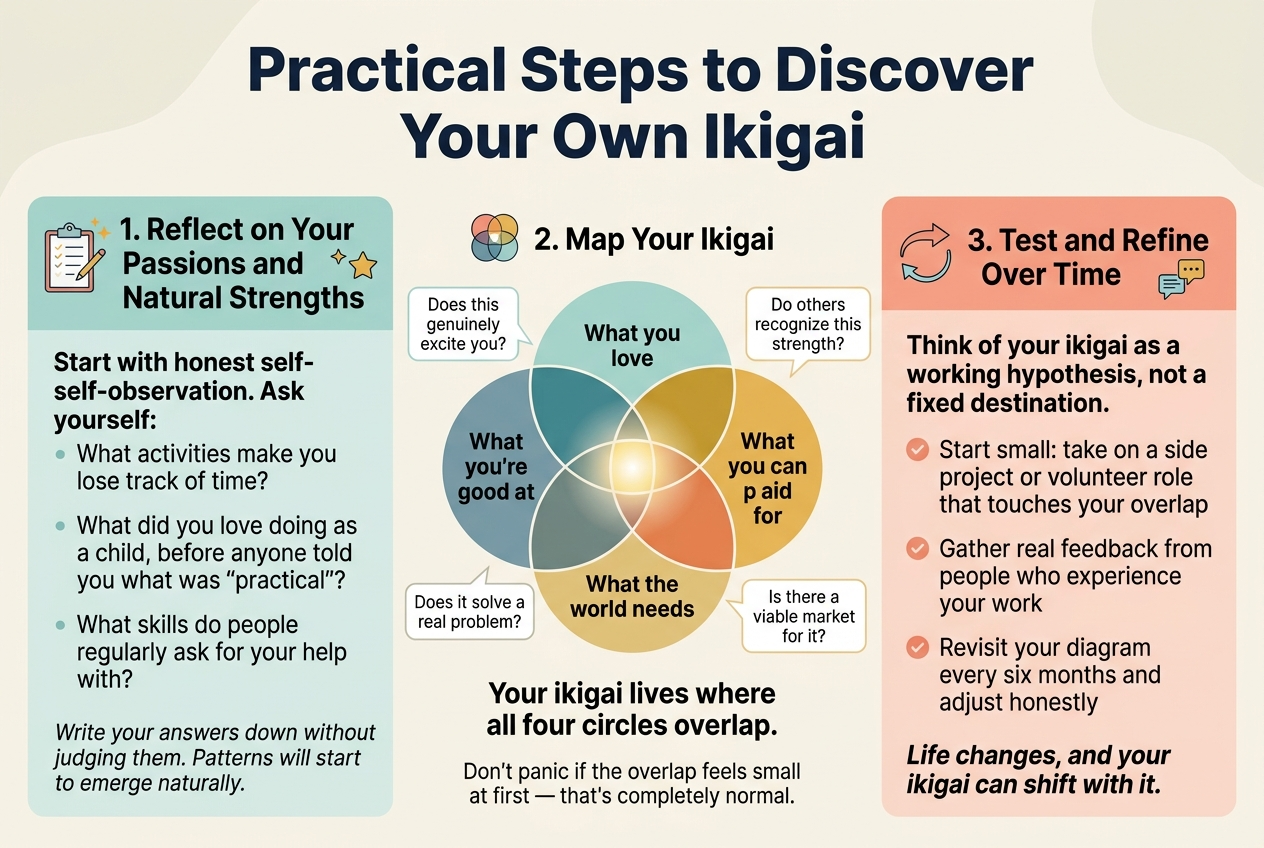
Start with honest self-observation. Ask yourself:
- What activities make you lose track of time?
- What did you love doing as a child, before anyone told you what was “practical”?
- What skills do people regularly ask for your help with?
Write your answers down without judging them. Patterns will start to emerge naturally.
Using the Ikigai Diagram to Find Your Personal Sweet Spot
Map your answers across the four core elements:
| Element | Key Question |
|---|---|
| What you love | Does this genuinely excite you? |
| What you’re good at | Do others recognize this strength? |
| What the world needs | Does it solve a real problem? |
| What you can be paid for | Is there a viable market for it? |
Your ikigai lives where all four circles overlap. Don’t panic if the overlap feels small at first — that’s completely normal.
How to Test and Refine Your Ikigai Over Time
Think of your ikigai as a working hypothesis, not a fixed destination.
- Start small: take on a side project or volunteer role that touches your overlap
- Gather real feedback from people who experience your work
- Revisit your diagram every six months and adjust honestly
Life changes, and your ikigai can shift with it.
Why Ikigai Remains Relevant for Modern Life
How Ikigai Addresses the Modern Meaning Crisis
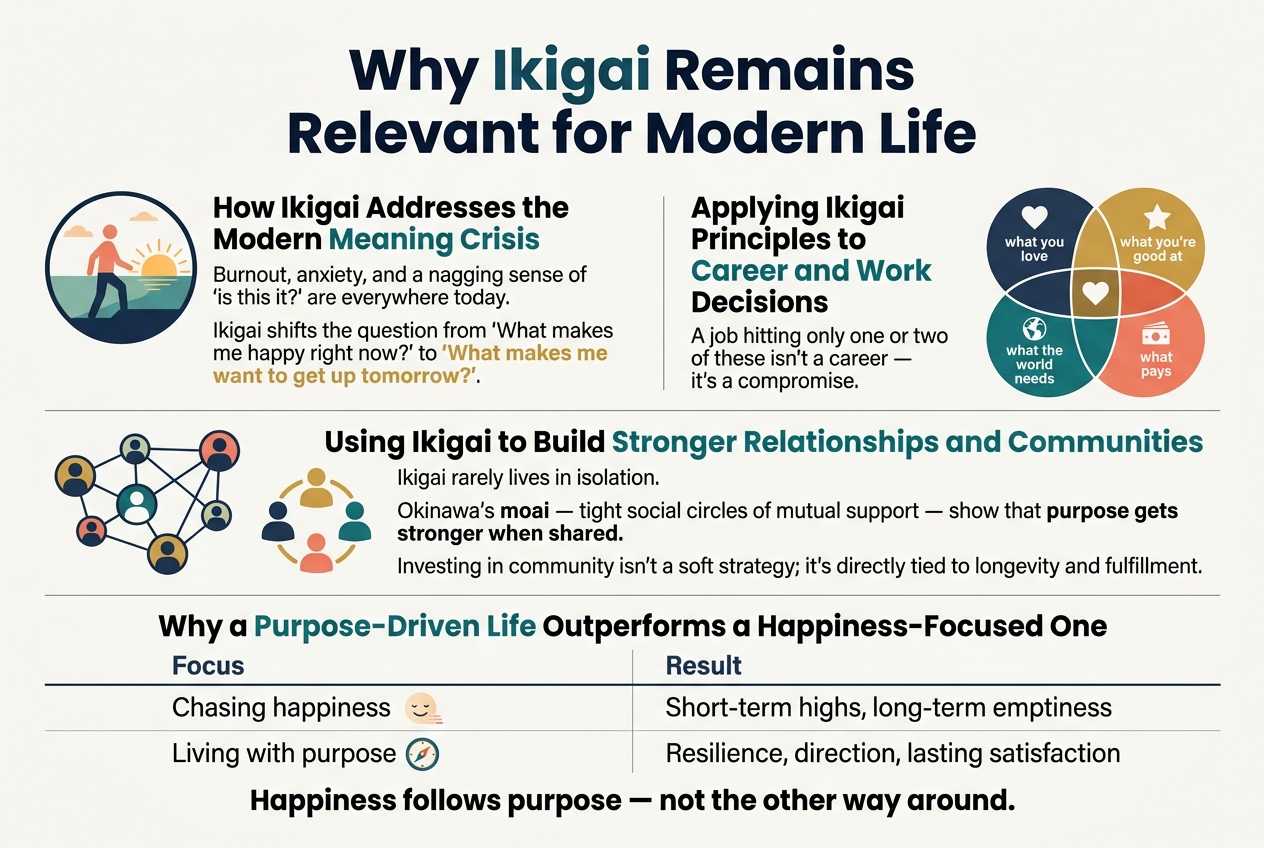
Burnout, anxiety, and a nagging sense of “is this it?” are everywhere today. Ikigai cuts through that noise by shifting the question from “What makes me happy right now?” to “What makes me want to get up tomorrow?” That small shift carries enormous weight.
Applying Ikigai Principles to Career and Work Decisions
Before accepting a promotion or switching jobs, run it through the ikigai filter:
- What you love – Does this work energize you?
- What you’re good at – Can you genuinely excel here?
- What the world needs – Does it solve a real problem?
- What pays – Can it sustain your life?
A job hitting only one or two of these isn’t a career — it’s a compromise.
Using Ikigai to Build Stronger Relationships and Communities
Ikigai rarely lives in isolation. Okinawa’s moai — tight social circles of mutual support — show that purpose gets stronger when shared. Investing in community isn’t a soft strategy; it’s directly tied to longevity and fulfillment.
Why a Purpose-Driven Life Outperforms a Happiness-Focused One
| Focus | Result |
|---|---|
| Chasing happiness | Short-term highs, long-term emptiness |
| Living with purpose | Resilience, direction, lasting satisfaction |
Happiness follows purpose — not the other way around.

Finding your ikigai isn’t about making dramatic life changes overnight. It’s about noticing what already lights you up, what you’re good at, what the world needs, and what someone would actually pay you for. When those four things start to overlap, even just a little, something shifts. Life feels less like a routine you’re surviving and more like something you’re genuinely living.
The beauty of what García and Miralles uncovered in their research is how simple and human the whole idea really is. The people living the longest, most fulfilled lives weren’t chasing big goals or grinding toward some distant finish line. They had small, daily reasons to get up in the morning. Start there. Ask yourself what that reason is for you, and let that question lead you somewhere worth going.
✨ Subscribe to The Zen Journal for soulful book reviews, mindful travel stories, and wellness inspiration delivered weekly.✨