In-Flight Yoga: Simple Stretches to Survive Long-Haul Travel Comfortably

In-Flight Yoga: Simple Stretches to Survive Long-Haul Travel Comfortably
Aspect ratio 3:2, full-bleed clean professional infographic illustration, modern travel wellness style, wide horizontal layout with no inset frame. Large bold title at top left in dark navy sans-serif: "Survive Your Next Long Flight Without Arriving Stiff and Exhausted". Under the title, smaller subtitle text: "Long-haul flight survival guide". Background in soft light blue and white with subtle airplane cloud shapes and faint cabin-window motifs.

Across the center, use 3 wide horizontal content blocks or columns with numbered circular icons and clear visual hierarchy:

1) Left block: blue circular icon with an airplane seat, stiff back and legs symbol. Heading text: "1. Why long flights wear you down". Three short bullet lines with small check icons:
- "Cramped sitting strains your back"
- "Poor circulation makes your legs stiff"
- "Stress and fatigue build in the air"

2) Middle block: teal circular icon with a seated stretching figure. Heading text: "2. Seated and standing stretches". Three short bullet lines with small check icons:
- "Neck and shoulder rolls"
- "Ankle circles and calf lifts"
- "Gentle aisle-friendly stretches"

3) Right block: warm orange circular icon with breathing waves. Heading text: "3. Breathing techniques". Three short bullet lines with small check icons:
- "Slow, steady inhales and exhales"
- "Calm travel anxiety"
- "Fight mid-flight fatigue"

Bottom band across the width with a bold takeaway banner and a small suitcase/yoga icon on the left. Text in the banner: "Short, effective, easy-to-remember in-flight yoga routine". Smaller text beneath: "No yoga mat required. No embarrassing poses in the aisle."

Use crisp sans-serif typography, strong spacing, subtle divider lines, blue/teal/orange accent colors, minimal flat vector style, polished editorial infographic look.

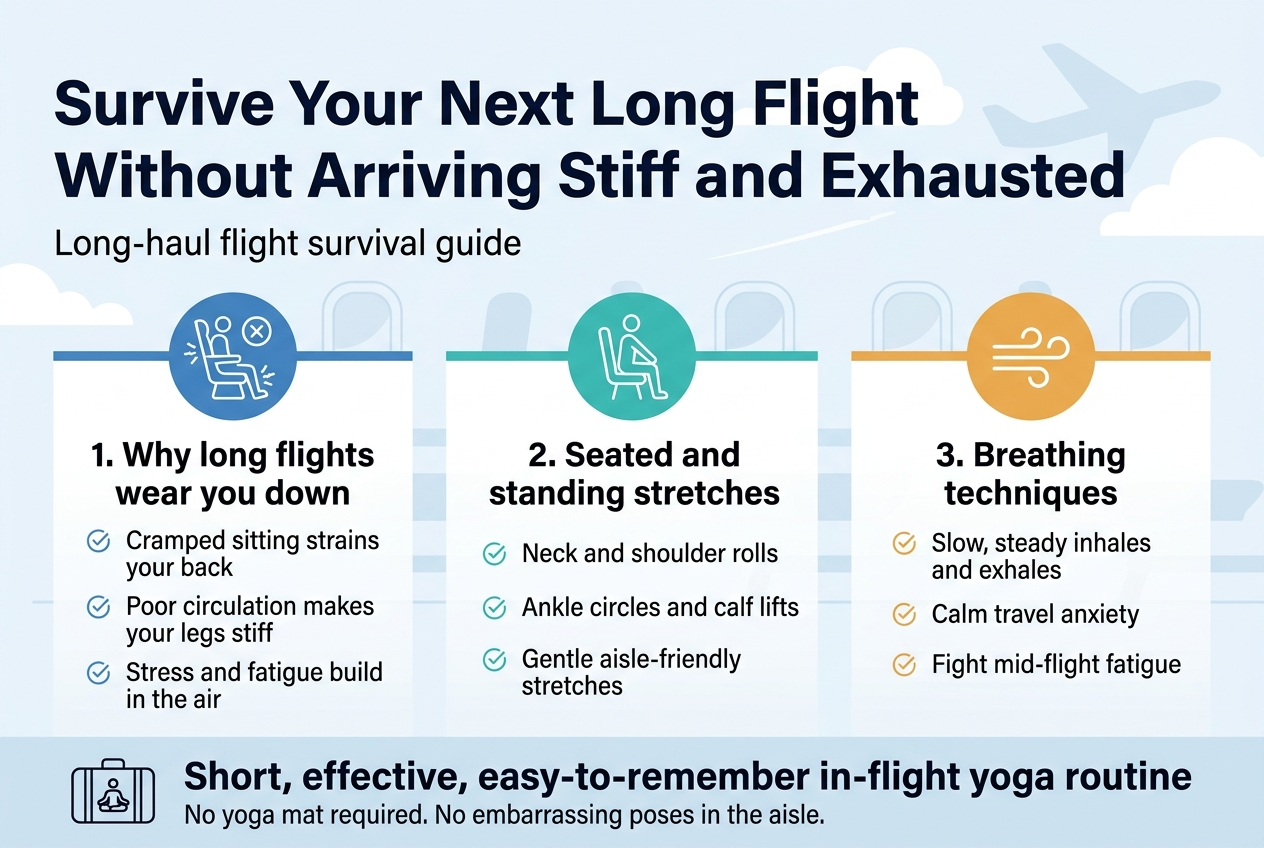
Survive Your Next Long Flight Without Arriving Stiff and Exhausted

Long-haul flights are brutal on your body. Hours of sitting in a cramped seat leave your back aching, your legs stiff, and your energy completely drained by the time you land. If you’ve ever stepped off a 10-hour flight feeling like you aged 20 years, you’re not alone.

This guide is for frequent flyers, nervous travelers, and anyone who wants to land feeling human, not wrecked. No yoga mat required, no embarrassing poses in the aisle — just practical, low-key moves you can actually do at 35,000 feet.

Here’s what you’ll walk away with:

  • Why your body struggles on long flights and what’s really happening to your muscles, circulation, and stress levels in the air
  • Seated and standing stretches you can do without disturbing your row or drawing stares from strangers
  • Simple breathing techniques that calm travel anxiety and fight that heavy, foggy fatigue mid-flight

By the end, you’ll have a go-to in-flight yoga routine you can pull out on your next trip — one that’s short, effective, and easy to remember even when you’re half-asleep over the Pacific.

Why Long-Haul Flights Take a Toll on Your Body
Create a clean professional medical infographic in a 3:2 aspect ratio, full-bleed wide layout, no frame, no inset margins, no vertical poster stack. Use a modern sans-serif font, bold title, white background with deep navy, teal, and red accents, subtle light blue panels, and clear visual hierarchy.

Top header across the full width:
Large bold title text: "Why Long-Haul Flights Take a Toll on Your Body"
Add a small airplane icon near the title.

Below the title, arrange four wide horizontal sections in a 2x2 grid with icons and bold numbered labels:

1. Left-top panel with a blue seated-leg icon and vein/circulation arrows:
Heading text: "1. Prolonged Sitting Restricts Blood Circulation"
Body text: "Leg muscles stop contracting"
"Veins work harder to push blood back to the heart"
"Blood pools in lower legs"
"Feet swell and calves feel heavy and tight"

2. Right-top panel with a cabin/pressure icon and a muscle with small oxygen bubbles:
Heading text: "2. Cabin Pressure Increases Muscle Stiffness"
Body text: "Cabin pressure simulates 6,000–8,000 feet"
"More fluid is retained in soft tissues"
"Muscles become stiffer"
"Less oxygen per breath increases cramping risk"

3. Left-bottom panel with an economy seat icon showing narrow seat, reclined seatback, bent knees, and armrest pressure marks:
Heading text: "3. Economy Seats Increase Discomfort and Fatigue"
Include a simple four-row mini list with small icons:
"Narrow seat width — Forces unnatural hip positioning"
"Minimal recline — Compresses the lumbar spine"
"Limited legroom — Keeps knees bent for hours, straining hip flexors"
"Armrest pressure — Restricts shoulder movement and circulation"

4. Right-bottom panel with a blood clot warning icon and lung silhouette:
Heading text: "4. Inactivity Raises Deep Vein Thrombosis Risk"
Body text: "Sitting still longer than four hours raises DVT risk"
"Blood clots can form in deep leg veins"
"Clots can travel to the lungs"
Use a red warning triangle and a dark red highlight for "DVT".

Add a thin footer bar along the bottom with a simple reminder line in small text:
"Long periods of immobility can cause swelling, stiffness, fatigue, and serious circulation risks."

Use clean spacing, strong iconography, clear labels, and balanced wide composition with all sections aligned horizontally and visually connected.

How Prolonged Sitting Restricts Blood Circulation

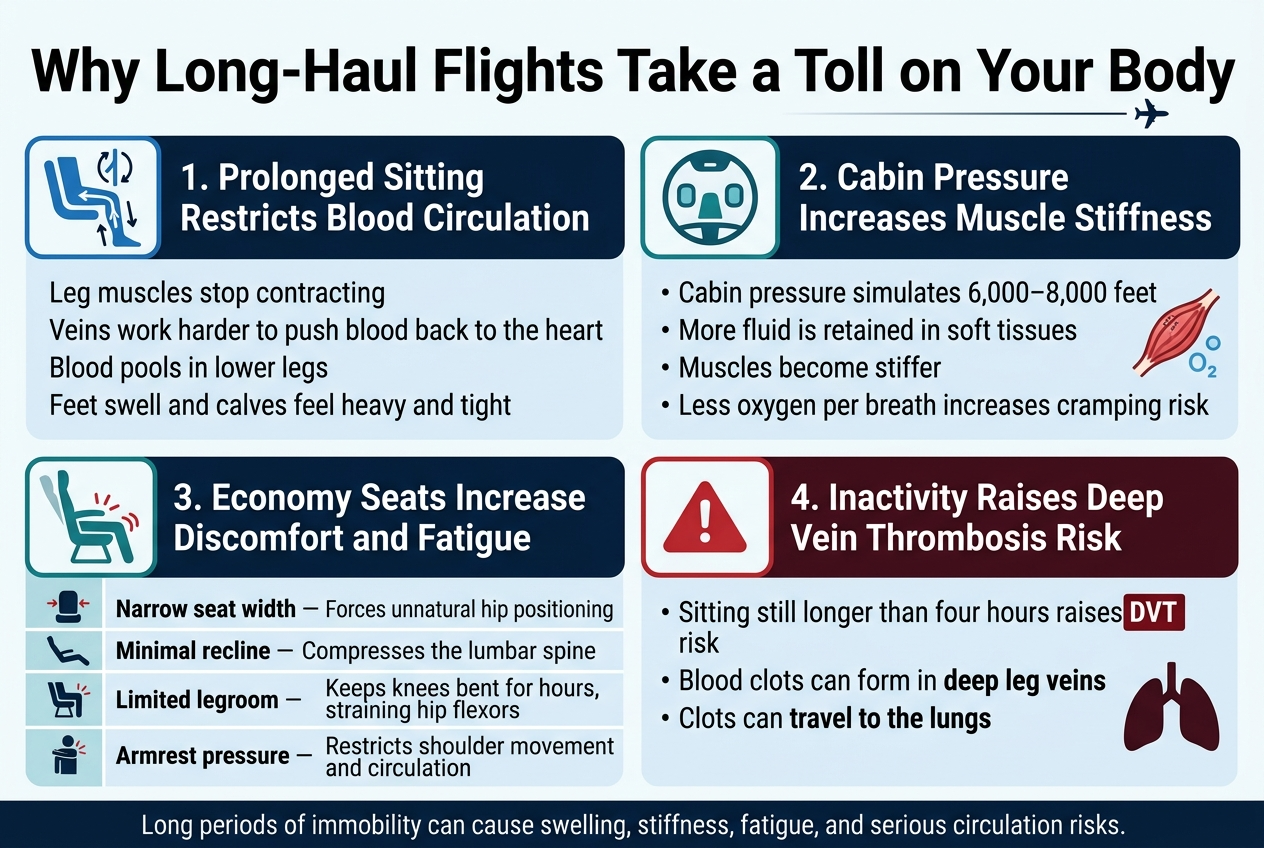
When you stay seated for hours, your leg muscles stop contracting, which means your veins have to work much harder to push blood back up toward your heart. Blood starts pooling in your lower legs, leaving your feet swollen and your calves feeling heavy and tight.

The Impact of Cabin Pressure on Muscle Stiffness

Aircraft cabins are pressurized to simulate altitudes of 6,000–8,000 feet. At that level, your body retains more fluid in soft tissues, which makes your muscles stiffer than usual. You also absorb less oxygen per breath, leaving your muscles slightly starved and more prone to cramping.

Why Economy Class Seats Increase Discomfort and Fatigue

FactorEffect on Your Body
Narrow seat widthForces unnatural hip positioning
Minimal reclineCompresses your lumbar spine
Limited legroomKeeps knees bent for hours, straining hip flexors
Armrest pressureRestricts shoulder movement and circulation

The Link Between Inactivity and Deep Vein Thrombosis Risk

Sitting still for longer than four hours significantly raises your risk of deep vein thrombosis (DVT), where blood clots form in your deep leg veins. These clots can travel to your lungs, making DVT a genuine health concern — not just a travel inconvenience you can brush off.

How to Prepare Your Body Before Boarding
Create a clean, professional infographic illustration in a 3:2 aspect ratio, full-bleed wide layout with no poster frame. Use a modern travel theme with soft blues, teal, white, and orange accents, crisp sans-serif fonts, strong visual hierarchy, and subtle airport/airplane elements in the background.

Top header across the full width:
Bold title in large dark navy text: "How to Prepare Your Body Before Boarding"
Smaller subtitle beneath it in teal: "Pre-Flight Stretches to Loosen Tight Muscles"

Main layout: three wide horizontal sections or three side-by-side panels across the page, each with clear icons and labels.

LEFT SECTION: "1. Pre-Flight Stretches"
Use four stacked mini-cards with simple illustrated icons and numbered markers:
1) A lunge pose icon with the text:
"Hip flexor lunge"
"Step one foot forward, drop your back knee, and hold for 30 seconds each side"
2) A bent-forward standing figure icon with the text:
"Standing forward fold"
"Hinge at your hips, let your head hang heavy, and breathe deeply"
3) Shoulder rotation icon with circular arrows around shoulders and the text:
"Shoulder rolls"
"Roll them forward and backward 10 times to release upper-body tension"
4) Tiptoe calf icon with upward arrows and the text:
"Calf raises"
"Stand on your toes repeatedly to get blood circulating before you sit for hours"

CENTER SECTION: "2. Choose the Right Seat"
Use a simple seat map / airplane seating graphic with four labeled seat blocks and small movement icons:
"Aisle seat" — "Easy access to stretch and walk"
"Bulkhead row" — "Extra legroom for in-seat stretches"
"Emergency exit row" — "Maximum leg space"
"Window seat" — "Back support but limited movement"
Add a highlighted callout badge in orange:
"Book an aisle seat whenever possible"
Small note beneath in navy:
"You won't disturb anyone when you need to stand up and move"

RIGHT SECTION: "3. What to Wear for Comfort"
Use a clothing icon cluster: stretchy shirt, layered jacket, slip-on shoes, loose waistband symbol.
Include four bullet points with check icons:
"Choose stretchy, breathable fabrics like cotton blends or moisture-wicking material"
"Wear layers since cabin temperatures fluctuate unexpectedly"
"Pick slip-on shoes for easy removal during stretches"
"Avoid tight waistbands that restrict deep breathing"

Add small visual symbols near each section: stretching figure, airplane seat, and clothing items. Use clean lines, ample spacing, and balanced alignment. Keep all text sharp, readable, and exactly as written.

Pre-Flight Stretches to Loosen Tight Muscles

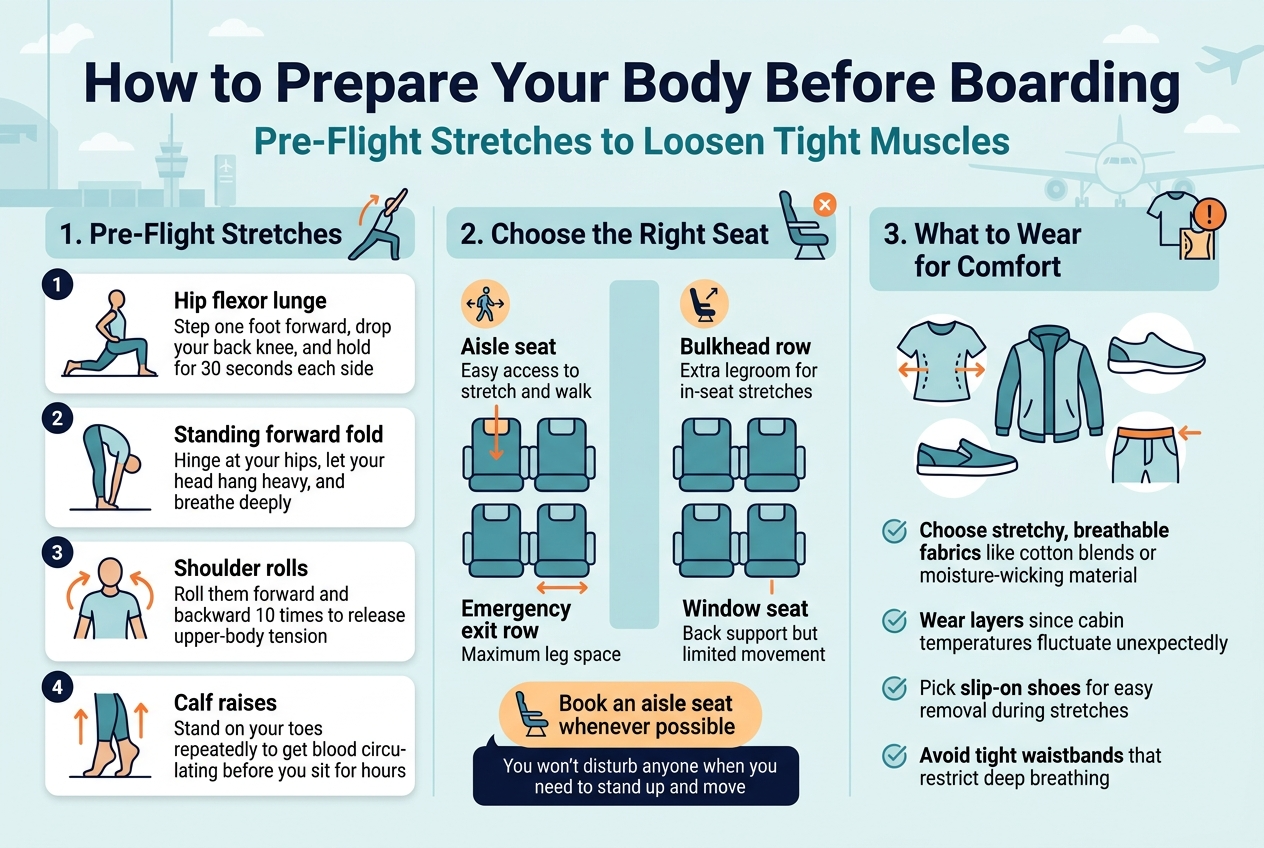
Getting your body moving before you board makes a huge difference. At the gate, try these quick moves:

  • Hip flexor lunge – Step one foot forward, drop your back knee, and hold for 30 seconds on each side
  • Standing forward fold – Hinge at your hips, let your head hang heavy, and breathe deeply
  • Shoulder rolls – Roll them forward and backward 10 times to release upper-body tension
  • Calf raises – Stand on your toes repeatedly to get blood circulating before you sit for hours

Choosing the Right Seat to Maximize Movement Freedom

Your seat choice shapes your entire flight experience.

Seat TypeBest For
Aisle seatEasy access to stretch and walk
Bulkhead rowExtra legroom for in-seat stretches
Emergency exit rowMaximum leg space
Window seatBack support but limited movement

Book an aisle seat whenever possible — you won’t disturb anyone when you need to stand up and move.

What to Wear for Comfort and Flexibility in the Air

Ditch the jeans. Your clothing should move with your body, not against it.

  • Choose stretchy, breathable fabrics like cotton blends or moisture-wicking material
  • Wear layers since cabin temperatures fluctuate unexpectedly
  • Pick slip-on shoes for easy removal during stretches
  • Avoid tight waistbands that restrict deep breathing

Seated Yoga Stretches You Can Do Without Leaving Your Seat
Create a clean, professional infographic illustration in a 3:2 aspect ratio, full-bleed wide layout with no poster frame and no inset margins. Use a light background with soft blue, teal, and warm orange accents, modern sans-serif fonts, bold dark navy headings, and clear visual hierarchy.

Top center: large bold title text, exactly: "Seated Yoga Stretches You Can Do Without Leaving Your Seat"

Below the title, arrange five wide horizontal content blocks in a two-row grid: three blocks across the top row and two larger blocks across the bottom row, with thin dividing lines and subtle rounded rectangles. Include simple flat fitness icons beside each block title.

Block 1, top left: a line icon of a seated person with head tilted and shoulders lifted. Bold subheading text: "1. Neck Rolls and Shoulder Shrugs". Smaller body text beneath:
"Drop your chin to your chest, then slowly roll your head in a half-circle from shoulder to shoulder."
"Do 3–4 reps each way."
"Lift both shoulders toward your ears, hold for 3 seconds, then release."
"Repeat 5 times."

Block 2, top center: a line icon of a seated person twisting at the waist. Bold subheading text: "2. Seated Spinal Twist". Smaller body text beneath:
"Sit tall, place your right hand on your left knee, and gently twist left."
"Hold 20–30 seconds, then switch sides."

Block 3, top right: a line icon of feet with circular arrows and small circulation dots. Bold subheading text: "3. Ankle Circles and Calf Raises". Smaller body text beneath:
"Lift both feet slightly and draw slow circles with your ankles."
"10 rotations each direction."
"Press your heels down, then rise onto your toes."
"15 reps."
"Keep blood moving and reduce swelling risk."

Block 4, bottom left: a line icon of a seated person stretching one leg back at the edge of a chair. Bold subheading text: "4. Hip Flexor Stretch". Smaller body text beneath:
"Sit at your seat's edge, extend one leg back as far as space allows, and gently press your hip forward."
"Hold 20 seconds per side."

Block 5, bottom right: a line icon of an extended arm with wrist flex and open fingers. Bold subheading text: "5. Wrist and Finger Stretches". Smaller body text beneath:
"Extend one arm, flex your wrist back, and hold 15 seconds."
"Spread your fingers wide, then squeeze into a fist."
"Repeat 8 times per hand."

Use small numbered badges for each section, consistent icon style, and clean spacing. Add subtle motion arrows around the neck roll and ankle circle icons, and small breath/wave lines near the spinal twist. Keep the overall design airy, balanced, easy to read, and visually organized.

Neck Rolls and Shoulder Shrugs to Release Upper Body Tension

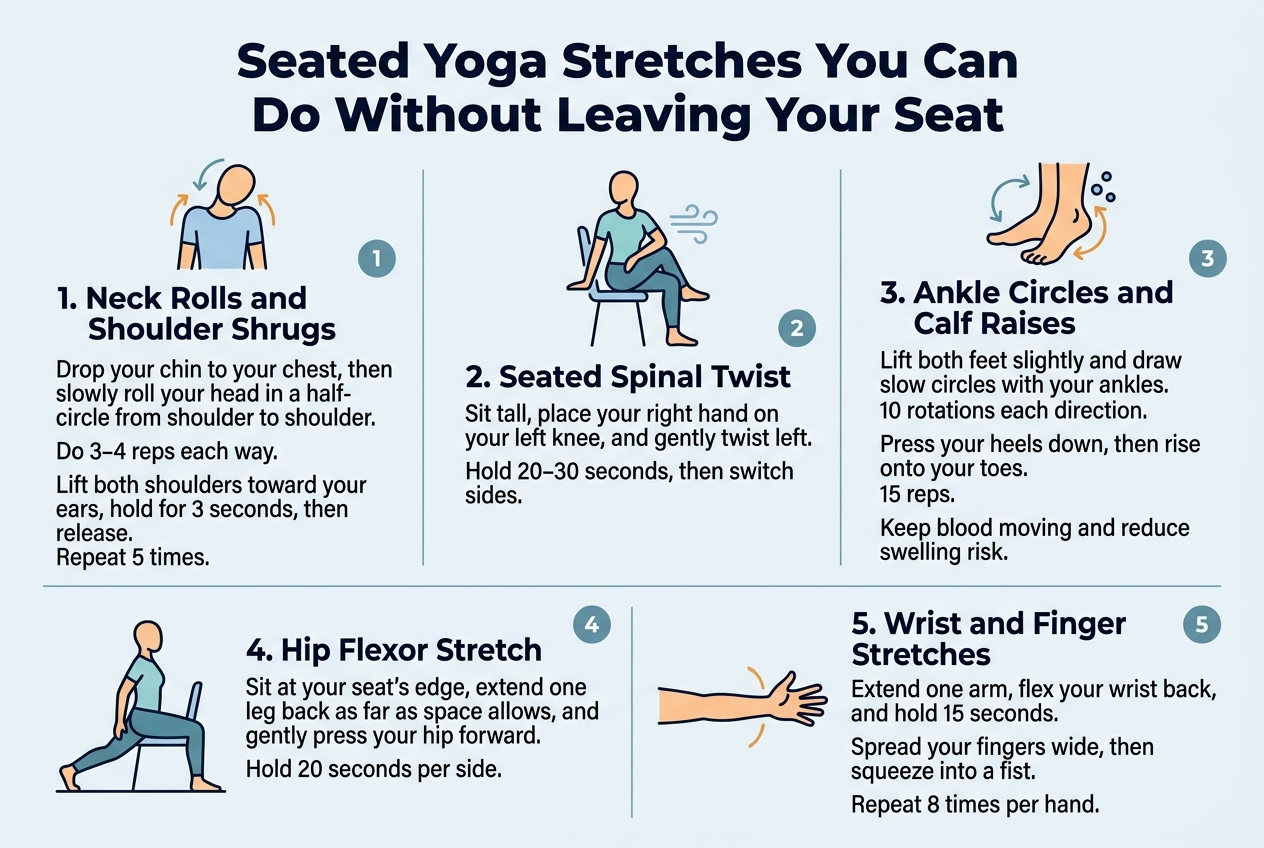
Drop your chin to your chest, then slowly roll your head in a half-circle from shoulder to shoulder. Do 3–4 reps each way. Follow with shoulder shrugs — lift both shoulders toward your ears, hold for 3 seconds, then release. Repeat 5 times to melt away that familiar cabin tension.

Seated Spinal Twist to Restore Back Mobility

Sit tall, place your right hand on your left knee, and gently twist left. Hold 20–30 seconds, breathe deeply, then switch sides. Your spine will thank you immediately.

Ankle Circles and Calf Raises to Boost Lower Body Circulation

  • Lift both feet slightly and draw slow circles with your ankles — 10 rotations each direction
  • Press your heels down, then rise onto your toes repeatedly for 15 reps

This keeps blood moving and reduces the risk of swelling.

Hip Flexor Stretch to Counter Prolonged Sitting Pressure

Sit at the edge of your seat, extend one leg back as far as space allows, and gently press your hip forward. Hold 20 seconds per side.

Wrist and Finger Stretches for Tech-Weary Travelers

  • Extend one arm, flex your wrist back, and hold for 15 seconds
  • Spread your fingers wide, then squeeze into a fist — repeat 8 times per hand

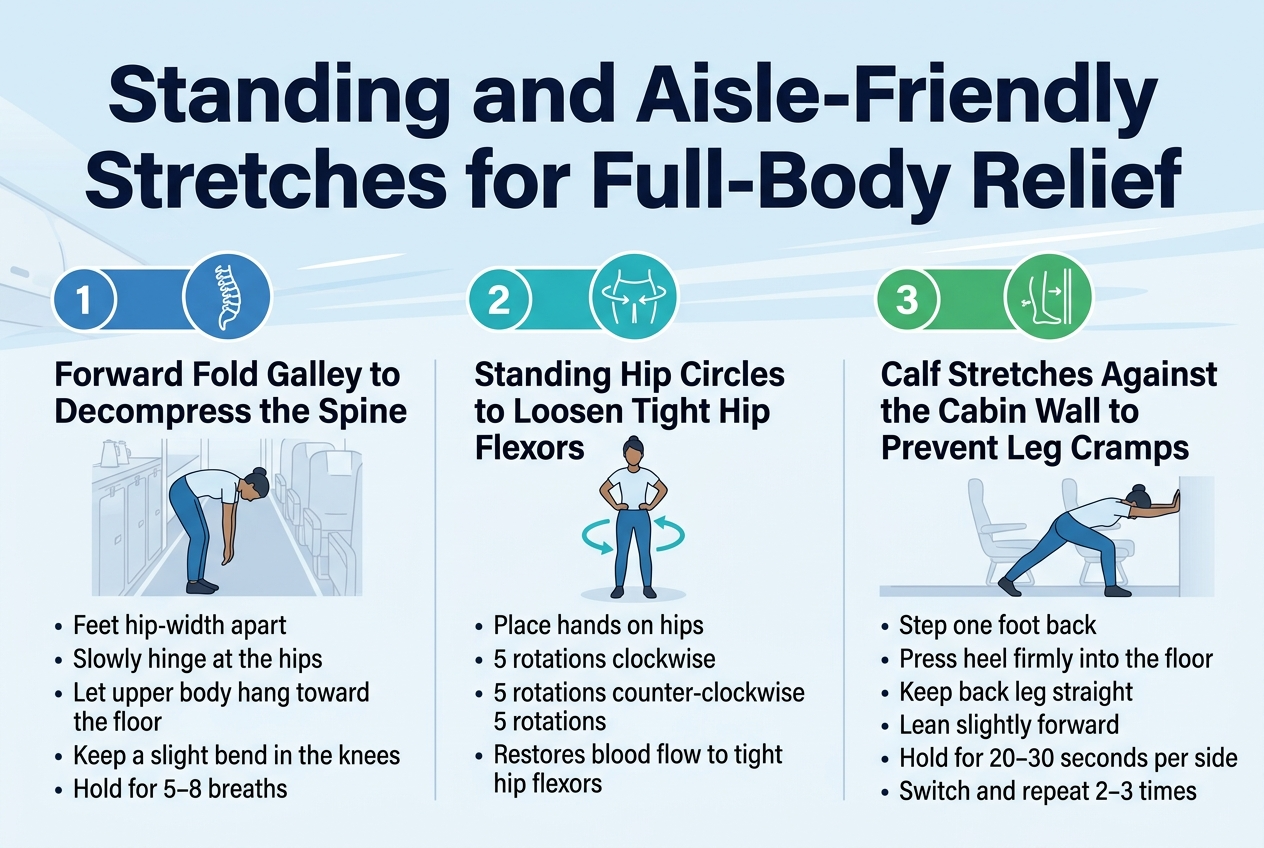
Standing and Aisle-Friendly Stretches for Full-Body Relief
Aspect ratio 3:2, full-bleed professional infographic, modern clean airline-travel wellness style, wide horizontal layout with no inset frame, no narrow centered stack. Background in soft light blue and white with subtle airplane cabin/galleley details and gentle motion lines, crisp vector illustration, high readability.

Top header spanning full width: large bold title in dark navy sans-serif: "Standing and Aisle-Friendly Stretches for Full-Body Relief"

Below title, arrange 3 wide horizontal sections in a clean 3-column layout with numbered badges and simple icons.

Section 1 on the left: blue circular badge with number "1" and a spine/forward-bend icon. Heading text: "Forward Fold at the Galley to Decompress the Spine". Include a small illustration of a person standing and hinging forward in the galley aisle. Add short bullet text:
"Feet hip-width apart"
"Slowly hinge at the hips"
"Let upper body hang toward the floor"
"Keep a slight bend in the knees"
"Hold for 5–8 breaths"

Section 2 in the center: teal circular badge with number "2" and a hips/circle motion icon. Heading text: "Standing Hip Circles to Loosen Tight Hip Flexors". Include a small illustration of a person standing with hands on hips and curved circular arrows around the pelvis. Add short bullet text:
"Place hands on hips"
"5 rotations clockwise"
"5 rotations counter-clockwise"
"Restores blood flow to tight hip flexors"

Section 3 on the right: green circular badge with number "3" and a calf stretch icon next to a cabin wall. Heading text: "Calf Stretches Against the Cabin Wall to Prevent Leg Cramps". Include a small illustration of one foot stepped back, heel pressed down, hands lightly on the wall. Add short bullet text:
"Step one foot back"
"Press heel firmly into the floor"
"Keep back leg straight"
"Lean slightly forward"
"Hold for 20–30 seconds per side"
"Switch and repeat 2–3 times"

Use bold section headings, smaller body text, clean sans-serif font, strong visual hierarchy, subtle dividers between sections, balanced spacing, and simple airplane-friendly icons. Color palette: navy, sky blue, teal, green, white, and soft gray.

Forward Fold at the Galley to Decompress the Spine

When the galley area is free, grab the opportunity for a standing forward fold. Stand with your feet hip-width apart, slowly hinge at your hips, and let your upper body hang toward the floor. Keep a slight bend in your knees to protect your lower back. Hold for 5–8 breaths. You’ll feel your spine lengthen and the tension your seat has been quietly building for hours start to melt away.

Standing Hip Circles to Loosen Tight Hip Flexors

Place your hands on your hips and draw slow, wide circles with your pelvis—5 rotations clockwise, then 5 counter-clockwise. Your hip flexors tighten up fast during long sits, and this simple movement gets blood flowing back into those stubborn areas without needing any extra space.

Calf Stretches Against the Cabin Wall to Prevent Leg Cramps

  • Step one foot back and press your heel firmly into the floor
  • Keep your back leg straight and lean slightly forward
  • Hold for 20–30 seconds per side
  • Switch and repeat 2–3 times

Your calves work hard to pump blood upward during flights, making this stretch one of the most practical ways to keep leg cramps and swelling at bay.

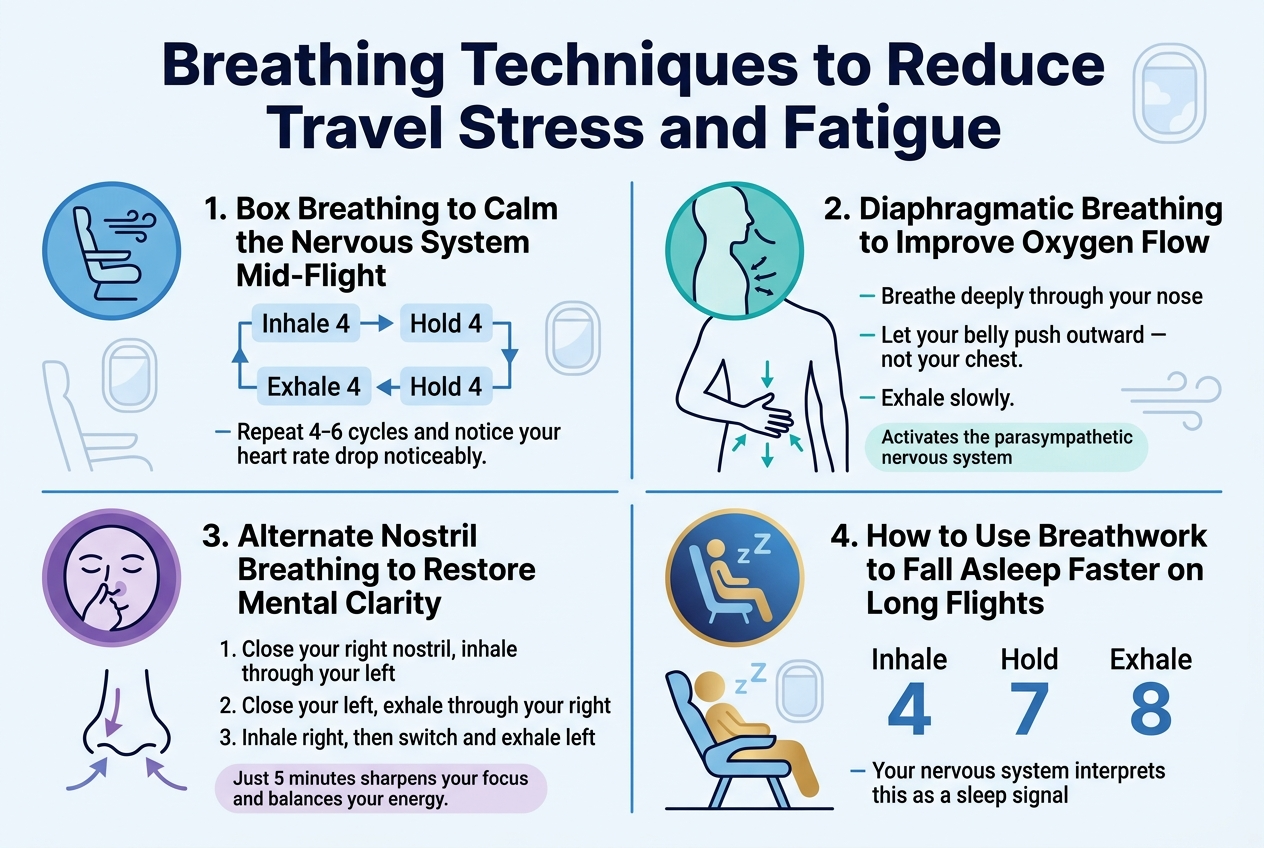
Breathing Techniques to Reduce Travel Stress and Fatigue
3:2 full-bleed professional infographic, clean modern travel-health style, white background with soft blue, teal, and navy accents, bold sans-serif typography, clear visual hierarchy. 

Top across full width: large bold heading in dark navy text: "Breathing Techniques to Reduce Travel Stress and Fatigue"

Below the heading, organize four wide rounded-corner sections in a balanced 2x2 grid with thin blue dividers, each section with a simple flat icon and numbered label.

Section 1, top left: blue circular icon with a calm airplane seat and small airflow lines. Title in bold: "1. Box Breathing to Calm the Nervous System Mid-Flight" Include four small connected boxes or arrows in a square loop labeled: "Inhale 4", "Hold 4", "Exhale 4", "Hold 4" Add a short line below: "Repeat 4–6 cycles and notice your heart rate drop noticeably."

Section 2, top right: teal circular icon with a belly breathing silhouette and expanding stomach lines. Title in bold: "2. Diaphragmatic Breathing to Improve Oxygen Flow" Include a simple body outline with one hand on the stomach, arrows moving downward into the belly. Include concise text lines: "Breathe deeply through your nose" "Let your belly push outward — not your chest." "Exhale slowly." Add small highlighted phrase: "Activates the parasympathetic nervous system"

Section 3, bottom left: purple circular icon with a face and one nostril highlighted. Title in bold: "3. Alternate Nostril Breathing to Restore Mental Clarity" Show a simple nose diagram with left and right nostril arrows in sequence. Include the steps as short numbered lines: "1. Close your right nostril, inhale through your left" "2. Close your left, exhale through your right" "3. Inhale right, then switch and exhale left" Add a small note in a colored pill: "Just 5 minutes sharpens your focus and balances your energy."

Section 4, bottom right: warm blue and gold circular icon with a sleeping person in a seat and soft Zs. Title in bold: "4. How to Use Breathwork to Fall Asleep Faster on Long Flights" Show a sleep-friendly breathing rhythm with three large numbers in sequence: "4" "7" "8" and labels: "Inhale 4" "Hold 7" "Exhale 8" Include a short line below: "Your nervous system interprets this as a sleep signal"

Use small travel-themed accents like subtle airplane windows, seatback lines, and airflow curves across the sections. Keep text crisp, readable, and evenly spaced, with strong contrast and a polished infographic layout.

Box Breathing to Calm the Nervous System Mid-Flight

When turbulence hits, or anxiety creeps in, box breathing brings you back to center fast. Try this:

  • Inhale for 4 counts
  • Hold for 4 counts
  • Exhale for 4 counts
  • Hold for 4 counts

Repeat 4–6 cycles and notice your heart rate drop noticeably.

Diaphragmatic Breathing to Improve Oxygen Flow

Cabin pressure reduces oxygen levels, leaving you sluggish. Belly breathing fights this directly. Place one hand on your stomach, breathe deeply through your nose, and let your belly push outward — not your chest. Exhale slowly. This activates your parasympathetic nervous system and boosts circulation throughout your body.

Alternate Nostril Breathing to Restore Mental Clarity

This technique works surprisingly well for clearing mental fog mid-flight:

  1. Close your right nostril; inhale through your left
  2. Close your left, exhale through your right
  3. Inhale right, then switch and exhale left

Just 5 minutes sharpens your focus and balances your energy.

How to Use Breathwork to Fall Asleep Faster on Long Flights

Combine diaphragmatic breathing with a 4-7-8 pattern — inhale for 4, hold for 7, exhale for 8. Your nervous system interprets this as a sleep signal, helping you drift off even in a cramped economy seat.

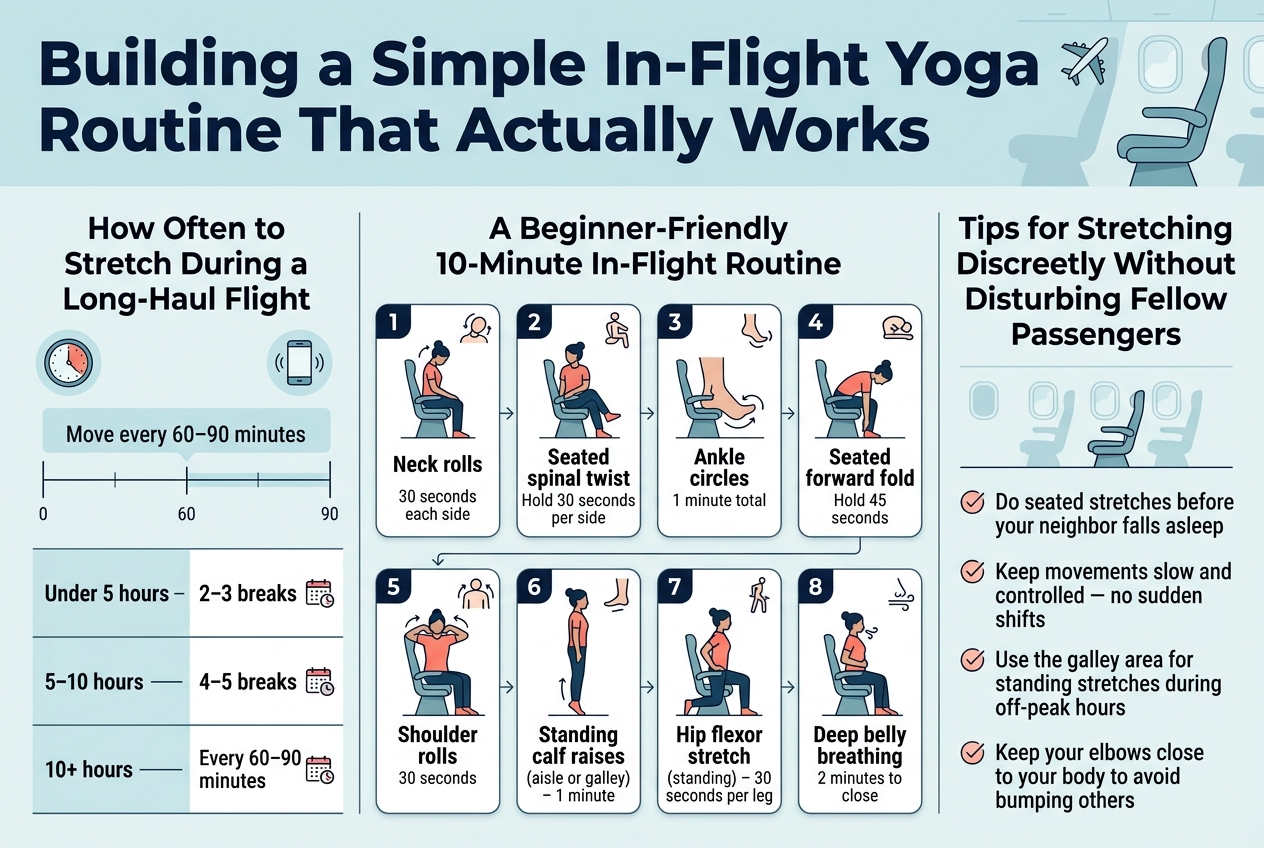
Building a Simple In-Flight Yoga Routine That Actually Works
Create a clean, professional full-bleed infographic in a 3:2 aspect ratio with a modern travel-health style. Use a light background with soft blue and teal accents, dark navy text, and coral highlights. Use a bold sans-serif heading at the top spanning the width.

Top header area: large title text in bold navy, “Building a Simple In-Flight Yoga Routine That Actually Works”. Add a small airplane icon and a subtle seat/airplane cabin motif behind the header.

Main layout: wide horizontal infographic with 3 clear sections arranged left to right or in a 2-row grid, using icons and blocks, not a narrow centered column.

Section 1 on the left: heading in bold, “How Often to Stretch During a Long-Haul Flight”. Include a small clock icon and a quiet phone reminder icon. Add a simple timeline graphic showing “Move every 60–90 minutes”. Beneath it, include a 3-row table with clear labels:
- “Under 5 hours” — “2–3 breaks”
- “5–10 hours” — “4–5 breaks”
- “10+ hours” — “Every 60–90 minutes”
Use a small calendar/clock symbol beside each row.

Section 2 in the center and largest: heading in bold, “A Beginner-Friendly 10-Minute In-Flight Routine”. Show a sequence of 8 numbered exercise cards with small illustrated icons of a seated traveler or body part for each move. Each card should include the exact text below:
1. “Neck rolls” — “30 seconds each side”
2. “Seated spinal twist” — “Hold 30 seconds per side”
3. “Ankle circles” — “1 minute total”
4. “Seated forward fold” — “Hold 45 seconds”
5. “Shoulder rolls” — “30 seconds”
6. “Standing calf raises” — “(aisle or galley) – 1 minute”
7. “Hip flexor stretch” — “(standing) – 30 seconds per leg”
8. “Deep belly breathing” — “2 minutes to close”
Arrange as two rows of four cards with clean arrows or numbered markers connecting them. Include small stretch/yoga icons, ankle rotation icon, shoulder circle icon, and breathing icon.

Section 3 on the right: heading in bold, “Tips for Stretching Discreetly Without Disturbing Fellow Passengers”. Use a subtle airplane cabin illustration and four bullet points with small checkmark icons:
- “Do seated stretches before your neighbor falls asleep”
- “Keep movements slow and controlled — no sudden shifts”
- “Use the galley area for standing stretches during off-peak hours”
- “Keep your elbows close to your body to avoid bumping others”

Visual style: crisp vector illustration, flat design with slight depth, strong hierarchy, clear spacing, professional airline wellness infographic, easy-to-read typography, balanced composition, no photo realism, no clutter.

How Often to Stretch During a Long-Haul Flight

Aim to move every 60–90 minutes — your muscles stiffen quickly in a pressurized cabin. Set a quiet phone reminder so you don’t lose track of time during a movie.

Flight DurationRecommended Stretch Breaks
Under 5 hours2–3 breaks
5–10 hours4–5 breaks
10+ hoursEvery 60–90 minutes

A Beginner-Friendly 10-Minute In-Flight Routine

Run through this sequence once per stretch break:

  • Neck rolls – 30 seconds each side
  • Seated spinal twist – Hold 30 seconds per side
  • Ankle circles – 1 minute total
  • Seated forward fold – Hold 45 seconds
  • Shoulder rolls – 30 seconds
  • Standing calf raises (aisle or galley) – 1 minute
  • Hip flexor stretch (standing) – 30 seconds per leg
  • Deep belly breathing – 2 minutes to close

Tips for Stretching Discreetly Without Disturbing Fellow Passengers

  • Do seated stretches before your neighbor falls asleep
  • Keep movements slow and controlled — no sudden shifts
  • Use the galley area for standing stretches during off-peak hours
  • Keep your elbows close to your body to avoid bumping others
Aspect ratio 3:2, full-bleed clean modern infographic, professional travel wellness style, white background with soft blue and teal accents, subtle airplane cabin and cloud graphics, bold sans-serif typography.

Top center: large bold heading in dark navy text: "Conclusion"

Below the heading, wide horizontal 3-step layout with three equal sections across the page, each with a colored circle icon and short text block:

Left section:
Blue circular icon with a stretching person silhouette and small airplane seat icon.
Bold subheading: "1. Move Your Body"
Body text: "Simple stretches can reduce stiffness and keep you feeling better in your seat."

Middle section:
Teal circular icon with lungs and soft curved breath lines.
Bold subheading: "2. Breathe Mindfully"
Body text: "Pair stretches with a breathing technique that feels right for you."

Right section:
Green circular icon with a suitcase checklist and airplane seat.
Bold subheading: "3. Prepare and Start Small"
Body text: "Pick 2 or 3 stretches, use them consistently, and build from there."

Bottom wide banner across the page with a calm airplane cabin scene and a seated traveler stretching comfortably:
Bold statement in dark navy: "Your seat doesn't have to be a trap — it can be a space where you take care of yourself."
Smaller supporting text beneath: "The more consistently you move during your flight, the better you'll feel when you land."

Include a subtle final callout badge near the bottom right in warm yellow with a checkmark icon:
"Your body will thank you"

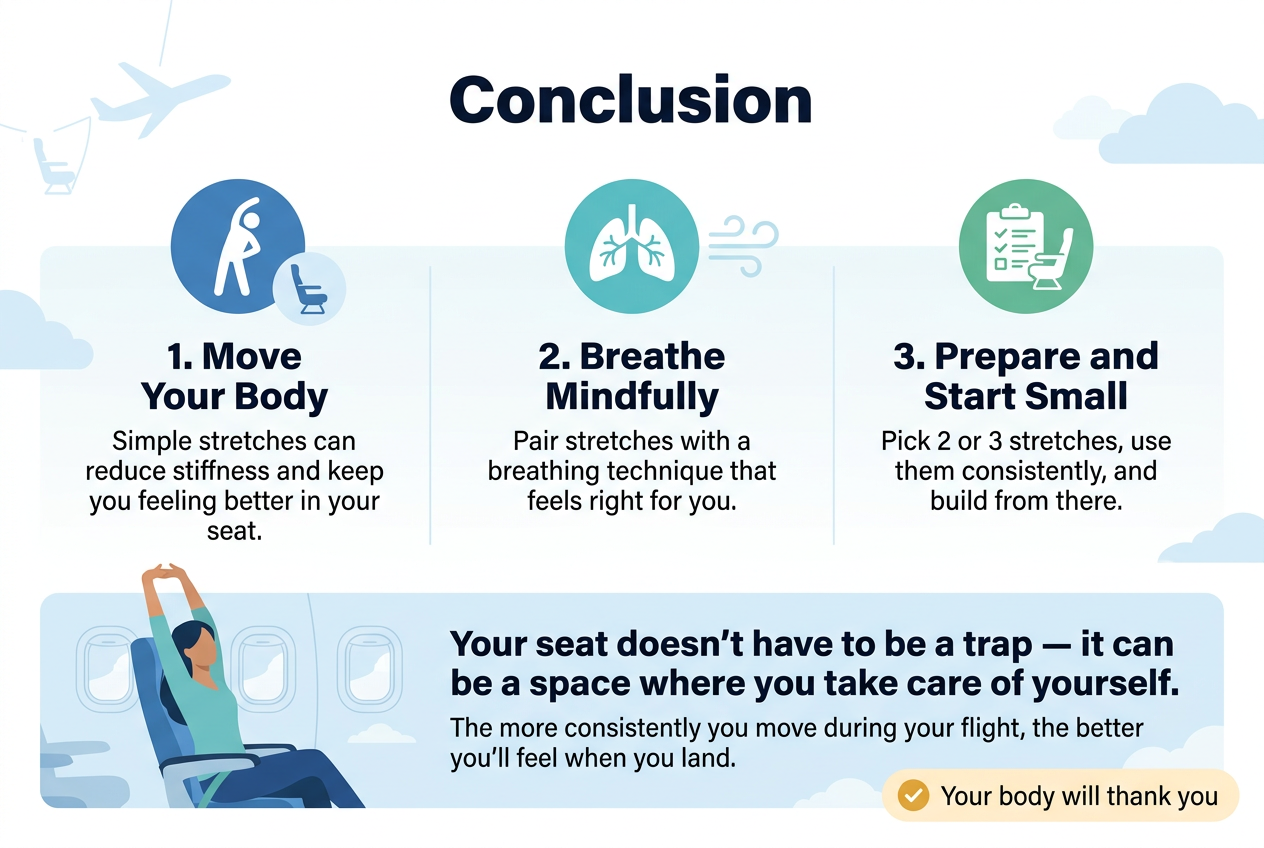
Long-haul flights don’t have to leave you feeling stiff, exhausted, and completely wrecked by the time you land. With a few simple stretches, some mindful breathing, and a little preparation before you even board, you can seriously change how your body feels from takeoff to touchdown. Your seat doesn’t have to be a trap—it can be a space where you take care of yourself, even at 35,000 feet.

Start small. Pick two or three stretches from this guide, pair them with a breathing technique that works for you, and build from there. The more consistently you move during your flight, the better you’ll feel when you finally step off that plane and into your destination. Your body will thank you — and so will your travel experience.

✨ Join The Zen Journal community — get fresh yoga and wellness insights straight to your inbox ✨