The 20-Minute Wind-Down Ritual That Actually Fixes Your Sleep

The 20-Minute Wind-Down Ritual That Actually Fixes Your Sleep
Create a clean, modern infographic illustration in a 3:2 aspect ratio, full-bleed layout with no frame, no margins, and no vertical poster stack. Use a professional editorial style with a calming nighttime palette: deep navy, slate blue, soft teal, warm white, and small accents of amber. Use bold sans-serif typography for headings and readable sans-serif body text. 

Top center: large bold headline in white and teal with a subtle moon-and-stars icon beside it. Exact text: "Introduction" 
Directly below, slightly larger subtitle text in warm white: "The 20-Minute Wind-Down Ritual That Actually Fixes Your Sleep"

Main layout: a wide 3-column horizontal section across the middle, each column in a rounded rectangle card with soft shadows and a distinct icon at the top.

Left card:
- Icon: a blue brain with a small glowing alarm clock and crossed-out phone
- Header text: "Why bedtime habits keep you awake"
- Short body text in 2 lines: "Some ‘relaxing’ habits are actually wiring your brain awake."

Center card:
- Icon: a teal stopwatch with a calm crescent moon
- Header text: "20-minute ritual"
- Short body text in 2 lines: "A minute-by-minute wind-down routine that tells your body it’s time to sleep."

Right card:
- Icon: a gold checkmark inside a circle with subtle sleep waves
- Header text: "How to know it’s working"
- Short body text in 2 lines: "Sleep improvements are subtle at first—spot the early signs and keep going."

Bottom section: a wide horizontal band with three small illustrated persona icons and short labels, spaced evenly left to right:
- Icon 1: a person with a laptop and moon above
  Text: "Night owl"
- Icon 2: a tired parent holding a child’s blanket
  Text: "Stressed-out parent"
- Icon 3: a hand holding a glowing phone with a crossed-out swipe motion
  Text: "Midnight scroller"

Bottom-right or lower center, include a small note box with a checklist icon and the text: 
"Common mistakes: stop trial and error, follow the routine, and give it time."

Use clear visual hierarchy, strong contrast, rounded shapes, and subtle line decorations like stars, crescent moons, and soft sleep waves. Keep the design balanced, spacious, and easy to scan, with all text crisp and legible.

The 20-Minute Wind-Down Ritual That Actually Fixes Your Sleep

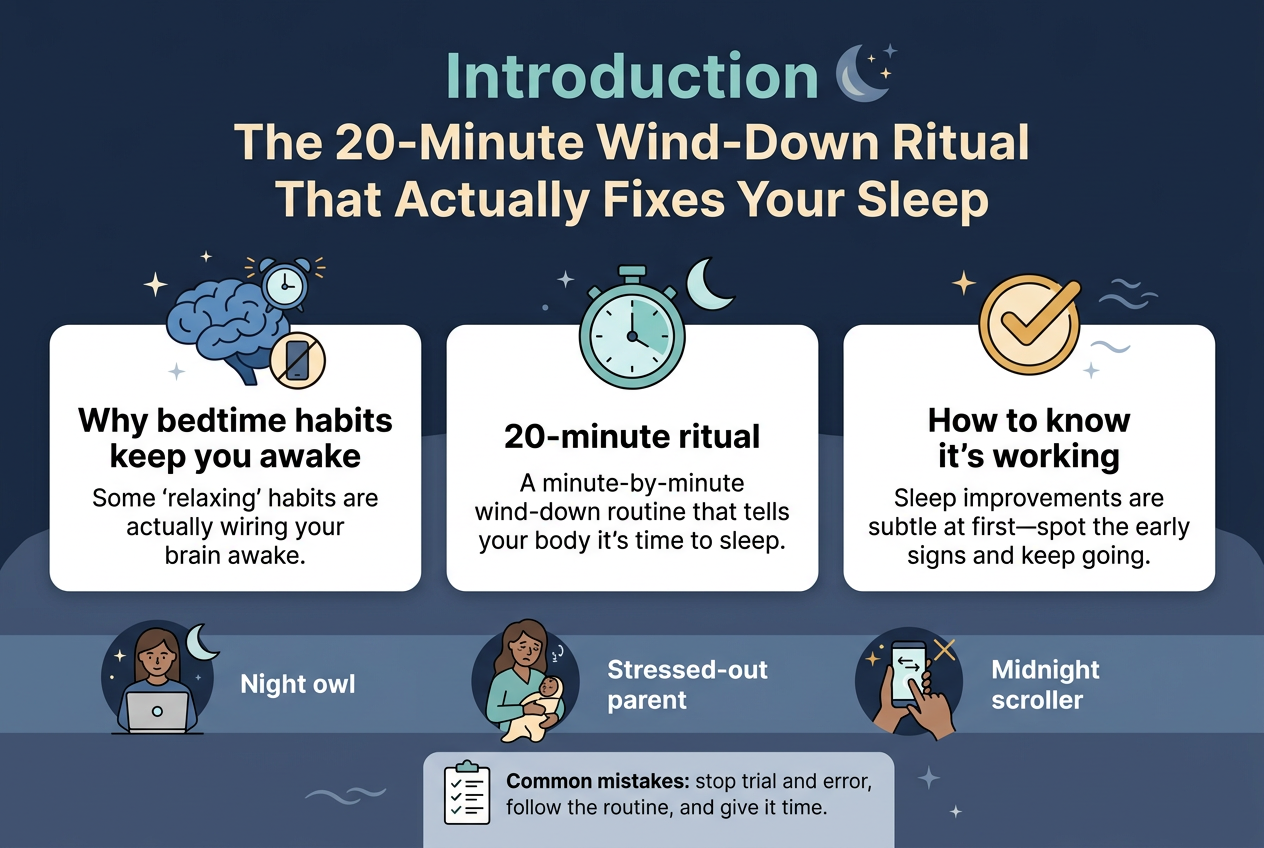
I used to lie in bed staring at the ceiling for an hour, replaying my to-do list like a broken record. Sound familiar? If you’re someone who falls into bed exhausted but can’t actually fall asleep, this is for me — and honestly, for you too. This 20‑Minute Wind‑Down Ritual changed how I sleep — and it can do the same for you.

This isn’t another “drink chamomile tea and hope for the best” kind of post. I’ve put together a real, practical sleep wind-down routine that takes just 20 minutes and actually improves your sleep quality.

Here’s what I’m covering:

  • Why your current bedtime habits might be the exact reason you can’t sleep — some of what you think is relaxing is actually wiring your brain awake
  • A minute-by-minute breakdown of the 20-minute wind-down ritual so you know exactly what to do and when
  • How to spot the signs it’s working — because good sleep improvements are subtle at first, and I don’t want you to quit too early

Whether you’re a night owl, a stressed-out parent, or someone who just scrolls their phone until midnight, this routine can fit into your real life. I’ll also walk through the common mistakes I made early on so you can skip the trial and error.

Let’s get into it.

Why Your Current Bedtime Routine Is Keeping You Awake
Create a clean modern infographic illustration in a full-bleed 3:2 aspect ratio, landscape layout, with a dark navy-to-deep blue background and bright cyan, teal, and warm orange accents. Use bold sans-serif typography with a strong hierarchy. Place a large bold title across the top: "Why Your Current Bedtime Routine Is Keeping You Awake".

Arrange the content in three wide horizontal sections across the canvas, with clear icons and short text blocks:

Left section: title "1. Stimulating Activities Keep Your Brain Alert" with a glowing brain icon and small icons of a thriller movie screen, a social media comment bubble, and a checklist/to-do list. Include the text: "Cortisol + adrenaline" and "Lingers 30–60 minutes" in a highlighted pill or callout. Add a subtle red/orange pulse line showing nervous system activation.

Center section: title "2. Screen Time Suppresses Melatonin" with a smartphone icon emitting blue light rays, a moon icon, and a crossed-out melatonin droplet icon. Include the text: "Blue light suppresses melatonin by up to 50%" and "30 minutes of scrolling delays sleep onset". Show a dimmed night-to-day slider or sleep meter dropping in quality, with a small label: "Deep sleep quality drops".

Right section: title "3. Inconsistent Schedule Disrupts Deep Sleep" with a clock icon, a calendar icon, and a sleeping person silhouette. Include the text: "Even a 90-minute shift creates 'social jet lag'" and three bullet points with small icons:
"Disrupted REM cycles"
"Reduced slow-wave (deep) sleep"
"Grogginess into the next day"

Use connecting arrows or flow lines from left to center to right to show the sequence of bedtime habits affecting sleep. Add subtle sleep-related motifs like stars, crescent moon, and waveform lines. Keep spacing balanced, with strong contrast and readable white text on dark panels. No border frame, no poster mockup, no centered vertical stack.

How Stimulating Activities Trick Your Brain Into Staying Alert

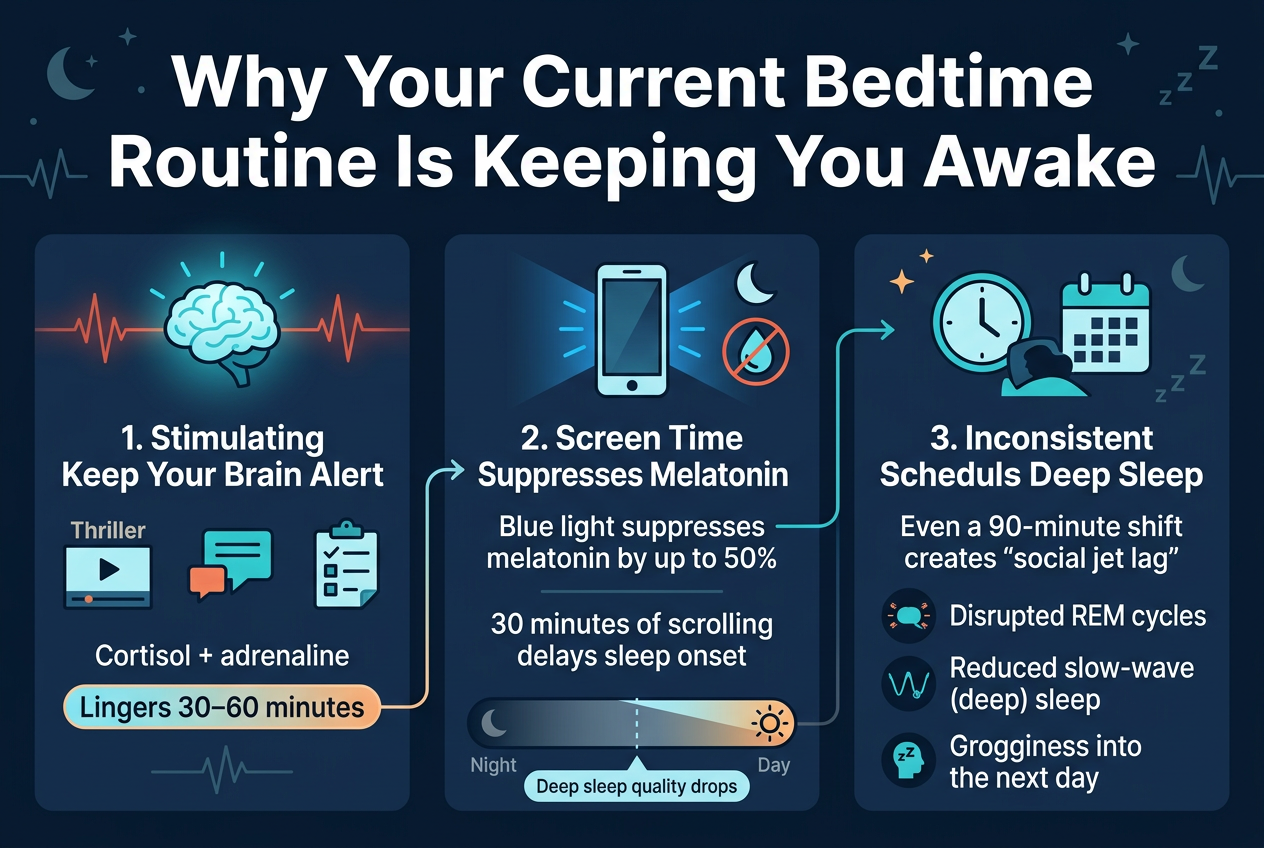
My brain doesn’t know the difference between “fun excitement” and “danger excitement.” When I watch a thriller, argue on social media, or even tackle my to-do list before bed, my nervous system releases cortisol and adrenaline—the same chemicals that kept my ancestors running from predators. That chemical cocktail doesn’t switch off the moment I close my laptop. It lingers for 30–60 minutes, making sleep feel impossible.

The Hidden Impact of Screen Time on Melatonin Production

Here’s what gets me every time — blue light from my phone suppresses melatonin by up to 50%. Melatonin is my body’s natural “it’s dark, sleep now” signal. When I scroll for just 30 minutes before bed, I’m essentially telling my brain it’s still afternoon. My sleep onset gets delayed, and the quality of my deep sleep drops noticeably.

Why an Inconsistent Schedule Sabotages Deep Sleep

My circadian rhythm runs like an internal clock — and I’m the one constantly resetting it. When my bedtime shifts by even 90 minutes on weekends, I create what scientists call “social jet lag.”

  • Disrupted REM cycles
  • Reduced slow-wave (deep) sleep
  • Grogginess that bleeds into the next day

The Science Behind the 20‑Minute Wind‑Down Ritual
Create a clean, professional full-bleed infographic in a 3:2 aspect ratio with a modern wellness-science style, using deep navy, soft teal, warm amber, and white accents. Use bold sans-serif fonts for headings and smaller readable sans-serif body text. 

Top header across the full width:
Large bold title in white on a dark navy banner: "The Science Behind a 20-Minute Wind-Down"
Subtitle directly below in smaller teal text: "How Your Nervous System Shifts From Alert to Rest Mode"

Main layout: four wide horizontal sections or cards arranged in a 2x2 grid across the page, with clear visual hierarchy, icons, and concise text.

Section 1 on the upper left:
Header with a split-circle nervous system icon showing lightning on one side and a moon on the other.
Title: "1. Nervous System Shift"
Body text:
"My autonomic nervous system runs two competing modes:"
"- Sympathetic (fight-or-flight)"
"- Parasympathetic (rest-and-digest)"
"Falling asleep requires a clean handoff between them."
"A deliberate 20-minute ritual gives my body enough time to complete that transition."

Section 2 on the upper right:
Header with a crescent moon, downward arrow, and cortisol droplet icon.
Title: "2. Cortisol Reduction"
Body text:
"Cortisol stays elevated when I'm stressed, scrolling, or problem-solving late at night."
"Calm, repetitive behaviors signal my adrenal glands to ease off."
"Melatonin takes over naturally."

Section 3 on the lower left:
Header with a horizontal comparison chart icon and a small clock.
Title: "3. Shorter Rituals Work Better"
Include a simple three-row table with clean lines:
"Routine Length" | "Outcome"
"Under 10 minutes" | "Too short to shift nervous system state"
"20 minutes" | "Optimal for cortisol drop and habit anchoring"
"60+ minutes" | "Increases sleep anxiety; hard to maintain"
Add a highlighted callout beneath the table in warm amber:
"Twenty minutes hits the sweet spot — long enough to work, short enough to actually do it every night."

Section 4 on the lower right:
Header with stacked icons of dimming lights, stretching figure, and journal notebook connected by arrows.
Title: "4. Habit-Stacking Before Sleep"
Body text:
"Sleep researchers find that chaining small behaviors together builds automatic cues."
"Dim lights → Stretch → Journal"
"My brain starts recognizing this as 'shutdown time.'"
"The stack trains my brain faster than any single habit alone."

Design details:
Use a light textured background with subtle gradient from pale blue to white.
Add thin divider lines between sections.
Use small accent icons beside each bullet.
Keep text crisp, high contrast, and evenly spaced.
Use a balanced multi-column layout with wide sections, not a narrow vertical poster.

How Your Nervous System Shifts From Alert to Rest Mode

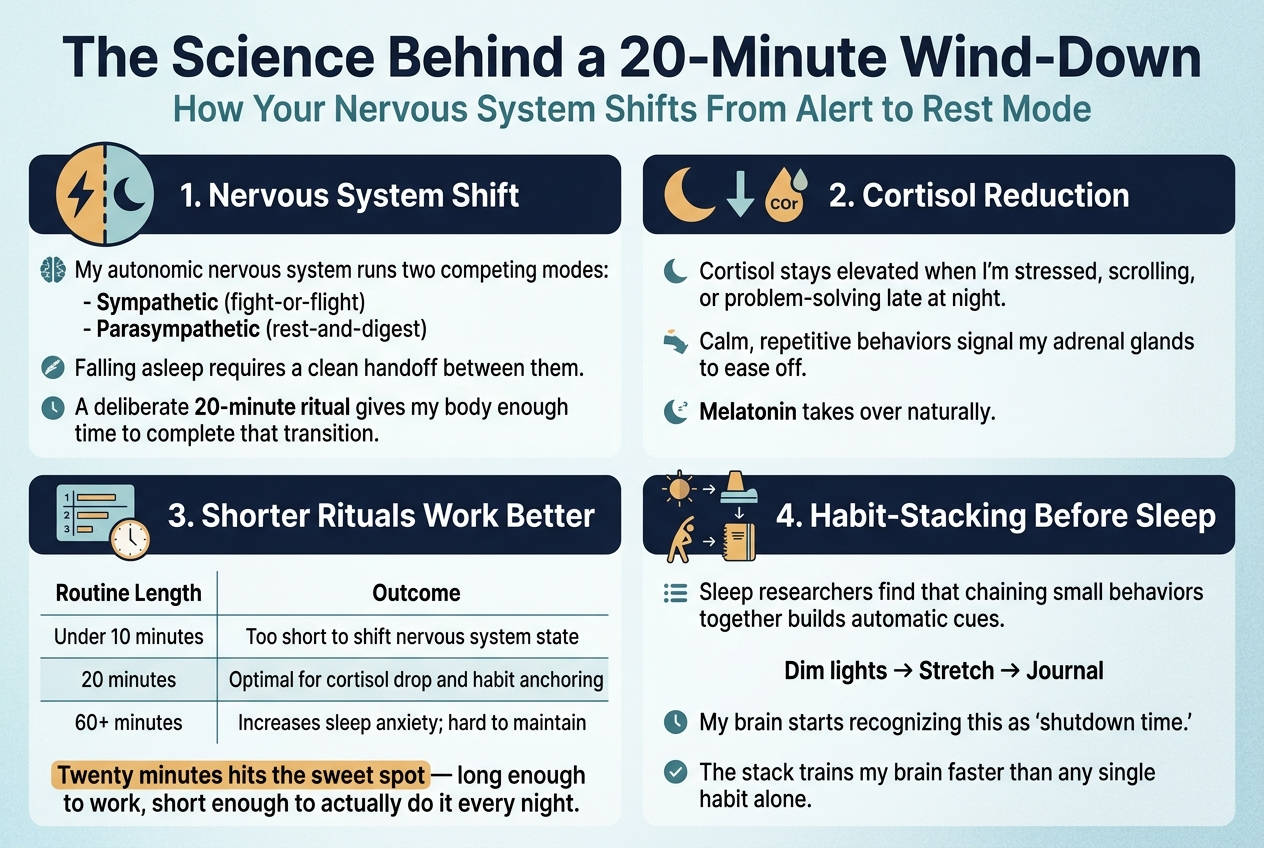
My autonomic nervous system runs two competing modes — sympathetic (fight-or-flight) and parasympathetic (rest-and-digest). Falling asleep requires a clean handoff between them. A deliberate 20-minute ritual gives my body enough time to complete that transition without forcing it.

The Role of Cortisol Reduction in Falling Asleep Faster

Cortisol doesn’t just spike in the morning — it stays elevated when I’m stressed, scrolling, or problem-solving late at night. Dropping into calm, repetitive behaviors signals my adrenal glands to ease off, letting melatonin take over naturally.

Why Shorter Rituals Outperform Lengthy Bedtime Routines

Routine LengthOutcome
Under 10 minutesToo short to shift nervous system state
20 minutesOptimal for cortisol drop and habit anchoring
60+ minutesIncreases sleep anxiety; hard to maintain

A bloated routine becomes another task I dread. Twenty minutes hits the sweet spot — long enough to work, short enough to actually do it every night.

What Research Says About Habit-Stacking Before Sleep

Sleep researchers find that chaining small behaviors together — like dimming lights, then stretching, then journaling — builds automatic cues my brain starts recognizing as “shutdown time.” The stack trains my brain faster than any single habit alone.

Add a short, natural link in your article — for example:

“According to theSleep Foundation, consistent bedtime routines help regulate your circadian rhythm.”

Minute‑by‑Minute Breakdown of the 20‑Minute  Wind Down Ritual
Create a clean, professional infographic in a full-bleed 3:2 landscape layout with a calm nighttime palette of deep navy, charcoal, soft lavender, muted teal, and warm amber accents. Use modern sans-serif fonts with a bold large title at the top and clear section hierarchy. Include subtle sleep-themed icons and soft glowing shapes, with a wide horizontal layout split into three main sections across the page.

Top header across the full width:
Bold title text: "Minute-by-Minute Breakdown of the Ritual"
Add a small crescent moon icon near the title.

Left section, labeled with a rounded dark panel and a clock icon:
"Minutes 1 to 7"
Heading text: "Dim Your Environment and Calm Your Senses"
Show a warm lamp icon, a dimmed lightbulb icon, a phone face-down icon, and small sound-wave/earplug icon.
Include short bullet text:
"- Lower lights to 10–20% brightness"
"- Set room temperature between 65–68°F"
"- Put your phone face-down or in another room"

Center section, labeled with a soft illustrated body silhouette and breathing icon:
"Minutes 8 to 14"
Heading text: "Release Physical Tension With Simple Body Techniques"
Show a simple vertical human figure with highlighted muscle groups and arrows moving upward from feet to head, plus a breathing icon.
Include short bullet text:
"- Feet → calves → thighs → stomach → shoulders → hands"
"- Pair with slow, deep belly breaths (4 counts in, 6 counts out)"
"- Gentle neck rolls work well if I'm carrying tension there"

Right section, labeled with a notebook and moon icon:
"Minutes 15 to 20"
Heading text: "Clear Your Mind and Signal Sleep to Your Brain"
Show an open journal icon, a pen icon, and a calm resting face icon.
Include short bullet text:
"- Tomorrow's three priorities"
"- Any lingering thoughts"
"- Close the journal and do nothing"
"- Just breathe"

Use numbered time blocks with clear separators, subtle connecting lines, and plenty of negative space. Keep text legible, aligned, and balanced across the wide canvas. Add soft ambient gradients and minimal decorative stars or dots, but no clutter.

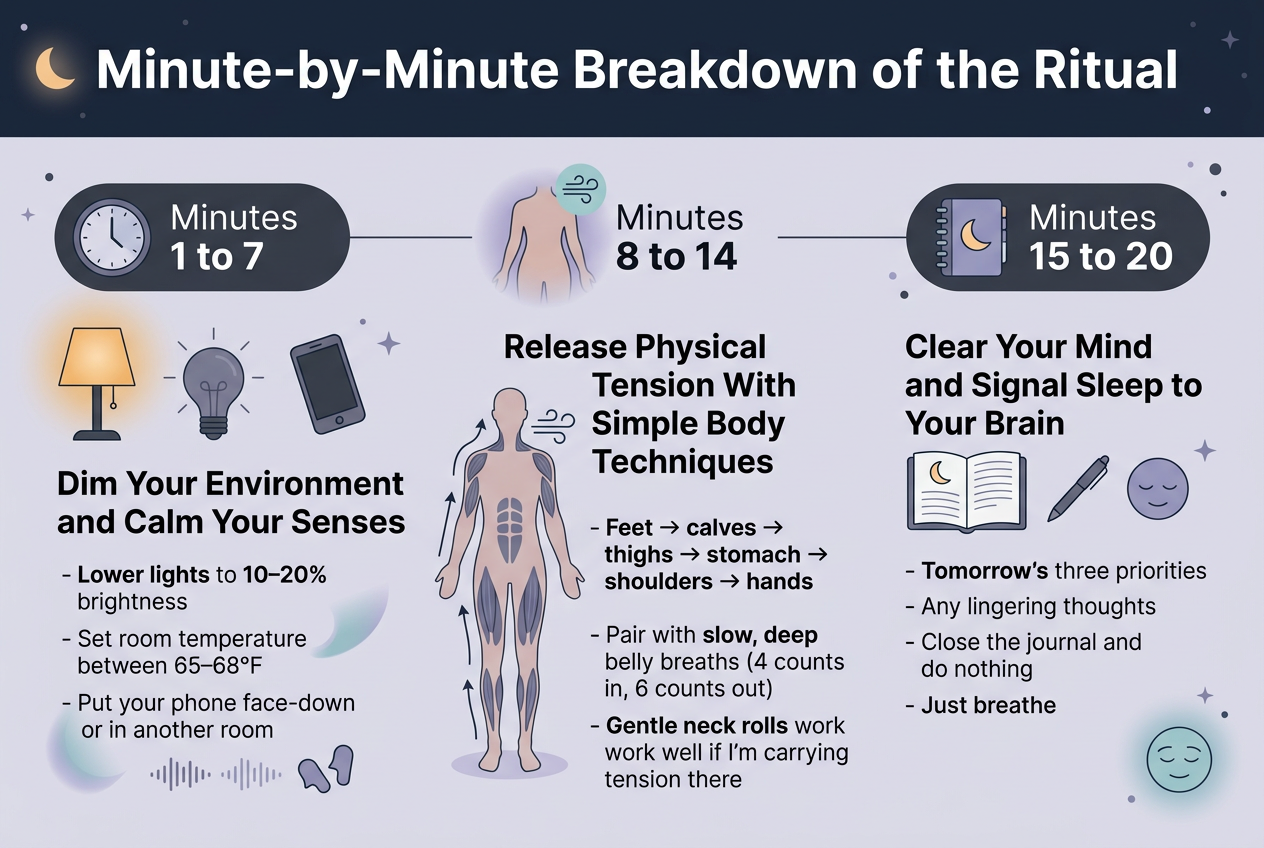
Minutes 1 to 7: Dim Your Environment and Calm Your Senses

I start by cutting harsh overhead lights and switching to warm, low lamps. Bright light suppresses melatonin, so I treat this like flipping a biological switch. I also silence notifications and, if needed, use earplugs or soft white noise.

  • Lower lights to 10–20% brightness
  • Set room temperature between 65–68°F
  • Put your phone face-down or in another room

Minutes 8 to 14: Release Physical Tension With Simple Body Techniques

My go-to here is progressive muscle relaxation — I tense each muscle group for five seconds, then release. I start at my feet and work upward. It sounds almost too simple, but the contrast between tension and release genuinely melts the day’s stress out of my body.

  • Feet → calves → thighs → stomach → shoulders → hands
  • Pair with slow, deep belly breaths (4 counts in, 6 counts out)
  • Gentle neck rolls work well if I’m carrying tension there

Minutes 15 to 20: Clear Your Mind and Signal Sleep to Your Brain

I spend these final minutes writing a short brain dump — tomorrow’s three priorities, any lingering thoughts. Getting them on paper stops my mind from cycling through them. Then I close my journal and do nothing. Just breathe.

Customizing the Ritual to Fit Your Lifestyle
Create a clean, modern infographic illustration in a 3:2 landscape aspect ratio with a full-bleed layout, no frame, no inset border, and a wide multi-section composition. Use a calm sleep-themed palette of deep navy, soft indigo, muted teal, and warm pale yellow accents. Use bold sans-serif typography for headings and clear readable sans-serif body text. 

Top header spanning full width:
Large bold title text: "Customizing the Ritual to Fit Your Lifestyle"
Add a subtle moon, clock, and crescent icon cluster near the title.

Below the header, organize the content into four wide horizontal sections with clear color-coded blocks and icons:

1) Left upper section titled: "Adjustments for Night Owls and Early Risers"
Use a clock icon and a moon icon. Include two bullet points with small circular markers:
- "Night owls: Start your wind-down at 11:40 PM if midnight is your goal"
- "Early risers: Begin at 9:10 PM without apologizing for it — your body will thank you"
Show a small timeline strip with a bedtime clock and a pre-sleep countdown cue.

2) Right upper section titled: "How to Adapt the Routine for High-Stress or Anxious Nights"
Use a brain icon, a notebook icon, and a breathing waves icon. Include two short bullet points:
- "Swap journaling for a simple \"brain dump\""
- "Extend the breathing segment by 3-4 minutes"
Add a visual of loose scribble lines flowing into a paper page, then calming wave lines.

3) Middle wide section titled: "Simple Swaps for Parents, Shift Workers, and Busy Professionals"
Create a 3-column table-style block with icons and labels:
Column 1: Parent icon, label "Parents"
Text: "Combine kids' bedtime story with your own wind-down reading"
Column 2: Night shift worker icon, label "Shift workers"
Text: "Use blackout curtains + a consistent 20-min pre-sleep ritual regardless of clock time"
Column 3: Briefcase icon, label "Busy professionals"
Text: "Replace journaling with a 2-minute tomorrow task list to clear mental clutter"
Use clean dividers between columns and small checkmark bullets.

4) Bottom wide section titled: "Keeping the Ritual Consistent While Traveling"
Use a suitcase icon, eye mask icon, earplugs icon, and music note icon. Include the text:
- "I pack a small \"sleep kit\" — earplugs, an eye mask, and my go-to sleep playlist"
- "The physical cues signal my brain that sleep is coming, even in an unfamiliar hotel room"
Show a small travel bag with the items arranged beside it and subtle hotel-room background hints.

Design details:
- Use clear section headers in bold white or dark navy depending on background contrast
- Add small illustrative icons next to each key idea
- Use rounded rectangles, soft shadows, and tidy spacing
- Keep text legible, balanced, and left-aligned within each block
- Avoid dense paragraphs; use short lines and bullets
- Make the composition wide and evenly distributed across the canvas

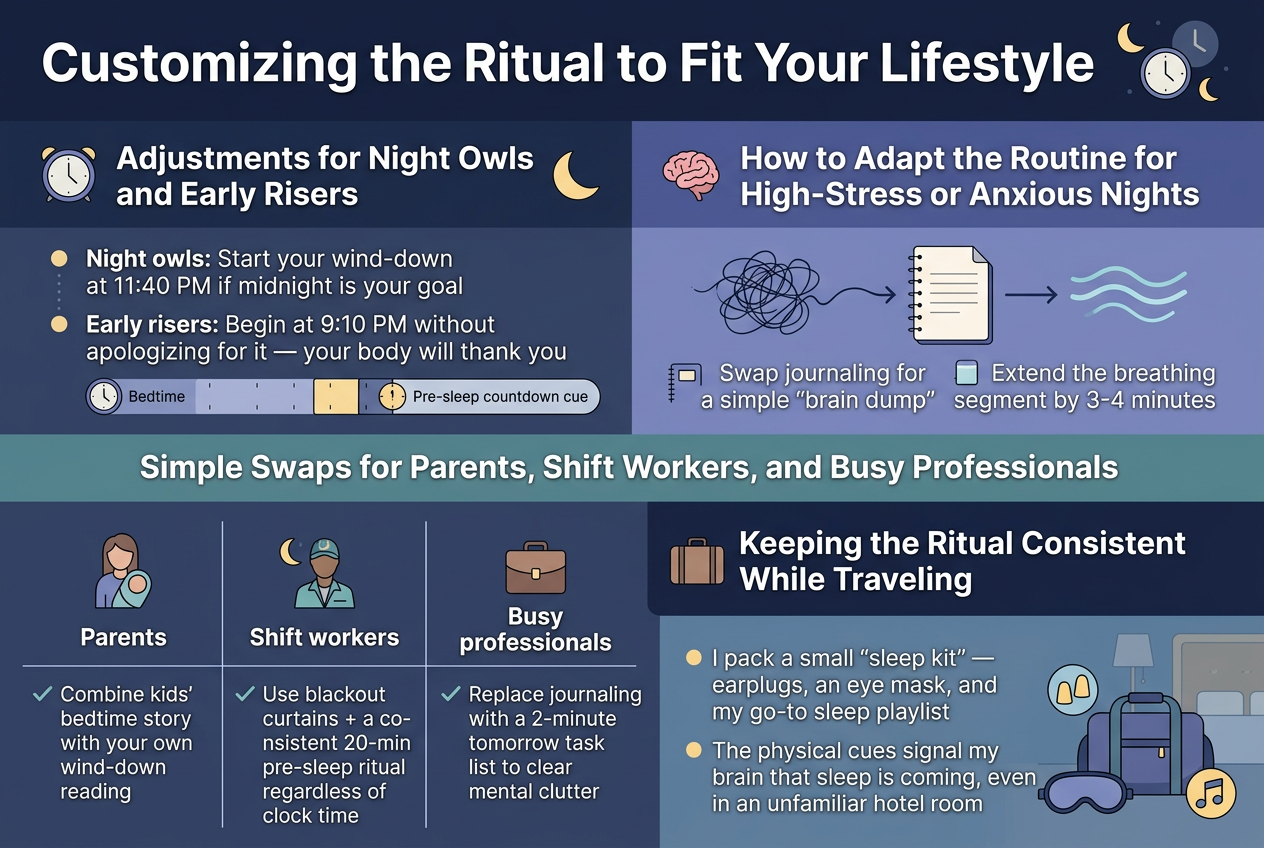
Adjustments for Night Owls and Early Risers

My ritual doesn’t care what time you go to bed — it just needs to happen consistently 20 minutes before your target sleep time.

  • Night owls: Start your wind-down at 11:40 PM if midnight is your goal
  • Early risers: Begin at 9:10 PM without apologizing for it — your body will thank you

How to Adapt the Routine for High-Stress or Anxious Nights

On rough nights, I swap the journaling portion for a simple “brain dump” — everything swirling in my head goes onto paper, no organizing required. I also extend the breathing segment by 3-4 minutes. Anxious nights need more nervous system calming, not less.

Simple Swaps for Parents, Shift Workers, and Busy Professionals

GroupBest Adjustment
ParentsCombine kids’ bedtime story with your own wind-down reading
Shift workersUse blackout curtains + a consistent 20-min pre-sleep ritual regardless of clock time
Busy professionalsReplace journaling with a 2-minute tomorrow task list to clear mental clutter

Keeping the Ritual Consistent While Traveling

I pack a small “sleep kit” — earplugs, an eye mask, and my go-to sleep playlist. The physical cues signal my brain that sleep is coming, even in an unfamiliar hotel room.

Mistakes That Undermine Your Wind-Down Efforts
Full-bleed wide infographic illustration in 3:2 aspect ratio, clean modern editorial style, soft dark navy background with warm amber and teal accents, crisp white typography, subtle glow highlights, professional sans-serif font with bold heading hierarchy.

Top center: large bold title in white text: "Mistakes That Undermine Your Wind-Down Efforts"

Below the title, divide the canvas into three wide horizontal sections or three side-by-side content blocks with numbered labels and clear icons.

Left section:
A blue smartphone icon with a red alert symbol, dim bedroom lighting, and a small clock icon.
Bold subheading text: "1. Reintroducing Stimulation During the Ritual Window"
Body text in smaller white text:
"Dim the lights, then 'quickly' check one notification"
"Five minutes of screen exposure can reset your nervous system's calm-down clock"
"Keep devices out of the ritual window completely. No exceptions."

Center section:
A calendar icon showing Friday and Saturday, with a broken rhythm line or loop arrow, and a moon icon.
Bold subheading text: "2. Skipping the Routine on Weekends and Breaking Your Rhythm"
Body text in smaller white text:
"Your brain doesn't recognize Saturday as a holiday"
"Consistency trains your nervous system to associate the ritual with sleep onset"
"Treat Friday and Saturday nights the same as Tuesday"

Right section:
A progress timeline icon with a small calendar marked 10–14 days, a sleepy face icon, and checkmarks for tracking.
Bold subheading text: "3. Expecting Instant Results Before the Habit Takes Hold"
Body text in smaller white text:
"Most people need 10–14 days of consistent practice"
"Track your sleep quality daily, even briefly"
"Notice small wins — falling asleep slightly faster, waking less often"
"Trust the neurological process; the habit is building even when it doesn't feel like it"

Use numbered circular markers "1", "2", and "3" for each block. Add thin dividing lines between sections, balanced spacing, and a polished infographic layout with strong visual hierarchy. Keep all text legible, aligned, and left-justified within each section. No frame border, no inset margins, full-bleed composition.

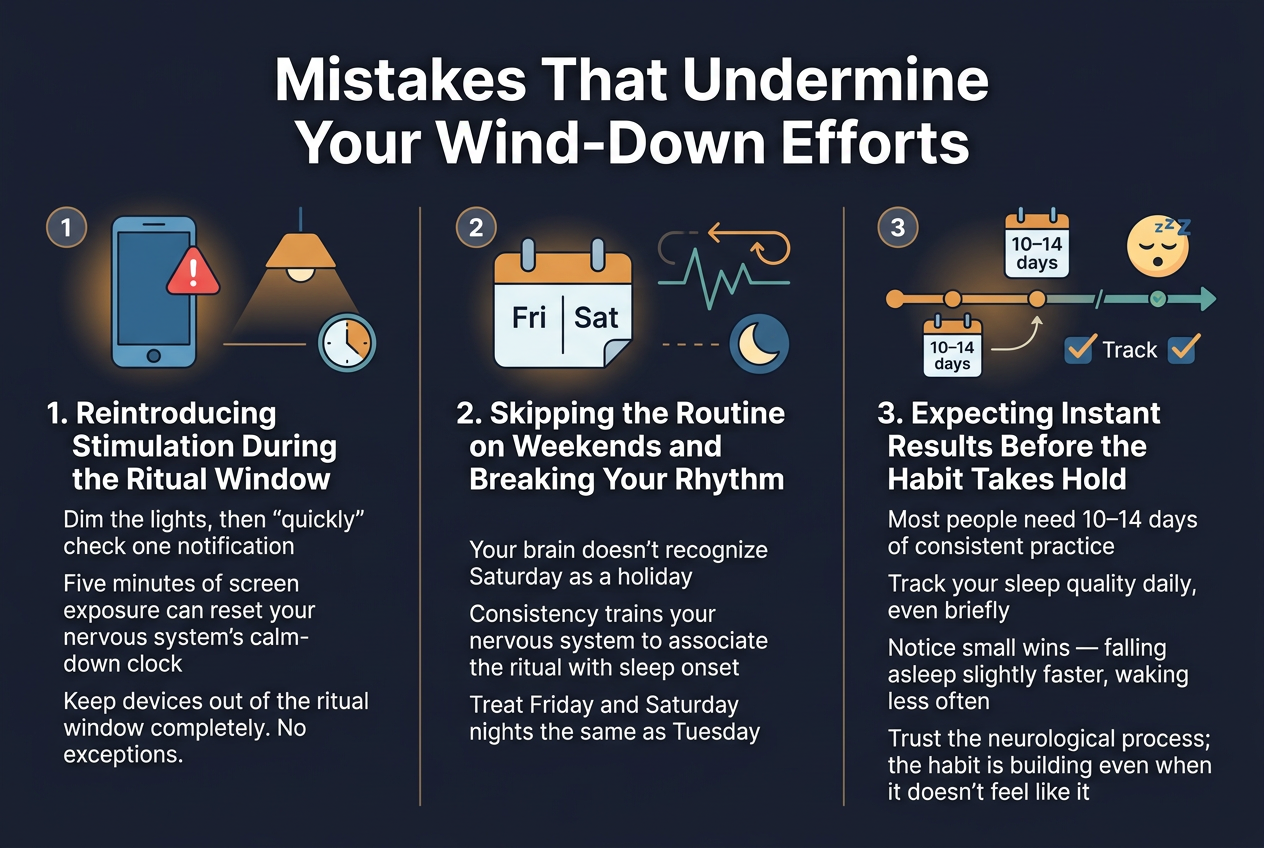
Reintroducing Stimulation During the Ritual Window

This is the mistake I see most often — and I’ve made it myself. You dim the lights, then “quickly” check one notification. Suddenly you’re reading a heated comment thread and your cortisol is spiking again. Even five minutes of screen exposure can reset your nervous system’s calm-down clock. Keep devices completely out of the ritual window. No exceptions.

Skipping the Routine on Weekends and Breaking Your Rhythm

I get it — weekends feel like earned freedom. But your brain doesn’t recognize Saturday as a holiday. When I skip my wind-down two nights in a row, Monday sleep is wrecked. Consistency is what trains your nervous system to associate the ritual with sleep onset. Treat Friday and Saturday nights the same as Tuesday. The payoff is worth it.

Expecting Instant Results Before the Habit Takes Hold

I wish I could promise you’ll sleep like a baby on night one. You won’t. Most people need 10–14 days of consistent practice before the ritual starts triggering a genuine drowsy response. Here’s what actually helped me stay patient:

  • Track your sleep quality daily, even briefly
  • Notice small wins — falling asleep slightly faster, waking less often
  • Trust the neurological process; the habit is building even when it doesn’t feel like it

Signs the Ritual Is Actually Working
Create a full-bleed landscape infographic in 3:2 aspect ratio with a clean modern wellness aesthetic, soft midnight blue, lavender, pale teal, and warm cream color palette, subtle gradient background, crisp sans-serif typography, high contrast white text, and clear visual hierarchy. 

Top center: a bold large heading in white text, exactly: "Signs the Ritual Is Actually Working"

Below the heading, arrange four wide horizontal sections in a 2x2 grid across the canvas, each with a numbered circular icon on the left, a strong subheading, and a short supporting line. Use simple flat icons with soft glow accents:
1. A crescent moon and clock icon in a blue circle.
2. A sleeping person with a small bed icon in a lavender circle.
3. A bright morning sun with a calm face icon in a pale teal circle.
4. A relaxed face with unclenched jaw and lowered shoulders icon in a warm cream circle.

Section 1, upper left:
Bold subheading text: "A. Falling Asleep Faster Within the First Two Weeks"
Smaller body text beneath: "Drifting off in 10–15 minutes instead of staring at the ceiling for 45 minutes."

Section 2, upper right:
Bold subheading text: "B. Waking Up Less Often Throughout the Night"
Smaller body text beneath: "Longer uninterrupted sleep with fewer middle-of-the-night wakeups."

Section 3, lower left:
Bold subheading text: "C. Feeling Genuinely Rested and Mentally Sharp Each Morning"
Smaller body text beneath: "Clearer thinking, steadier mood, and no foggy heavy feeling on waking."

Section 4, lower right:
Bold subheading text: "D. Noticing Reduced Anxiety and Tension at Bedtime"
Smaller body text beneath: "Shoulders drop, jaw unclenches, and bedtime feels calm instead of stressful."

Use thin dividing lines or soft rounded cards to separate the four sections, with subtle shadows and consistent spacing. Keep the layout balanced and spacious, with no vertical poster framing. Add small decorative stars, soft waves, and quiet sleep motifs in the background, but keep the text highly legible and dominant.

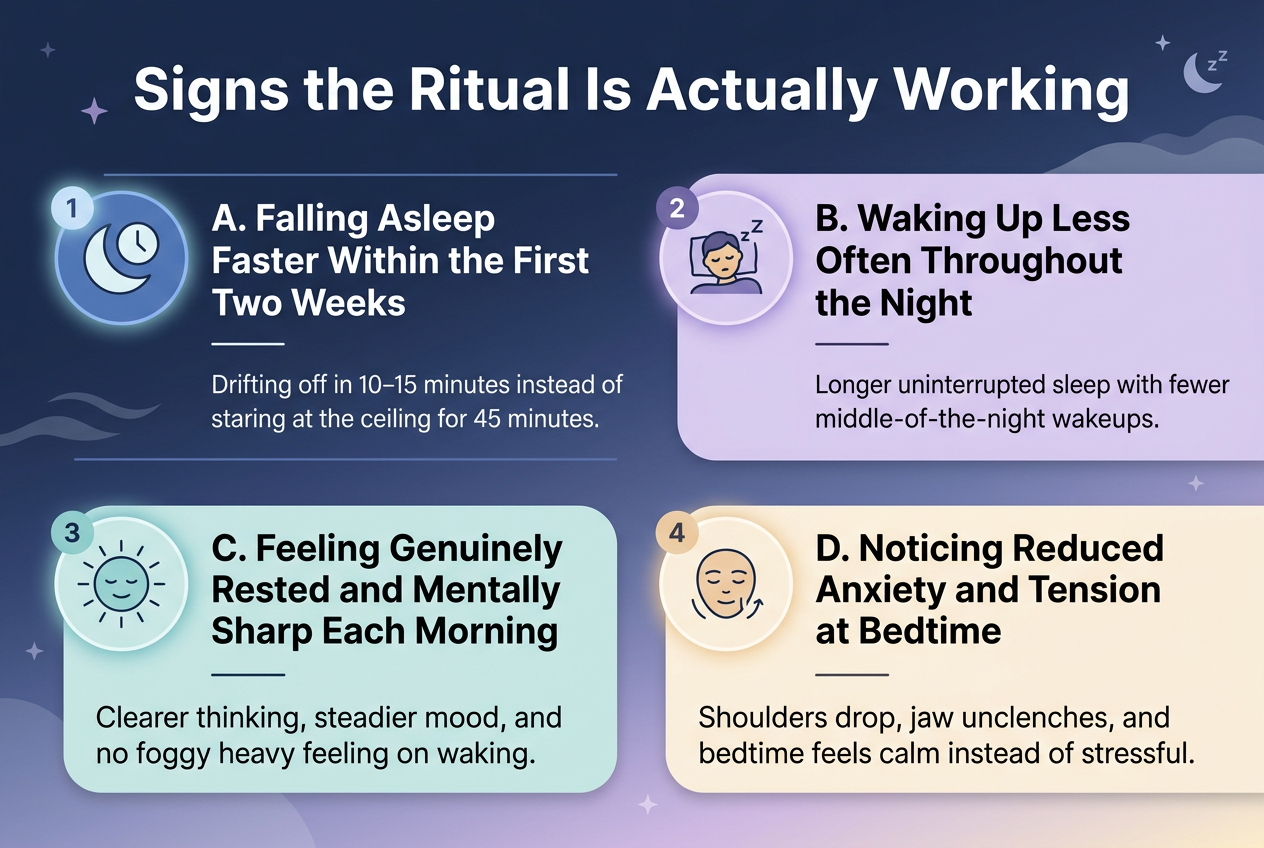
A. Falling Asleep Faster Within the First Two Weeks

I notice this one first — instead of staring at the ceiling for 45 minutes, I’m drifting off within 10-15 minutes. My body starts recognizing the ritual as a sleep cue, and that transition from wakefulness to sleep becomes smoother almost immediately.

B. Waking Up Less Often Throughout the Night

Before the ritual, I’d wake up two or three times, mind already racing. Now, I sleep in longer, uninterrupted stretches. My nervous system settles properly before bed, so I’m not fighting shallow, fragmented sleep all night.

C. Feeling Genuinely Rested and Mentally Sharp Each Morning

This is the big payoff. I wake up without that heavy, foggy feeling dragging me down. My thinking is clearer, my mood is steadier, and I’m not immediately reaching for coffee just to function. Real rest actually shows up in my days.

D. Noticing Reduced Anxiety and Tension at Bedtime

Bedtime used to feel like a battle. Now I notice my shoulders dropping, my jaw unclenching, and my thoughts quieting as I move through the ritual. That dread around sleep simply stops showing up — and that alone makes the whole thing worth it.

Create a clean, professional full-bleed infographic illustration in a 3:2 aspect ratio with a modern dark navy background, soft blue and teal accents, and white sans-serif typography with bold headings.

Top center, large bold title text: "Conclusion"

Below the title, use a wide 3-column horizontal layout with numbered sections and clear icon markers:

Left section:
A blue brain icon with subtle wakefulness lines
Large number label: "1"
Bold heading text: "Old habits wired wakefulness"
Smaller body text: "Final-minute habits can quietly train the brain to stay alert."

Center section:
A teal clock icon showing "20 min"
Large number label: "2"
Bold heading text: "20 intentional minutes"
Smaller body text: "A short, structured pre-bed ritual can shift sleep quality."

Right section:
A white checklist icon with a small warning symbol
Large number label: "3"
Bold heading text: "Science + structure + fewer mistakes"
Smaller body text: "The method works best when backed by science, a clear routine, and avoiding sabotage."

Across the lower third, add a wide highlighted banner with two side-by-side blocks:

Left lower block:
A simple minimalist path or step icon
Bold text: "No complicated system"
Smaller text: "Just a smarter approach to the time already spent before bed."

Right lower block:
A calm moon-and-bed icon
Bold text: "Try it for a week"
Smaller text: "Watch for signs it is working and trust that your body wants to sleep."

Use subtle dividing lines, rounded rectangles for each section, balanced spacing, strong visual hierarchy, and a polished editorial infographic style. No vertical poster frame, no inset margins, no extra text.

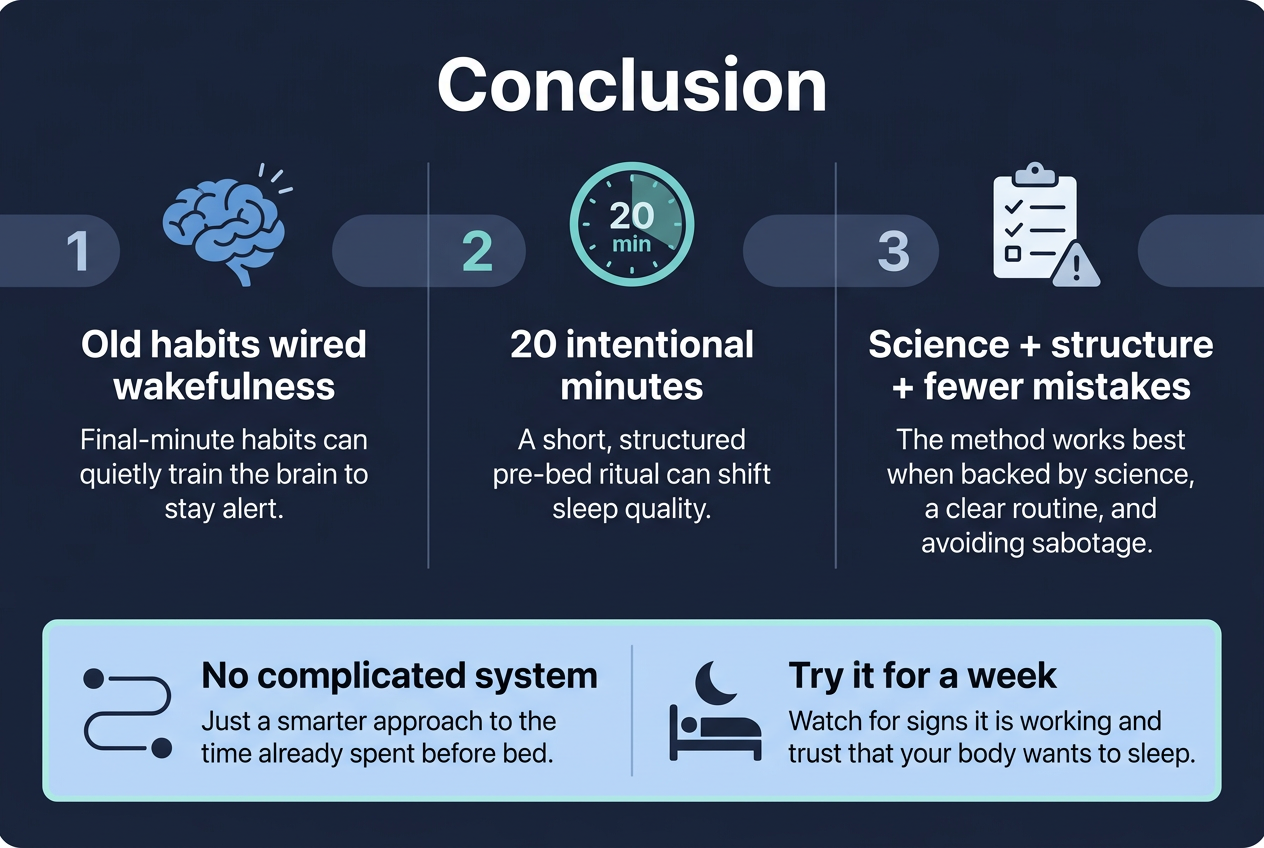
Sleep has always felt like something that should come naturally, but I learned the hard way that what I do in those final minutes before bed makes all the difference. From understanding why my old habits were quietly wiring my brain for wakefulness, to discovering how just 20 intentional minutes can completely shift my sleep quality — the pieces finally started making sense. The science backed it up, the minute-by-minute structure gave me something real to follow, and knowing what mistakes to avoid kept me from sabotaging my own progress.

The best part? I didn’t need a complicated system or a complete lifestyle overhaul. I just needed a smarter approach to the time I was already spending before bed. If you’ve been lying awake wondering why sleep feels so hard to catch, give this ritual an honest try for a week. Pay attention to the signs that it’s working — and trust that your body actually wants to sleep. You just have to stop getting in its way.

✨ Join The Zen Journal community — get fresh yoga and wellness insights straight to your inbox ✨