
Saying No Without Guilt: The Boundary-Setting Method That Protects Your Energy
Saying No Without Guilt: The Boundary-Setting Method That Protects Your Energy
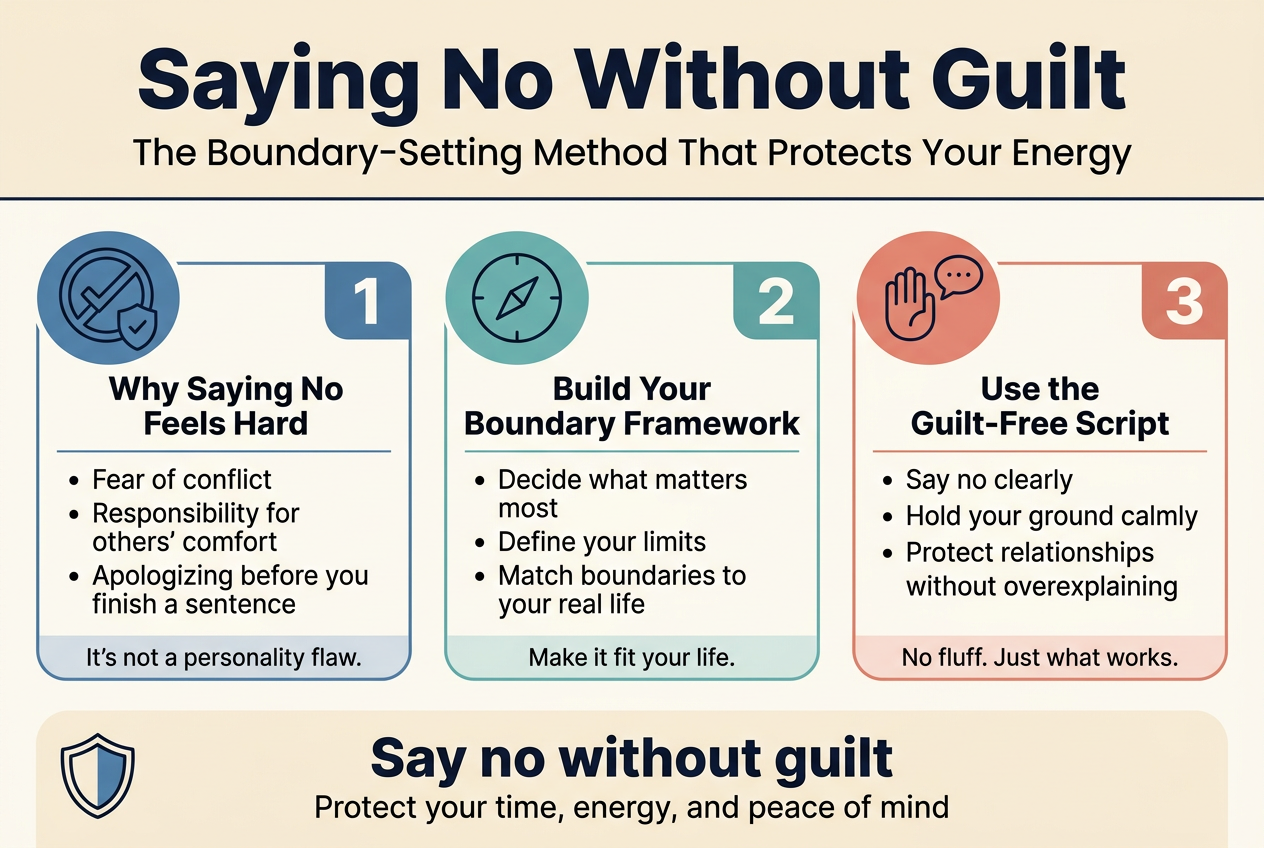
I used to say yes to everything — and I paid for it with my time, my energy, and honestly, my peace of mind. If you dread conflict, feel responsible for everyone else’s comfort, or apologize before you even finish a sentence, this is for you.
In this post, I’m walking through the boundary-setting method that helped me finally say no without the spiral of guilt that usually followed. I’ll cover why saying no feels so hard in the first place (hint: it’s not a personality flaw), how to build a personal boundary framework that actually fits your life, and the practical guilt-free script I now use to hold my ground without burning relationships.
No fluff. Just the real stuff that works.
Why Saying No Feels So Hard
The Role of People-Pleasing in Draining Your Energy
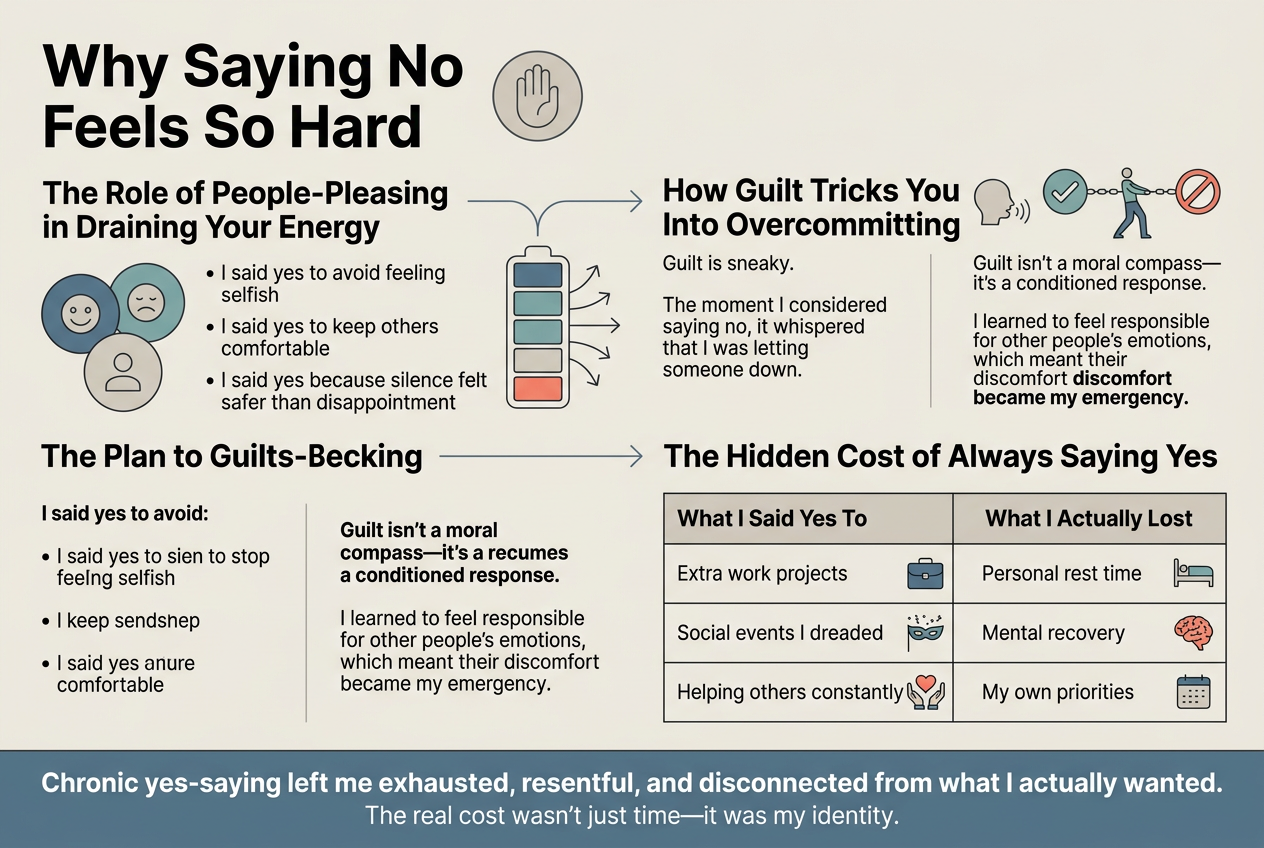
People-pleasing isn’t just a habit—it’s an energy leak I didn’t recognize for years. I kept saying yes to protect relationships, avoid conflict, and feel needed. But each yes came with a hidden price: my time, my peace, and eventually my sense of self.
- I said yes to avoid feeling selfish
- I said yes to keep others comfortable
- I said yes because silence felt safer than disappointment
How Guilt Tricks You Into Overcommitting
Guilt is sneaky. The moment I considered saying no, it whispered that I was letting someone down. That whisper grew loud enough to override my own needs every single time.
Guilt isn’t a moral compass—it’s a conditioned response. I learned to feel responsible for other people’s emotions, which meant their discomfort became my emergency.
The Hidden Cost of Always Saying Yes
| What I Said Yes To | What I Actually Lost |
|---|---|
| Extra work projects | Personal rest time |
| Social events I dreaded | Mental recovery |
| Helping others constantly | My own priorities |
Chronic yes-saying left me exhausted, resentful, and disconnected from what I actually wanted. The real cost wasn’t just time—it was my identity.
Recognize When Your Boundaries Are Being Crossed
Physical and Emotional Warning Signs to Watch For
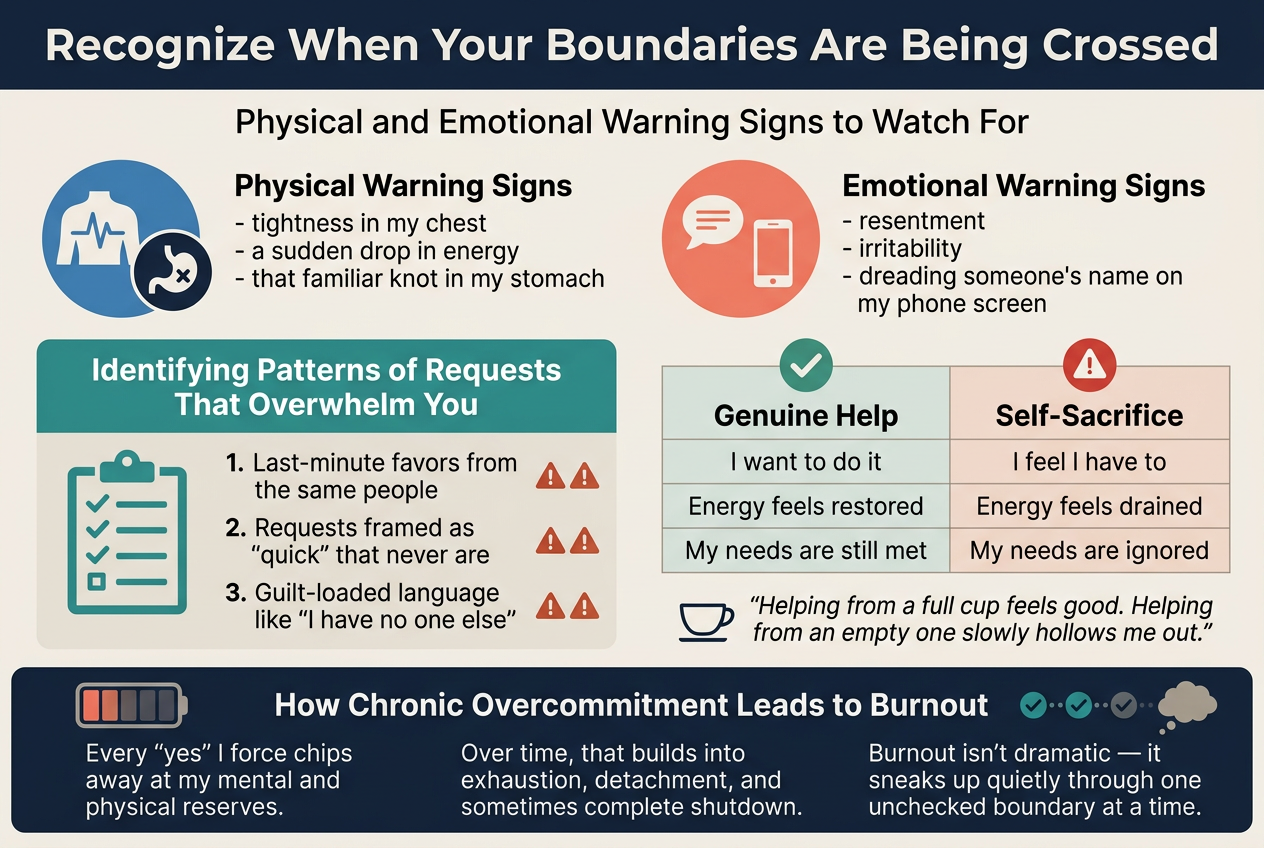
My body usually knows before my mind does. I notice tightness in my chest when someone asks too much of me, a sudden drop in energy, or that familiar knot in my stomach. Emotional signs hit just as hard — resentment, irritability, or dreading someone’s name on my phone screen.
Identifying Patterns of Requests That Overwhelm You
I started tracking which situations left me exhausted. Patterns became obvious fast:
- Last-minute favors from the same people
- Requests framed as “quick” that never are
- Guilt-loaded language like “I have no one else”
Distinguishing Between Genuine Help and Self-Sacrifice
| Genuine Help | Self-Sacrifice |
|---|---|
| I want to do it | I feel I have to |
| Energy feels restored | Energy feels drained |
| My needs are still met | My needs are ignored |
Helping from a full cup feels good. Helping from an empty one slowly hollows me out.
How Chronic Overcommitment Leads to Burnout
Every “yes” I force chips away at my mental and physical reserves. Over time, that builds into exhaustion, detachment, and sometimes complete shutdown. Burnout isn’t dramatic — it sneaks up quietly through one unchecked boundary at a time.
Build a Personal Boundary Framework That Works for You
Define Your Core Values and Non-Negotiables
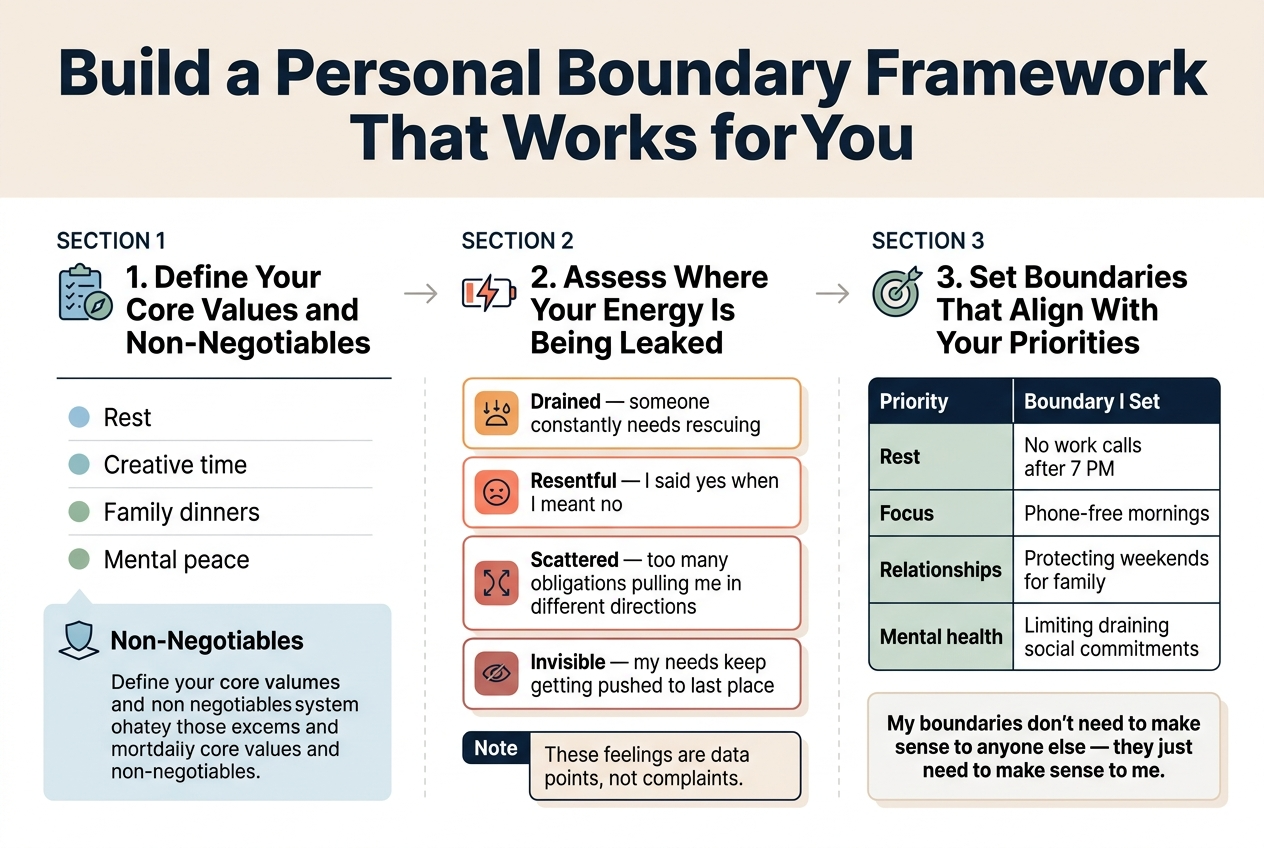
Before I can set any boundary, I need to know what I’m protecting. I start by listing the values that matter most to me — things like rest, creative time, family dinners, or mental peace. Once I see them written down, my non-negotiables become obvious. These aren’t selfish demands; they’re the foundation everything else is built on.
Assess Where Your Energy Is Being Leaked
I pay attention to how I feel after certain interactions or commitments:
- Drained — someone constantly needs rescuing
- Resentful — I said yes when I meant no
- Scattered — too many obligations pulling me in different directions
- Invisible — my needs keep getting pushed to last place
These feelings are data points, not complaints. They show me exactly where my boundaries are missing or weak.
Set Boundaries That Align With Your Priorities
Once I know my values and energy leaks, I match my boundaries directly to them:
| Priority | Boundary I Set |
|---|---|
| Rest | No work calls after 7 PM |
| Focus | Phone-free mornings |
| Relationships | Protecting weekends for family |
| Mental health | Limiting draining social commitments |
My boundaries don’t need to make sense to anyone else — they just need to make sense to me.
The Guilt-Free Method for Saying No Effectively
Use Clear and Direct Language Without Over-Explaining
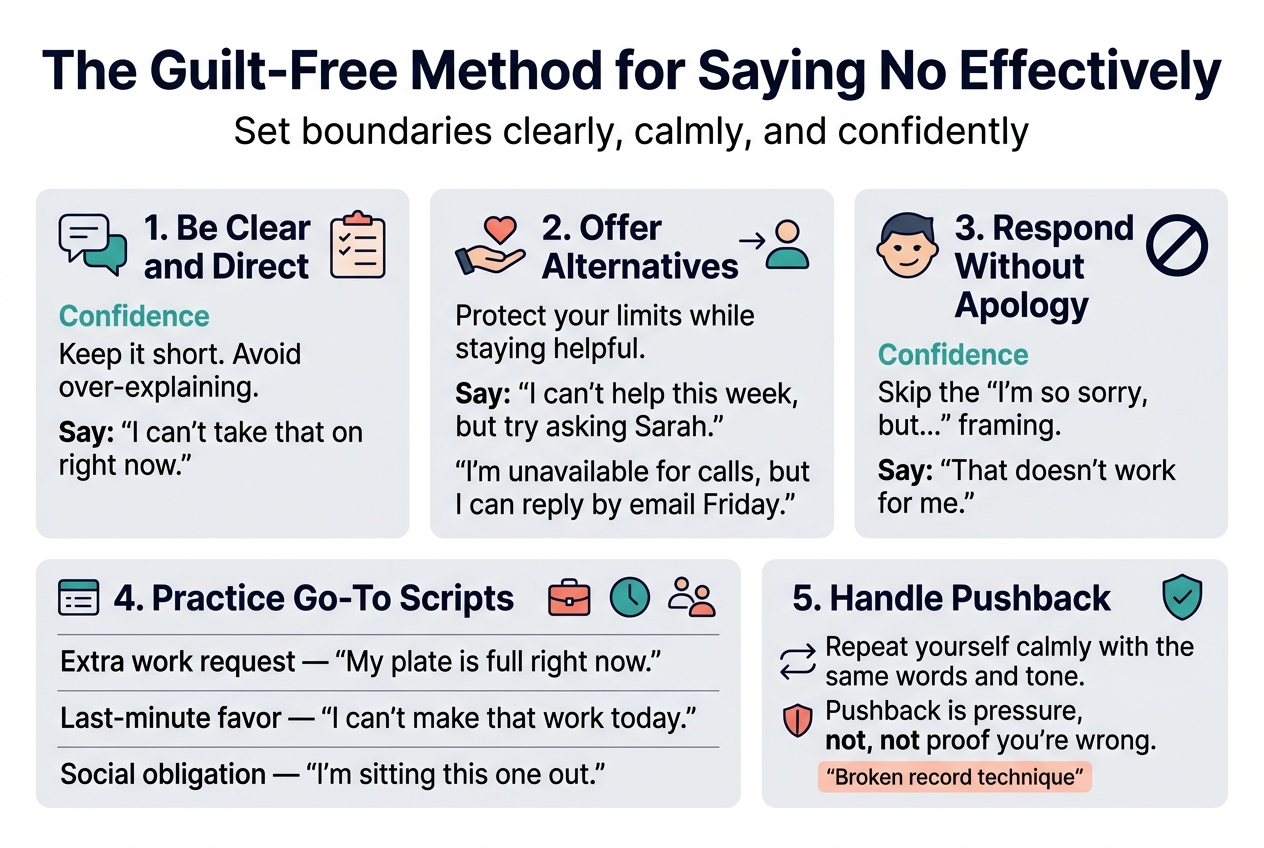
When I say no, I keep it short. Over-explaining signals insecurity and invites negotiation. “I can’t take that on right now” is complete. I don’t owe anyone a paragraph.
Offer Alternatives Without Compromising Your Limits
Sometimes I soften a no by pointing somewhere helpful — without sacrificing my own bandwidth:
- “I can’t help this week, but try asking Sarah.”
- “I’m unavailable for calls, but I can reply by email Friday.”
This keeps relationships warm without draining me.
Respond With Confidence Instead of Apology
I stopped opening with “I’m so sorry, but…” That framing hands my power away immediately. Confident sounds like: “That doesn’t work for me.” No sorry needed.
Practice Scripts for Common Difficult Situations
| Situation | My Go-To Response |
|---|---|
| Extra work request | “My plate is full right now.” |
| Last-minute favor | “I can’t make that work today.” |
| Social obligation | “I’m sitting this one out.” |
Handle Pushback Without Backing Down
When someone pushes back, I simply repeat myself calmly — same words, same tone. This is called the broken record technique, and it works. Pushback is pressure, not proof that I’m wrong.
Protect Your Energy With Consistent Boundary Habits
Schedule Regular Check-Ins With Yourself
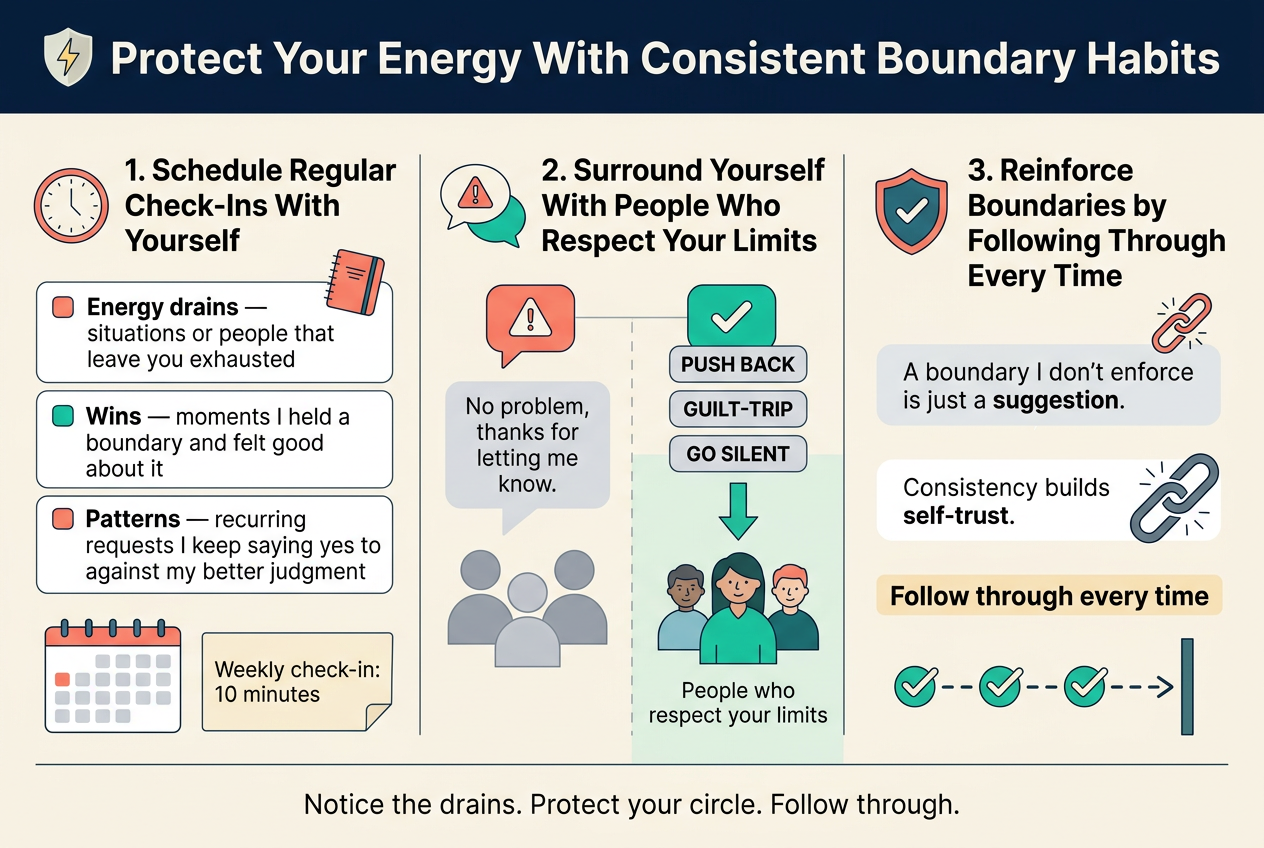
I block time weekly — even just ten minutes — to ask myself where I feel drained, resentful, or overextended. These check-ins help me catch boundary erosion early before it turns into burnout. I keep a simple journal where I track:
- Energy drains: situations or people that leave me exhausted
- Wins: moments I held a boundary and felt good about it
- Patterns: recurring requests I keep saying yes to against my better judgment
Surround Yourself With People Who Respect Your Limits
My inner circle matters enormously here. I’ve learned to pay attention to how people respond when I say no. Those who push back, guilt-trip, or go silent are showing me exactly who they are. I gradually invest less energy in those relationships and more in people who say, “No problem, thanks for letting me know.” That shift alone has changed how safe I feel setting limits.
Reinforce Boundaries by Following Through Every Time
A boundary I don’t enforce is just a suggestion. Every time I cave after saying no, I teach people my limits aren’t real. I stay consistent—even when it’s uncomfortable—because that consistency builds genuine self-trust and trains others to take my word seriously.
Reframe No as an Act of Self-Respect
Shift Your Mindset From Selfish to Empowering
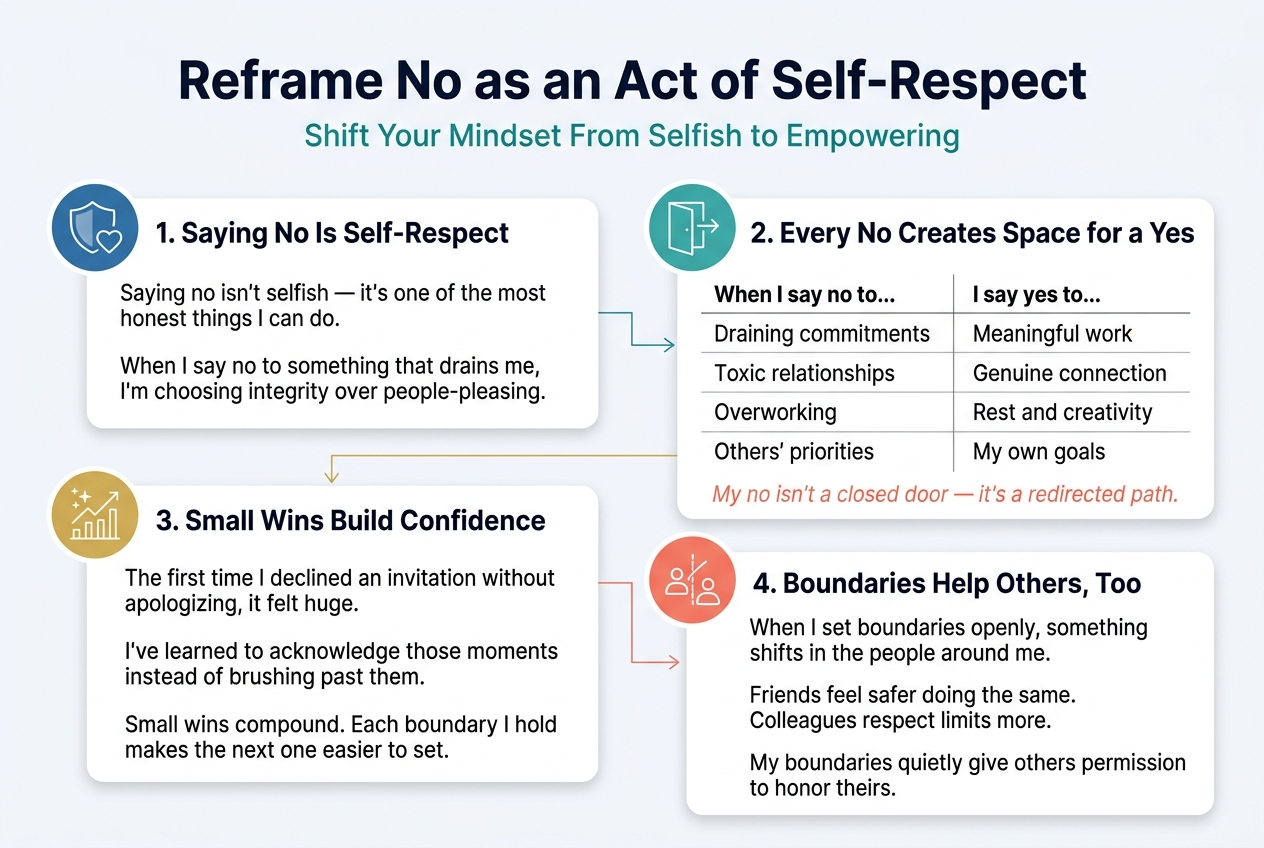
Saying no isn’t selfish — it’s one of the most honest things I can do. When I say no to something that drains me, I’m choosing integrity over people-pleasing. That’s not selfishness; that’s self-awareness.
Understand How Your No Creates Space for Your Yes
Every no I say carves out room for something better:
| When I say no to… | I say yes to… |
|---|---|
| Draining commitments | Meaningful work |
| Toxic relationships | Genuine connection |
| Overworking | Rest and creativity |
| Others’ priorities | My own goals |
My no isn’t a closed door — it’s a redirected path.
Celebrate Small Wins as Your Confidence Grows
The first time I declined an invitation without apologizing, it felt huge. I’ve learned to acknowledge those moments instead of brushing past them. Small wins compound. Each boundary I hold makes the next one easier to set.
Inspire Others by Modeling Healthy Boundaries
When I set boundaries openly, something shifts in the people around me. Friends feel safer doing the same. Colleagues respect limits more. I don’t have to announce it — living it is enough. My boundaries quietly give others permission to honor theirs.
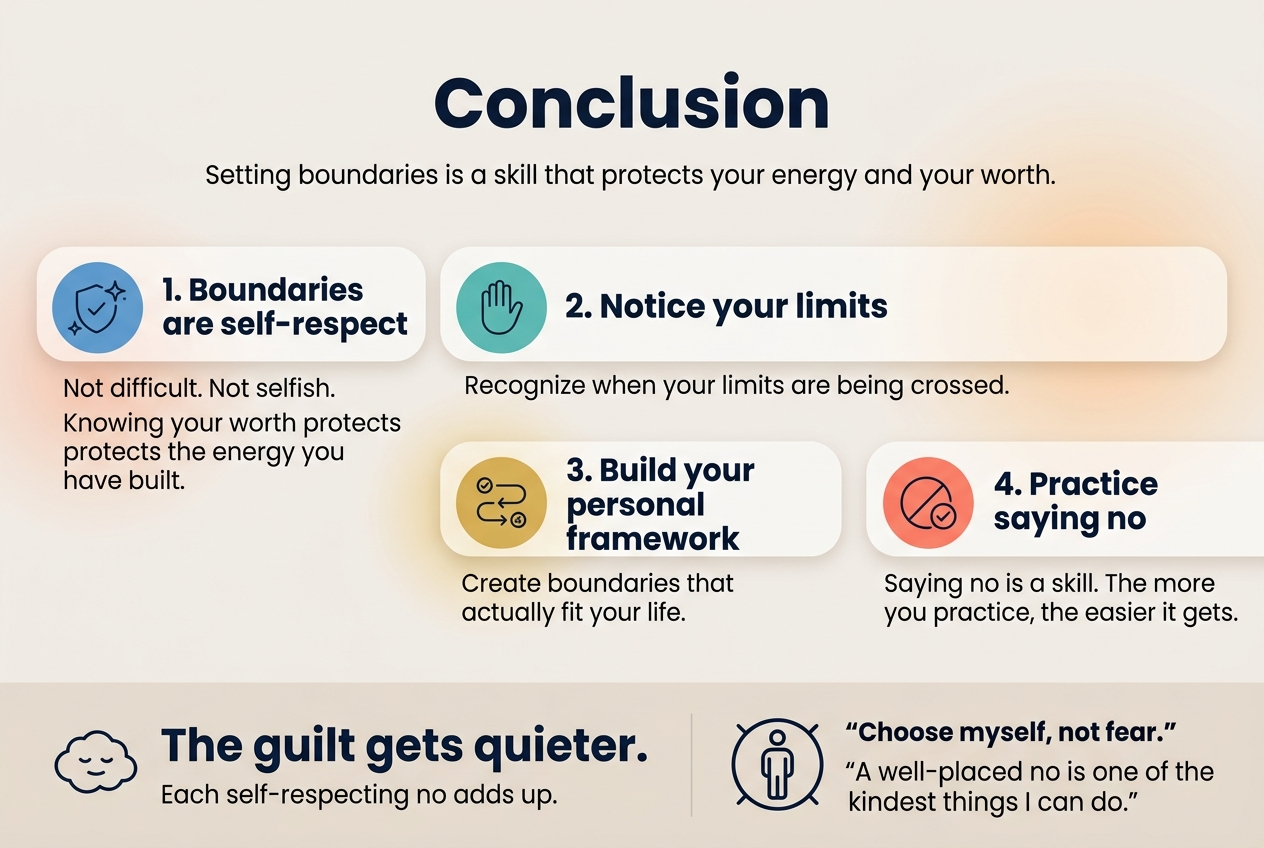
Setting boundaries is not about being difficult or selfish — it is about knowing your worth and protecting the energy you have worked so hard to build. From recognizing when your limits are being crossed to building a personal framework that actually fits your life, every step I have shared here points to one truth: saying no is a skill, and like any skill, it gets easier the more I practice it.
The guilt does not disappear overnight, but it does get quieter. Every time I say no from a place of self-respect rather than fear, I choose myself—and that choice adds up. So the next time someone asks something of me that I simply cannot give, I am not going to shrink or apologize. I am going to hold my boundary, protect my energy, and remind myself that a well-placed no is one of the kindest things I can do for both myself and the people around me.
✨ Join The Zen Journal community — get fresh yoga and wellness insights straight to your inbox ✨