Traveling as a Couple: How to Stay Mindful (and Sane) When Exploring Together

Traveling as a Couple: How to Stay Mindful (and Sane) When Exploring Together
3:2 landscape infographic, full-bleed background, clean modern editorial style, soft travel-themed colors (deep teal, warm coral, sand, white), bold sans-serif typography with clear hierarchy.

Top center: large bold title in dark teal: "Traveling as a Couple: How to Stay Mindful (and Sane) When Exploring Together"

Under the title, a short subtitle in smaller text: "Practical ways to reduce stress, communicate better, and enjoy the trip together"

Across the middle, three wide horizontal sections or side-by-side blocks with numbered headers and icons:

1. Left block with a split suitcase / map pin / tired face icon:
Text header: "1. Why friction happens"
Small supporting text: "Lost in unfamiliar places"
Small supporting text: "Running on no sleep"
Small supporting text: "Disagreeing about simple decisions"

2. Center block with a calendar / checklist / compass icon:
Text header: "2. Plan mindfully before you go"
Small supporting text: "Set expectations early"
Small supporting text: "Build in flexibility"
Small supporting text: "Reduce mid-trip tension"

3. Right block with two chat bubbles / heart / calm wave icon:
Text header: "3. Communicate when things get hard"
Small supporting text: "Pause before reacting"
Small supporting text: "Talk it through kindly"
Small supporting text: "Don’t let one rough afternoon ruin the trip"

Bottom band across the full width with a highlighted takeaway box and a simple checkmark icon:
Bold text: "No fluff. No generic advice. Just practical travel tips that work."

Include subtle background illustrations of a couple traveling together with luggage and a city map, kept secondary and not overpowering the text. Use clear spacing, balanced composition, strong contrast, and wide layout sections, with no centered vertical stack.

Traveling as a Couple: How to Stay Mindful (and Sane) When Exploring Together

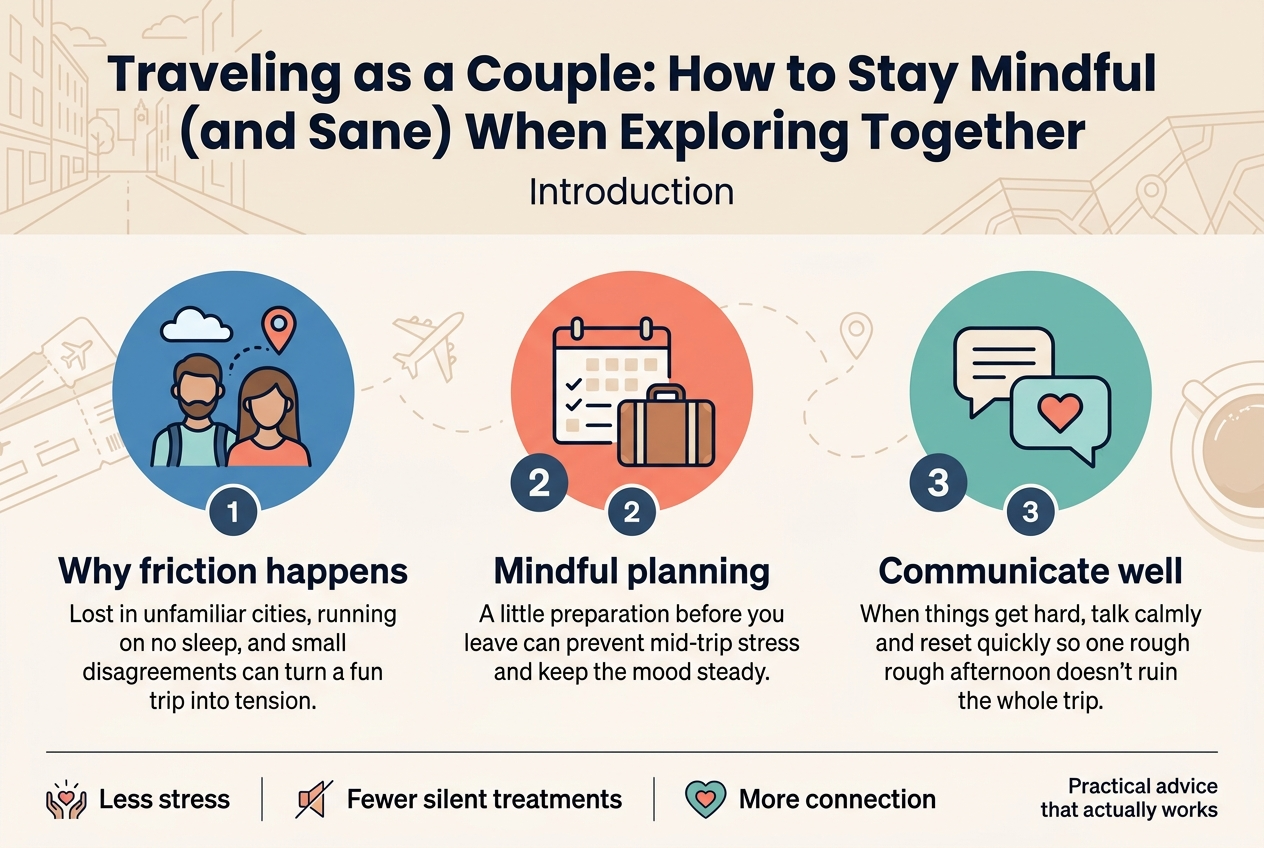
Traveling with your partner sounds dreamy — until you’re lost in an unfamiliar city, running on no sleep, and disagreeing about where to eat for the third time that day. If you’ve ever come home from a trip feeling more drained than connected, you’re not alone.

This guide is for couples who love traveling together but want to do it better — without the unnecessary stress, silent treatments, or “we’ll laugh about this later” moments that don’t actually feel funny in the moment.

Here’s what you’ll find inside: why even strong couples hit friction on the road, how a little mindful travel planning before you leave can save you from mid-trip tension, and simple ways to communicate when things get hard without letting a rough afternoon ruin the whole trip.

No fluff, no generic advice — just practical stuff that actually works.

Understanding Why Couples Struggle While Traveling Together
Create a clean, modern infographic in a 3:2 landscape format with a full-bleed white background, wide horizontal composition, and no poster frame. Use a professional travel-themed palette of deep navy, teal, warm coral, soft gold, and light gray. Use bold sans-serif typography for headings and smaller readable sans-serif text for body copy. 

Top full-width header bar: large bold title text centered, in dark navy:
"Understanding Why Couples Struggle While Traveling Together"

Below the title, divide the infographic into three wide horizontal sections with clear numbered labels and simple flat icons.

Section 1 across the upper-middle left: heading in bold coral with a lightning/stress icon:
"A. Recognize How Stress Amplifies Relationship Tension on the Road"
Under it, place a wide text block with these lines:
"Travel strips away routines, comfort zones, and personal space."
"Tired, hungry, or lost makes emotional regulation harder."
"Small irritations feel bigger on the road."
"Partner habits can become genuinely aggravating."

Add small icons beside the lines: suitcase, tired face, map pin, broken heart.

Section 2 across the upper-middle right: heading in bold teal with a warning/triangle icon:
"B. Identify the Most Common Triggers for Couple Conflicts During Trips"
Under it, arrange five horizontal mini-cards in a neat grid with icons and short labels:
"Decision fatigue" — icon of multiple choice arrows
"Budget disagreements" — icon of a coin and split arrow
"Itinerary overload" — icon of a packed calendar
"Unspoken expectations" — icon of two speech bubbles with a question mark
"Physical discomfort" — icon of hot sun, stomach, and tired face

Section 3 across the lower full width: heading in bold dark navy with a compass icon:
"C. Understand How Different Travel Styles Can Clash"
Place a clean 2-column comparison table with the header row:
"Travel Style" | "Typical Behavior"
Four rows beneath:
"The Planner" | "Needs structure, pre-booked itineraries"
"The Wanderer" | "Prefers spontaneity, hates rigid schedules"
"The Homebody" | "Craves comfort, familiar food, early nights"
"The Adventurer" | "Seeks novelty, pushes physical limits"

At the bottom, add a highlighted note bar in soft gold with centered text:
"When travel styles differ significantly, neither approach is wrong — you're just working from different internal maps."

Use subtle travel icons in section dividers, crisp spacing, strong visual hierarchy, and balanced alignment across the wide layout. Make all text legible and exact, with no extra words.

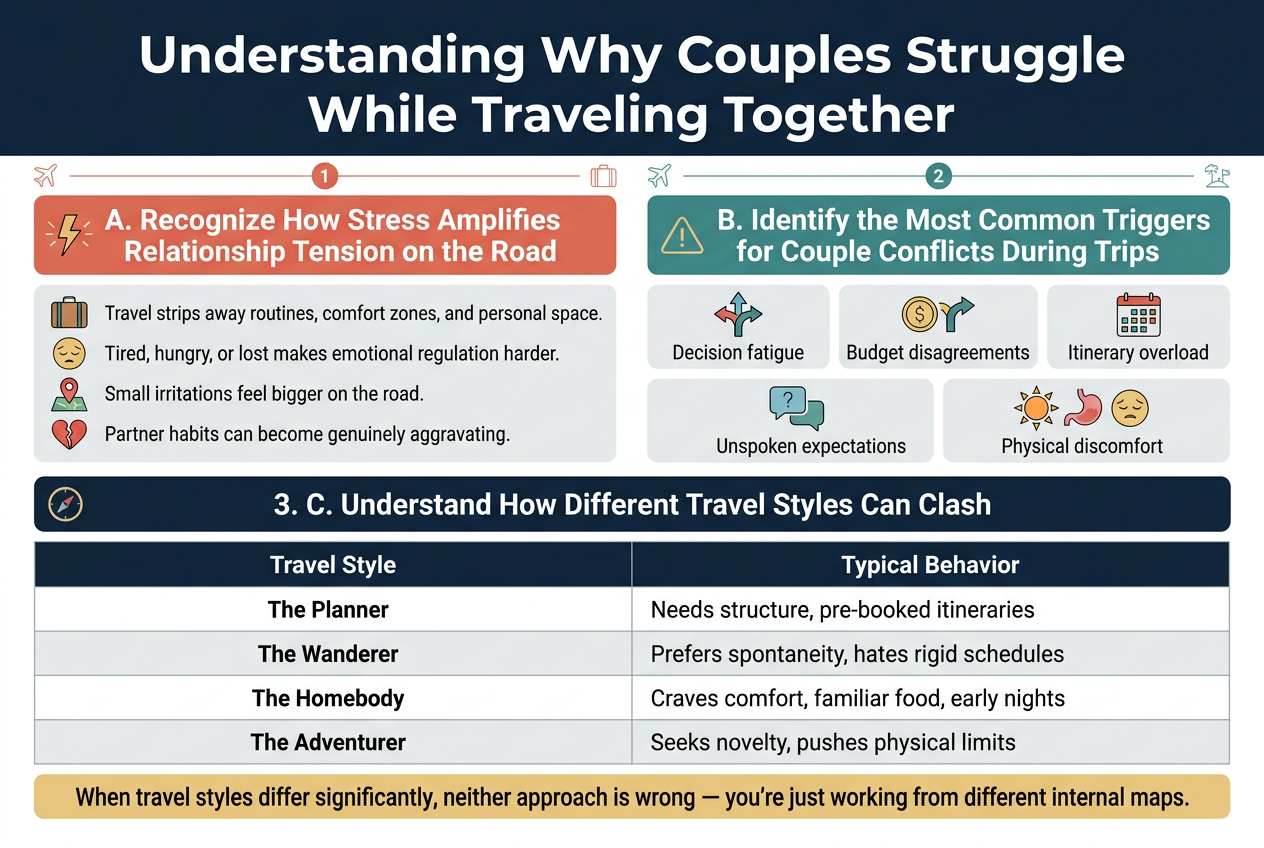
A. Recognize How Stress Amplifies Relationship Tension on the Road

Travel strips away your routines, comfort zones, and personal space — all at once. When you’re tired, hungry, or lost in an unfamiliar city, your emotional regulation suffers. Small irritations you’d normally brush off at home suddenly feel enormous. Your partner’s habits you barely notice day to day can become genuinely aggravating when you’re sleep-deprived and running on airport coffee.

B. Identify the Most Common Triggers for Couple Conflicts During Trips

Knowing your triggers ahead of time gives you a real advantage. Watch out for these common flashpoints:

  • Decision fatigue — too many choices about where to eat, sleep, or go next
  • Budget disagreements — one of you wants to splurge, the other wants to save
  • Itinerary overload — packing too much into a single day
  • Unspoken expectations — assuming your partner wants the same experience you do
  • Physical discomfort — hunger, exhaustion, and heat make everything worse

C. Understand How Different Travel Styles Can Clash

Your travel personality shapes everything about how you experience a trip.

Travel StyleTypical Behavior
The PlannerNeeds structure, pre-booked itineraries
The WandererPrefers spontaneity, hates rigid schedules
The HomebodyCraves comfort, familiar food, early nights
The AdventurerSeeks novelty, pushes physical limits

When your styles differ significantly, neither approach is wrong — you’re just working from different internal maps.

Planning Smarter to Prevent Friction Before You Leave Home
Create a full-bleed 3:2 horizontal infographic illustration in a clean modern editorial style, with a soft off-white background, dark navy text, teal and coral accents, and subtle line icons. Use a bold sans-serif headline at the top spanning full width.

Top header:
"Planning Smarter to Prevent Friction Before You Leave Home"

Below the title, arrange four wide horizontal content blocks in a 2x2 grid across the page, each with a colored numbered circle, a simple icon, a bold subheading, and short bullet text.

Block 1, top left, with a compass and conversation icon, teal accent:
"1. Align on Travel Goals and Expectations Early"
- "Ask: What do we each want from this trip?"
- "List your top three priorities individually, then compare"
- "Find overlap and build from there"
- "Be honest about deal-breakers: early mornings, crowds, budget restaurants"

Block 2, top right, with split-task checklist icon, coral accent:
"2. Divide Planning Responsibilities to Avoid Resentment"
- "Split the workload based on who enjoys what"
- "Partner A: Flights & accommodation; Transportation logistics"
- "Partner B: Restaurants & activities; Packing checklist"

Block 3, bottom left, with calendar and buffer space icon, blue accent:
"3. Build Flexibility Into Your Itinerary to Reduce Pressure"
- "Leave buffer time between activities"
- "Aim for one or two anchors per day—not ten"
- "Keep one afternoon per destination completely unplanned"
- "Unexpected detours can become the best memories"

Block 4, bottom right, with piggy bank and currency icon, golden yellow accent:
"4. Set a Shared Budget to Eliminate Financial Surprises"
- "Agree on a daily spending range before you go"
- "Decide together what to splurge on and where to save"
- "Money disagreements mid-trip drain energy"
- "Early alignment keeps you relaxed and present"

Add a slim footer band across the bottom with small icons of a suitcase, heart, clock, and wallet, plus the centered text:
"Plan together. Travel lighter. Stress less."

Use clear visual hierarchy, generous spacing, simple dividers between sections, strong legible typography, and balanced wide composition with no vertical poster frame.

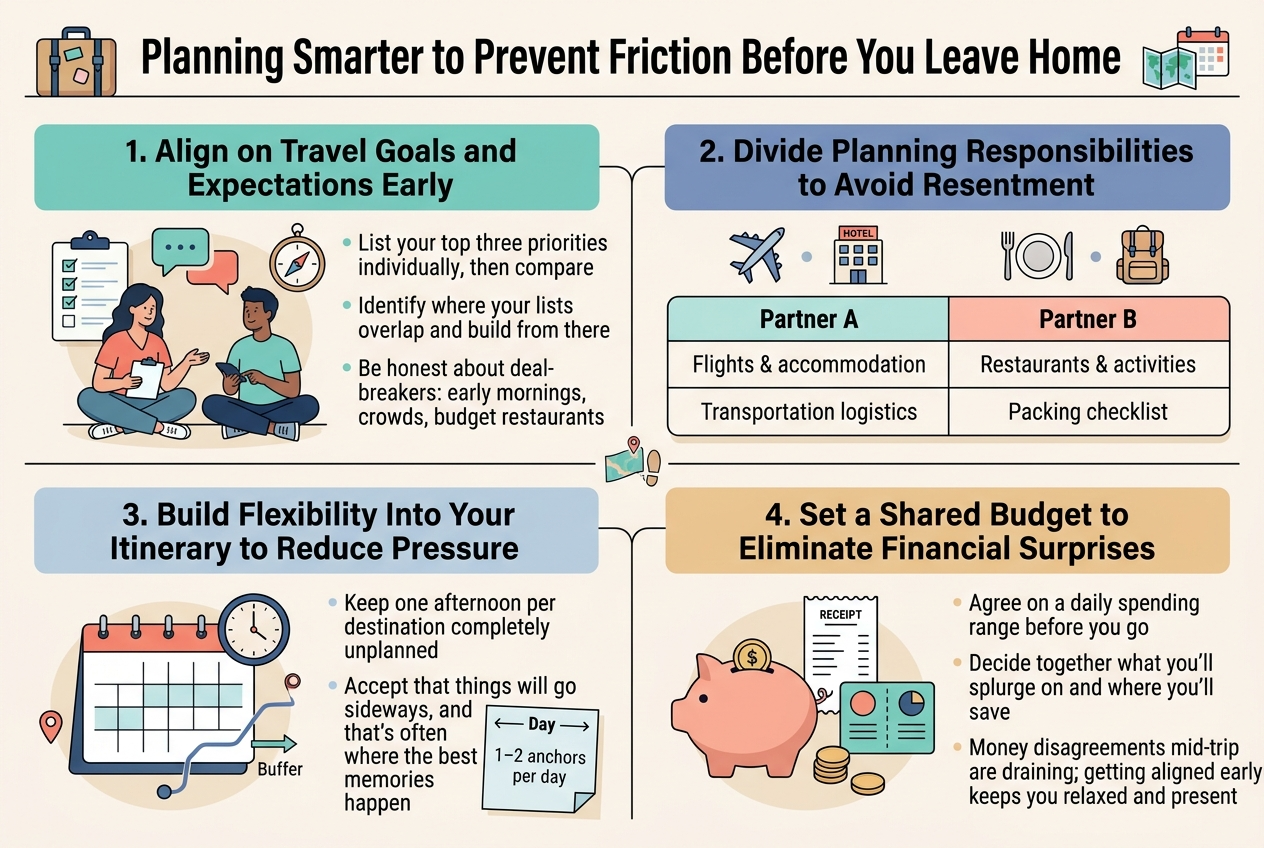
Align on Travel Goals and Expectations Early

Before booking anything, sit down together and ask the big question: What do we each want from this trip? One of you might crave adventure; the other might need rest. Neither is wrong—but ignoring the gap creates tension later.

  • List your top three priorities for the trip individually, then compare
  • Identify where your lists overlap and build from there
  • Be honest about deal-breakers (early mornings, crowds, budget restaurants)

Divide Planning Responsibilities to Avoid Resentment

When one person handles everything, burnout and blame follow. Split the workload based on what you genuinely enjoy.

Partner APartner B
Flights & accommodationRestaurants & activities
Transportation logisticsPacking checklist

Build Flexibility Into Your Itinerary to Reduce Pressure

Over-scheduling kills the joy fast. Leave buffer time between activities so unexpected detours feel like bonuses, not disasters. Aim for one or two anchors per day—not ten.

  • Keep one afternoon per destination completely unplanned
  • Accept that things will go sideways, and that’s often where the best memories happen

Set a Shared Budget to Eliminate Financial Surprises

Agree on a daily spending range before you go. Decide together what you’ll splurge on and where you’ll save. Money disagreements mid-trip are draining—getting aligned early keeps you both relaxed and present.

Practicing Mindfulness Together to Stay Grounded While Traveling
Create a clean, professional full-bleed infographic illustration in a 3:2 landscape aspect ratio with a modern travel-and-wellness aesthetic. Use a wide horizontal layout with three equal content blocks across the page, separated by subtle dividers, no vertical poster frame, no inset margins. Background in soft warm off-white with muted teal, dusty blue, and gentle coral accents. Use a clear bold sans-serif heading at the top left and smaller readable sans-serif body text. Include small line icons and simple illustrated symbols for each section.

Top heading, large bold text:
"Practicing Mindfulness Together to Stay Grounded While Traveling"

Below the heading, arrange three numbered sections in a row from left to right:

Section 1 on the left:
Number badge "1"
Blue-green circular icon of two people sitting together with coffee cups and a small sunrise
Title text:
"Start Each Day With a Simple Shared Mindfulness Ritual"
Body text:
"A quiet morning ritual anchors you both before the day gets chaotic. It doesn't need to be elaborate — even five minutes of sitting together with coffee, naming one thing you're each looking forward to, shifts your energy from rushed to intentional."

Section 2 in the center:
Number badge "2"
Coral circular icon of synchronized breathing waves with a calm face and four small count marks
Title text:
"Use Breathing Techniques to Defuse Tension in the Moment"
Body text:
"When frustration starts building — a missed train, a wrong turn, a long queue — your nervous system reacts before your brain catches up. Try box breathing together: inhale for four counts, hold for four, exhale for four, hold for four."

Section 3 on the right:
Number badge "3"
Teal circular icon of a map pin, open hands, and a small street market stall
Title text:
"Stay Present Instead of Chasing a Perfect Travel Experience"
Body text:
"Your trip will rarely match the highlight reel in your head, and that's actually okay. When you stop trying to manufacture a perfect experience, you start noticing the real ones — a spontaneous street market, a conversation with a local, a laugh over something going wrong."

Add a small bottom banner across the width with emphasized closing line in bold:
"Unscripted moments are what you'll actually remember together."

Use a clean grid, strong hierarchy, ample whitespace, and elegant iconography. Keep all text crisp, legible, and exactly as written.

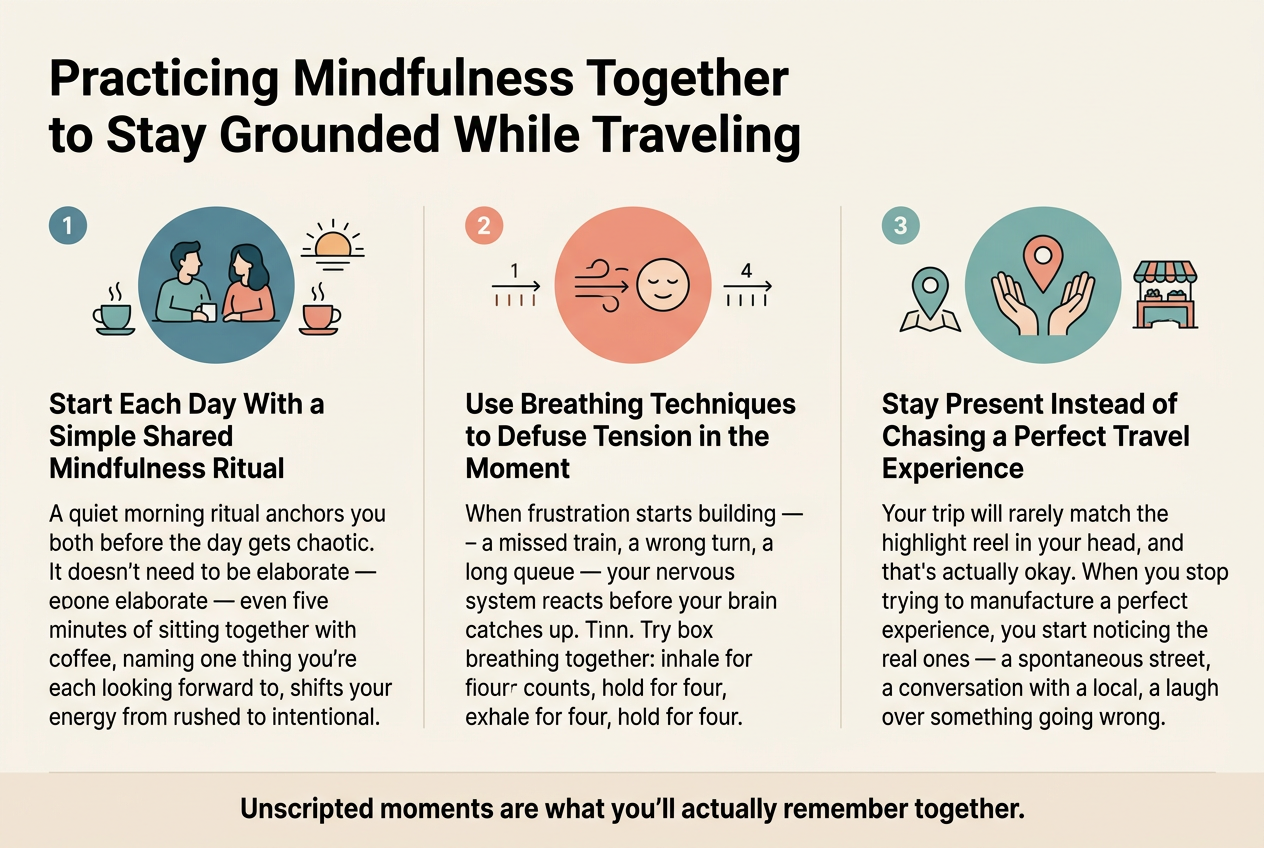
Start Each Day With a Simple Shared Mindfulness Ritual

A quiet morning ritual anchors you both before the day gets chaotic. It doesn’t need to be elaborate — even five minutes of sitting together with coffee, naming one thing you’re each looking forward to, shifts your energy from rushed to intentional. You’re syncing up emotionally before the noise of the day pulls you in different directions.

Use Breathing Techniques to Defuse Tension in the Moment

When frustration starts building — a missed train, a wrong turn, a long queue — your nervous system reacts before your brain catches up. Try box breathing together: inhale for four counts, hold for four, exhale for four, hold for four. Doing this side by side signals to each other that you’re choosing calm over conflict. It’s a small reset that prevents small irritations from snowballing.

Stay Present Instead of Chasing a Perfect Travel Experience

Your trip will rarely match the highlight reel in your head, and that’s actually okay. When you stop trying to manufacture a perfect experience, you start noticing the real ones — a spontaneous street market, a conversation with a local, a laugh over something going wrong. Those unscripted moments are what you’ll actually remember together.

Communicating Effectively When Disagreements Arise
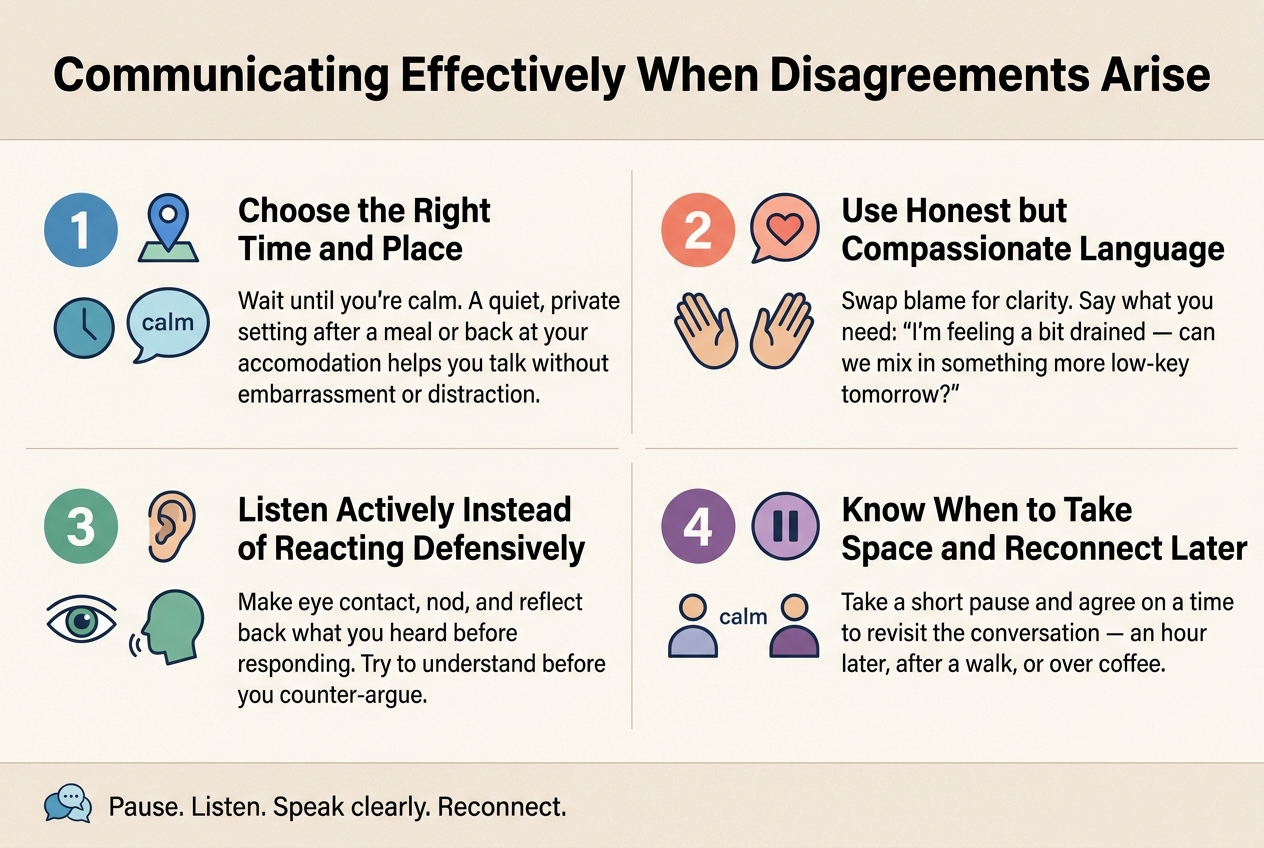
Full-bleed professional infographic in 3:2 aspect ratio, clean modern flat design, soft warm neutrals with teal, navy, and coral accents, subtle textured background, bold sans-serif typography, clear visual hierarchy. Top header bar with large bold title centered: "Communicating Effectively When Disagreements Arise". Below the title, arrange four wide horizontal sections in a 2x2 grid across the page, each with a numbered circle icon and a simple illustrative symbol.

Section 1 on upper left: blue number circle "1" with a small location pin and calm speech bubble icon. Heading: "Choose the Right Time and Place". Body text: "Wait until you're calm. A quiet, private setting after a meal or back at your accommodation helps you talk without embarrassment or distraction."

Section 2 on upper right: coral number circle "2" with a heart speech bubble and open hands icon. Heading: "Use Honest but Compassionate Language". Body text: "Swap blame for clarity. Say what you need: 'I'm feeling a bit drained — can we mix in something more low-key tomorrow?'"

Section 3 on lower left: green number circle "3" with an ear, eye contact lines, and nodding head icon. Heading: "Listen Actively Instead of Reacting Defensively". Body text: "Make eye contact, nod, and reflect back what you heard before responding. Try to understand before you counter-argue."

Section 4 on lower right: purple number circle "4" with a pause symbol and two people separated by a small calm space icon. Heading: "Know When to Take Space and Reconnect Later". Body text: "Take a short pause and agree on a time to revisit the conversation — an hour later, after a walk, or over coffee."

Add a thin footer strip with a small calm conversation icon and the short line: "Pause. Listen. Speak clearly. Reconnect." Use spacious alignment, crisp margins, balanced whitespace, and consistent icon style across all sections.

Choose the Right Time and Place to Address Frustrations

Bringing up a simmering frustration while you’re lost, hungry, or exhausted almost never ends well. Wait until you’re both calm — maybe after a meal or back at your accommodation. A quiet, private setting lets you talk without embarrassment or distraction.

Use Honest but Compassionate Language to Express Your Needs

Swap blame for clarity. Instead of “You always drag me to museums I hate,” try “I’m feeling a bit drained — can we mix in something more low-key tomorrow?” Your partner can’t fix what they don’t understand, so say what you actually need.

Listen Actively Instead of Reacting Defensively

When your partner speaks, resist the urge to prepare your counter-argument. Make eye contact, nod, and reflect back what you heard before responding. You don’t have to agree — you just have to genuinely try to understand.

Know When to Take Space and Reconnect Later

Sometimes the smartest move is a short pause. Agree on a time to revisit the conversation — an hour later, after a walk, or over coffee. Stepping away isn’t giving up; it’s giving yourselves room to cool down and come back with clearer heads.

Protecting Individual Needs Without Drifting Apart
Schedule Solo Time to Recharge Without Guilt

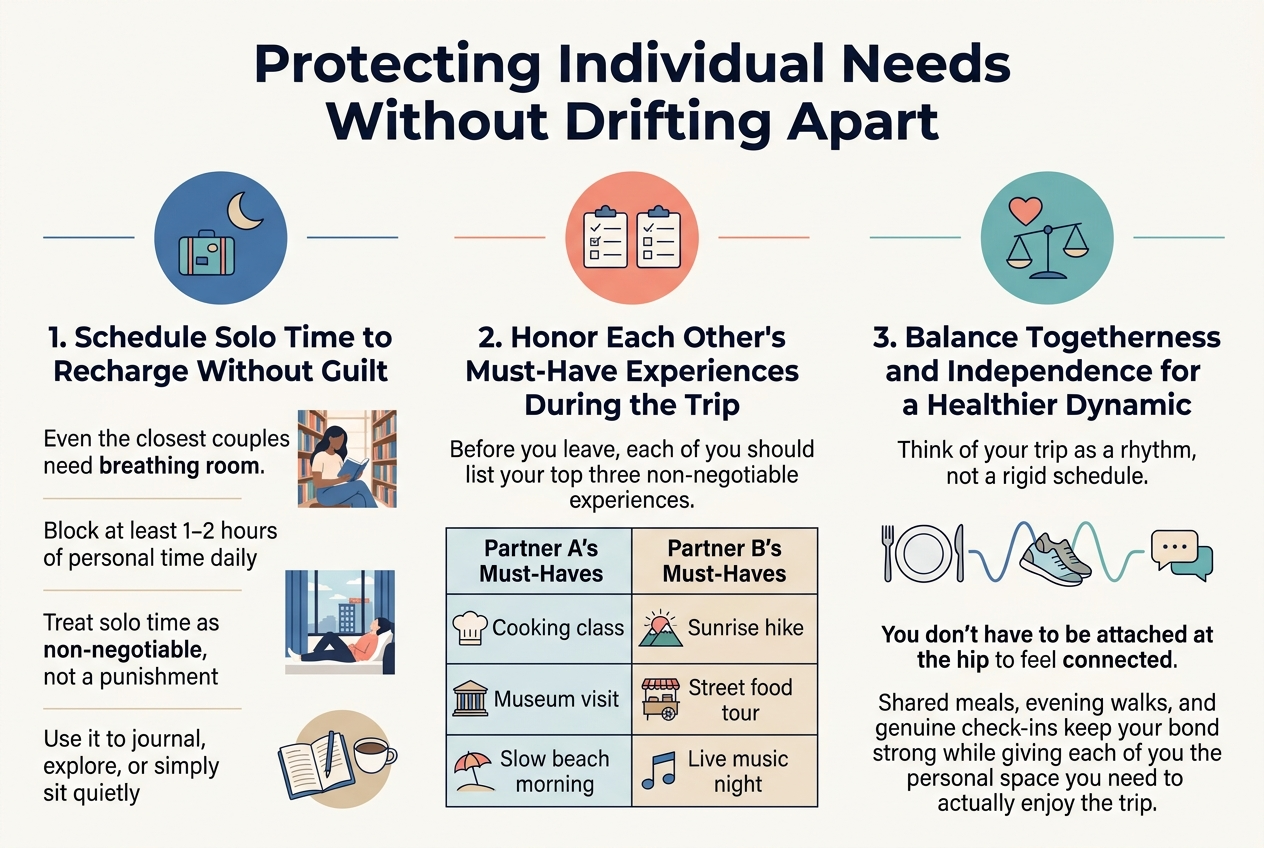
Even the closest couples need breathing room. Build dedicated solo hours into your itinerary — no explanations required. One of you might wander a bookstore while the other naps at the hotel. That separation isn’t distance; it’s what keeps you genuinely happy to reunite.

  • Block at least 1–2 hours of personal time daily
  • Treat solo time as non-negotiable, not a punishment
  • Use it to journal, explore, or simply sit quietly

Honor Each Other’s Must-Have Experiences During the Trip

Before you leave, each of you should list your top three non-negotiable experiences. Then protect them fiercely — even if your partner isn’t excited about all of them.

Partner A’s Must-HavesPartner B’s Must-Haves
Cooking classSunrise hike
Museum visitStreet food tour
Slow beach morningLive music night

Show up for each other’s moments wholeheartedly. Your enthusiasm makes the experience richer for both of you.

Balance Togetherness and Independence for a Healthier Dynamic

Think of your trip as a rhythm, not a rigid schedule. You don’t have to be attached at the hip to feel connected. Shared meals, evening walks, and genuine check-ins keep your bond strong while giving each of you the personal space you need to actually enjoy the trip.

Turning Challenges Into Relationship-Strengthening Moments
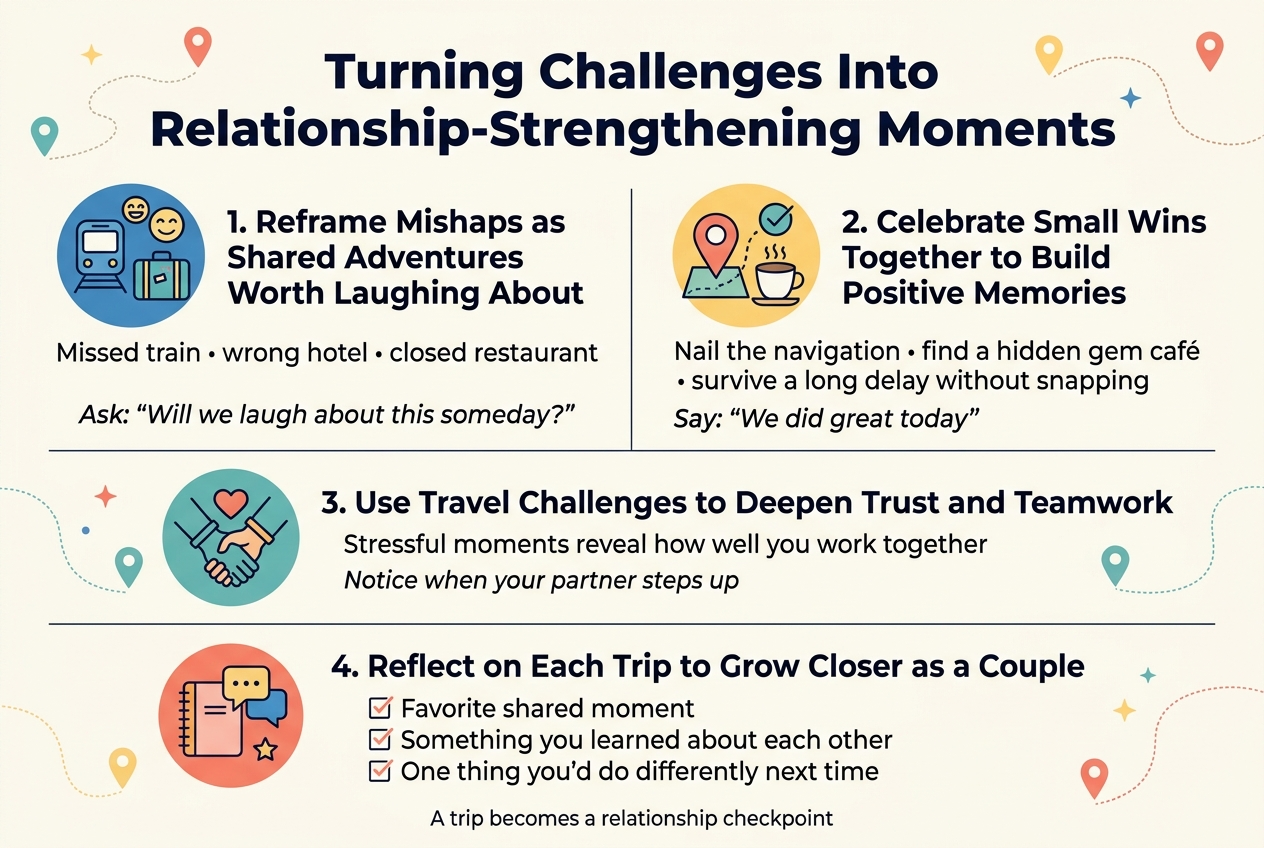
Create a clean professional infographic in a 3:2 aspect ratio, full-bleed layout with no border or poster frame. Use a warm modern travel palette: navy, teal, coral, soft yellow, and white, with subtle map-pin and route-line accents. Use a bold sans-serif font for headings and a readable sans-serif for body text.

Top center: large bold title text exactly: "Turning Challenges Into Relationship-Strengthening Moments"

Below the title, organize the infographic into four wide horizontal sections or two-column blocks across the canvas, with clear spacing and numbered headings.

Section 1 on the upper left: a blue circular icon with a train, suitcase, and smiling faces. Heading text exactly: "1. Reframe Mishaps as Shared Adventures Worth Laughing About" Body text: "Missed train • wrong hotel • closed restaurant" and smaller text: "Ask: "Will we laugh about this someday?""

Section 2 on the upper right: a yellow circular icon with a map pin, coffee cup, and checkmark. Heading text exactly: "2. Celebrate Small Wins Together to Build Positive Memories" Body text: "Nail the navigation • find a hidden gem café • survive a long delay without snapping" and smaller text: "Say: "We did great today""

Center band across the full width: a teal circular icon with two linked hands and a heart. Heading text exactly: "3. Use Travel Challenges to Deepen Trust and Teamwork" Body text: "Stressful moments reveal how well you work together" and smaller text: "Notice when your partner steps up"

Bottom section across the full width: a coral circular icon with a notebook, speech bubbles, and a small star. Heading text exactly: "4. Reflect on Each Trip to Grow Closer as a Couple" Body text as a short checklist with bullet points: "Favorite shared moment" "Something you learned about each other" "One thing you'd do differently next time" Small footer text exactly: "A trip becomes a relationship checkpoint"

Use clean icons, thin divider lines, and simple visual accents like dotted routes, tiny stars, and map pins. Keep the layout airy, balanced, and easy to read, with strong hierarchy and no extra text.

Reframe Mishaps as Shared Adventures Worth Laughing About

The missed train, the wrong hotel, the restaurant that was “definitely closed” — these moments feel awful in real time but become your best stories later. When something goes sideways, ask yourself: will we laugh about this someday? If yes, start laughing now. Shifting your perspective together turns frustration into connection.

Celebrate Small Wins Together to Build Positive Memories

Your brain naturally holds onto the hard moments, so you have to deliberately anchor the good ones. When you nail the navigation, find a hidden-gem café, or survive a long delay without snapping at each other, acknowledge it. A simple “we did great today” builds a mental highlight reel that lasts long after the trip ends.

Use Travel Challenges to Deepen Trust and Teamwork

Stressful situations reveal how well you work together. When your partner steps up during a tough moment, tell them you noticed. Let challenges show you what your team can do.

Reflect on Each Trip to Grow Closer as a Couple

Before you unpack, take ten minutes to talk about:

  • Your favorite shared moment
  • Something you learned about each other
  • One thing you’d do differently next time

This habit turns every trip into a relationship checkpoint — not just a vacation.
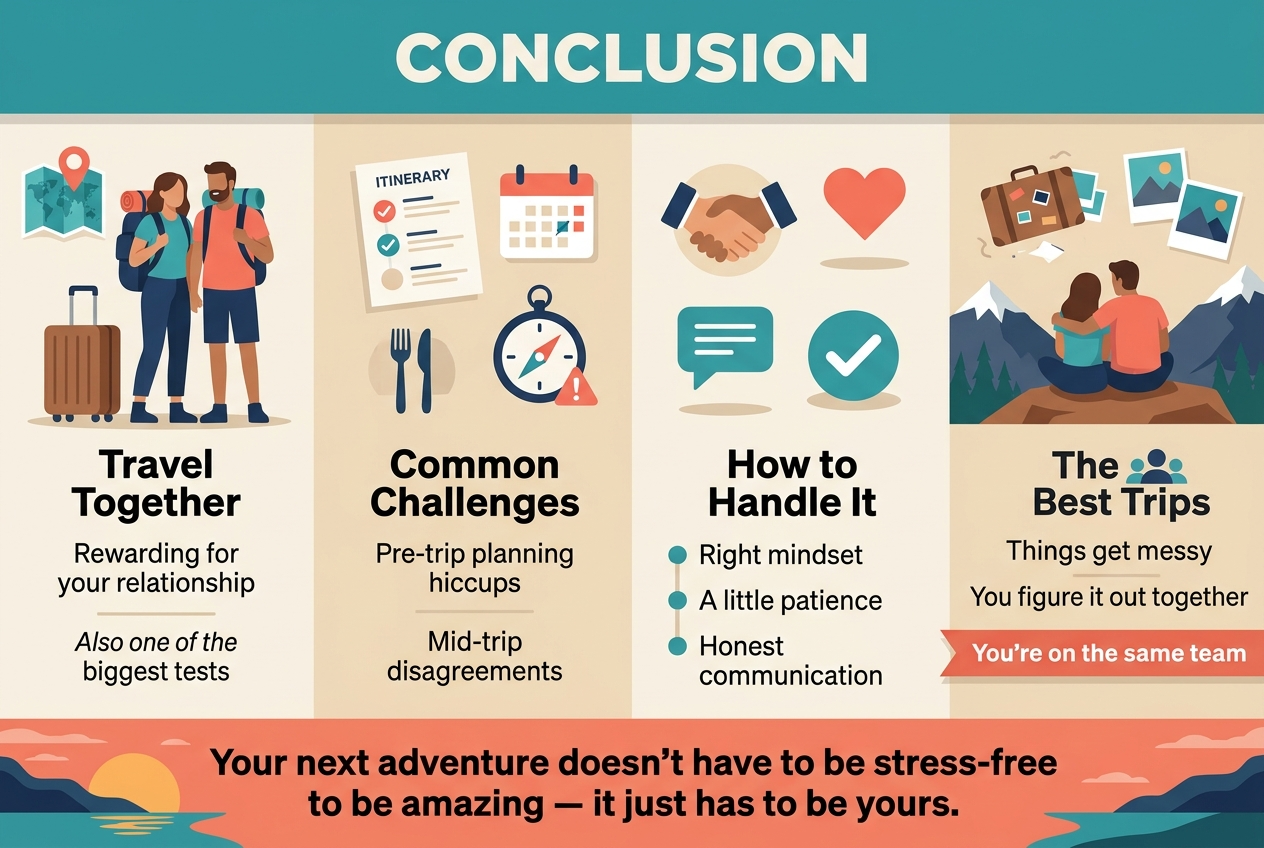
3:2 aspect ratio, full-bleed infographic illustration, clean professional modern style, warm travel color palette of teal, coral, navy, sand, and white, bold sans-serif typography, clear visual hierarchy, no borders, no inset frame, wide horizontal layout with multiple sections.

Top full-width header bar with large bold title text: "CONCLUSION"

Below the header, a wide 4-panel horizontal infographic with simple flat vector icons and short text blocks:

Left panel:
A couple with backpacks standing beside a suitcase and a map icon.
Bold subtitle text: "Travel Together"
Body text: "Rewarding for your relationship"
Smaller line beneath: "Also one of the biggest tests"

Second panel:
A small itinerary page, calendar, fork-and-knife icon, and compass icon with a tiny warning symbol.
Bold subtitle text: "Common Challenges"
Body text in two lines: "Pre-trip planning hiccups" and "Mid-trip disagreements"

Third panel:
A handshake icon, heart icon, speech bubble icon, and a calm checkmark symbol.
Bold subtitle text: "How to Handle It"
Three short bullet points with small circular markers:
"Right mindset"
"A little patience"
"Honest communication"

Right panel:
A couple sitting together on a mountain overlook with messy suitcase and travel photo snapshots floating nearby, plus a team icon.
Bold subtitle text: "The Best Trips"
Body text in two lines: "Things get messy" and "You figure it out together"
Final bold closing line in a highlighted ribbon at the bottom of this panel: "You're on the same team"

Along the bottom of the full infographic, a wide closing banner with a sunset travel background motif and a final centered quote in large bold text:
"Your next adventure doesn't have to be stress-free to be amazing — it just has to be yours."

Use strong iconography, balanced spacing, wide section dividers, subtle shadows, crisp vector shapes, and readable text throughout.

Traveling together as a couple is one of the most rewarding things you can do for your relationship, but it’s also one of the biggest tests you’ll face. From pre-trip planning hiccups to mid-trip disagreements about where to eat or what to do next, the challenges are real. The good news is that most of them are totally manageable with the right mindset, a little patience, and honest communication.

The trips that bring couples closest together aren’t usually the ones where everything went perfectly. They’re the ones where things got messy, you figured it out together, and you came home with stories worth telling. So lean into the hard moments, give each other grace, and remember that you’re on the same team. Your next adventure doesn’t have to be stress-free to be amazing — it just has to be yours.

✨ Subscribe to The Zen Journal for mindful travel tips, yoga flows, and wellness inspiration delivered weekly ✨