
Wherever You Go, There You Are by Jon Kabat-Zinn – The Original Guide to Everyday Mindfulness
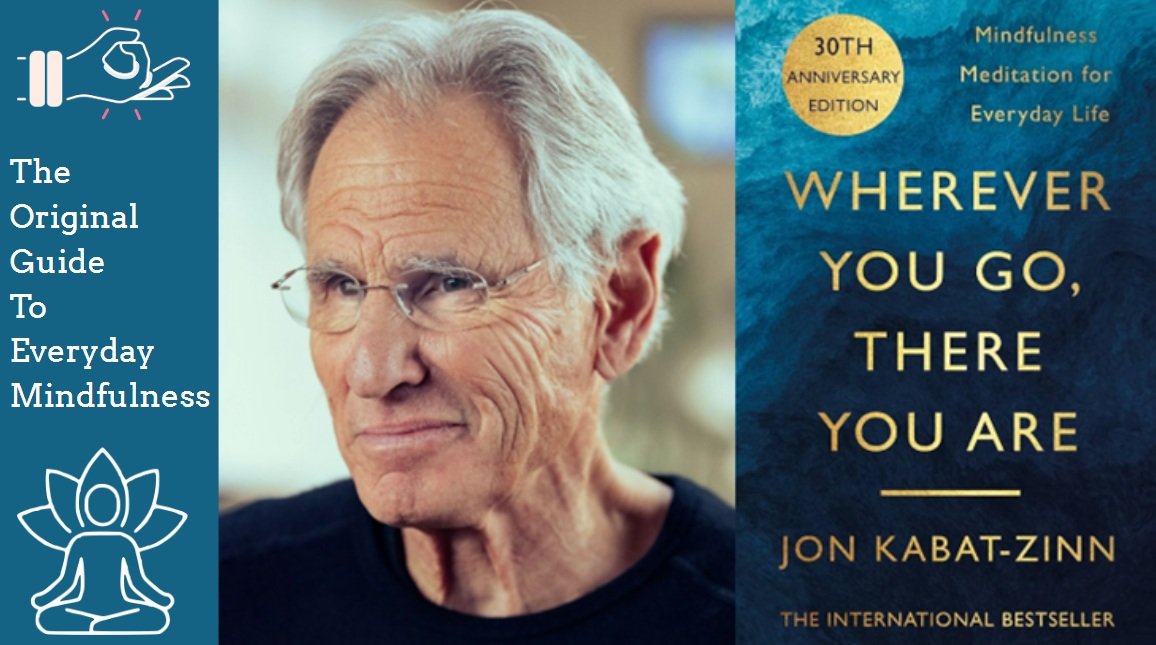
I picked up Wherever You Go, There You Are during a stretch of my life when my mind felt like a browser with 47 tabs open. I wasn’t looking for a self-help fix — I just wanted to feel less scattered. What I found was a book that quietly changed how I pay attention to, well, everything.
If you keep hearing the word “mindfulness” but find most explanations either too vague or too spiritual to use, this guide is for you. Jon Kabat-Zinn writes for real people living real, messy lives — not monks on mountaintops.
In this post, I’ll walk you through what the book is actually about (beyond the buzzwords), break down the key mindfulness concepts Kabat-Zinn teaches, and share the practical techniques you can start using today. I’ll also cover who gets the most out of reading it and how to approach it so it doesn’t just sit on your shelf looking impressive.
Whether you’re brand new to mindfulness or you’ve tried meditation before and quietly given up, I think you’ll find something genuinely useful here.
Who Is Jon Kabat-Zinn and Why His Work Still Matters
His Background in Science and Meditation
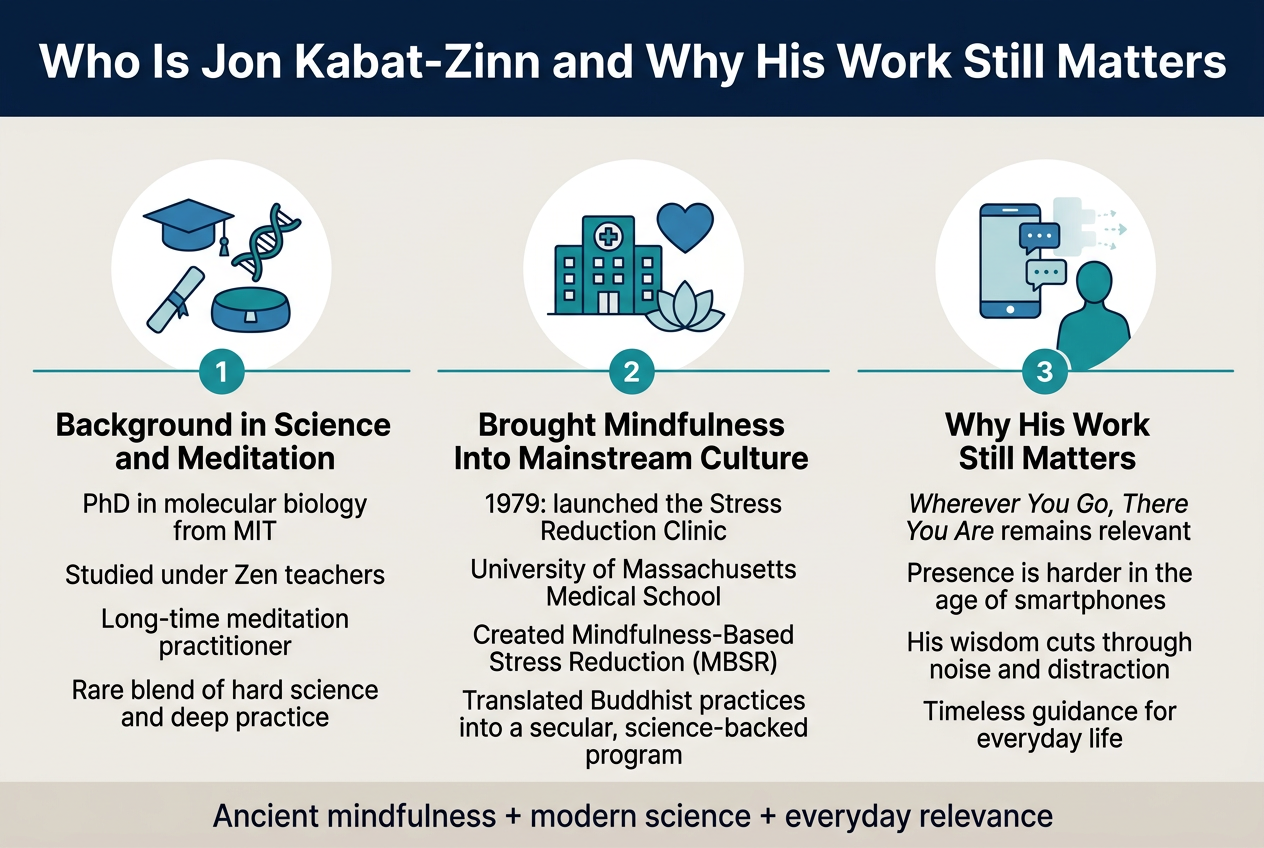
Jon Kabat-Zinn holds a PhD in molecular biology from MIT, and I find that combination of hard science and deep meditation practice genuinely rare. He studied under Zen teachers and practiced for years before bringing mindfulness into a clinical setting. That dual grounding gives his work a credibility I haven’t found anywhere else.
How He Brought Mindfulness Into Mainstream Western Culture
In 1979, Kabat-Zinn launched the Stress Reduction Clinic at the University of Massachusetts Medical School, creating what became known as Mindfulness-Based Stress Reduction (MBSR). What impresses me most is how he translated ancient Buddhist practices into a secular, science-backed program that hospitals and everyday people could use—no robes or Sanskrit required.
Why This Book Remains Relevant Decades After Publication
Reading Wherever You Go, There You Are today, I’m struck by how nothing feels dated. The core problem Kabat-Zinn addresses — our inability to simply be present — has only gotten worse in the age of smartphones and constant notifications. His insights cut through the noise in a way that newer self-help books rarely manage. The wisdom here doesn’t expire.
What the Book Is Really About
The Core Message Behind the Title
The title says it all, really. No matter where you run, travel, or escape to, you bring yourself along. Kabat-Zinn’s central point is simple: your mind travels with you everywhere, so learning to work with it — right here, right now — is the only practice that matters.
How It Differs From Other Mindfulness Books
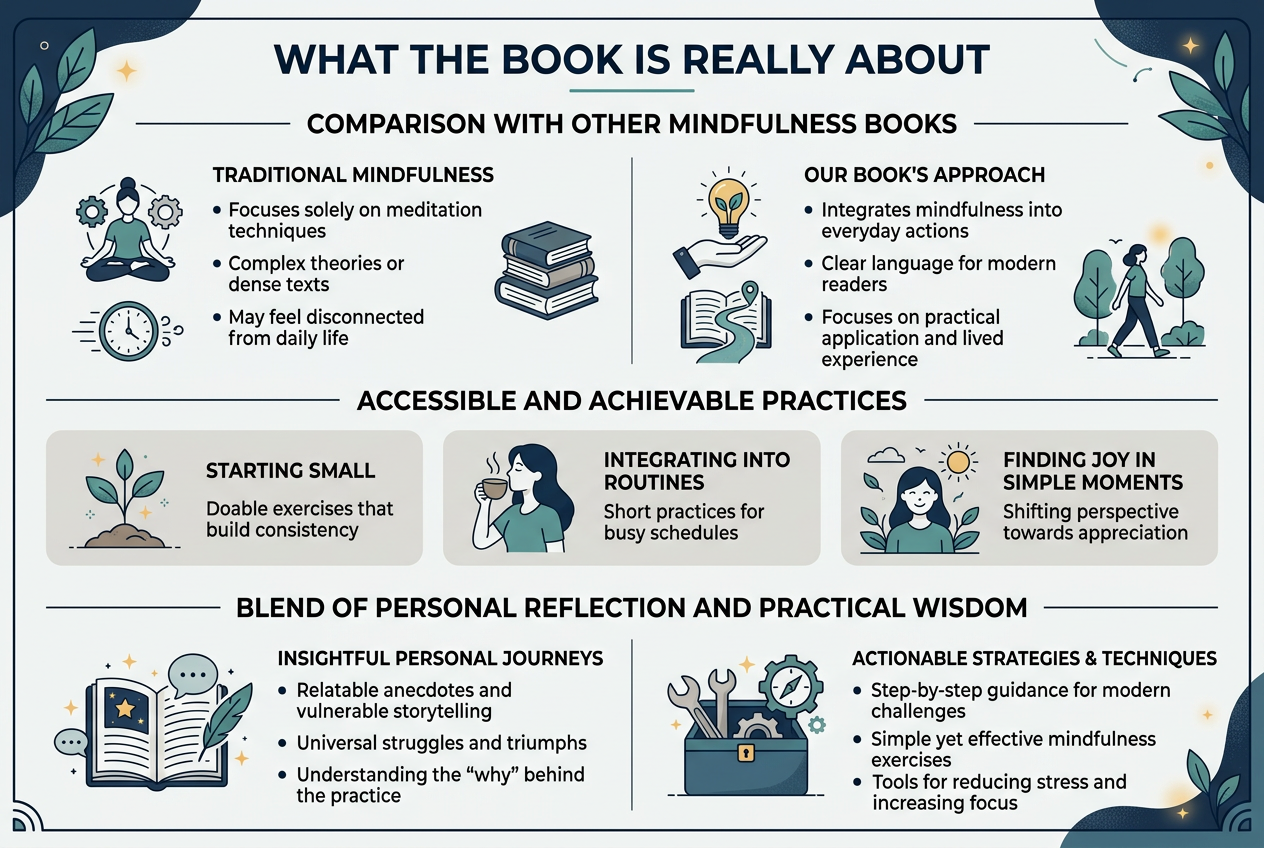
Most mindfulness books hand you a checklist. This one hands you a mirror. Where others focus on techniques as endpoints, Kabat-Zinn treats them as doorways into deeper self-awareness.
| Other Mindfulness Books | Wherever You Go |
|---|---|
| Technique-heavy | Insight-driven |
| Quick-fix framing | Lifelong practice |
| Abstract concepts | Grounded in real life |
Its Accessible Approach for Everyday Readers
I genuinely appreciate how Kabat-Zinn writes like he’s sitting across from you. No jargon, no intimidating Buddhist terminology. Short chapters mean I can pick it up between meetings or before bed without losing the thread.
The Blend of Personal Reflection and Practical Wisdom
What I find rare here is the balance. Kabat-Zinn shares his own uncertainties and observations without preaching. Each page feels like an honest conversation — part philosophy, part lived experience — making the wisdom feel earned rather than borrowed.
Key Mindfulness Concepts You Will Learn From This Book
Understanding the Present Moment and Why It Matters
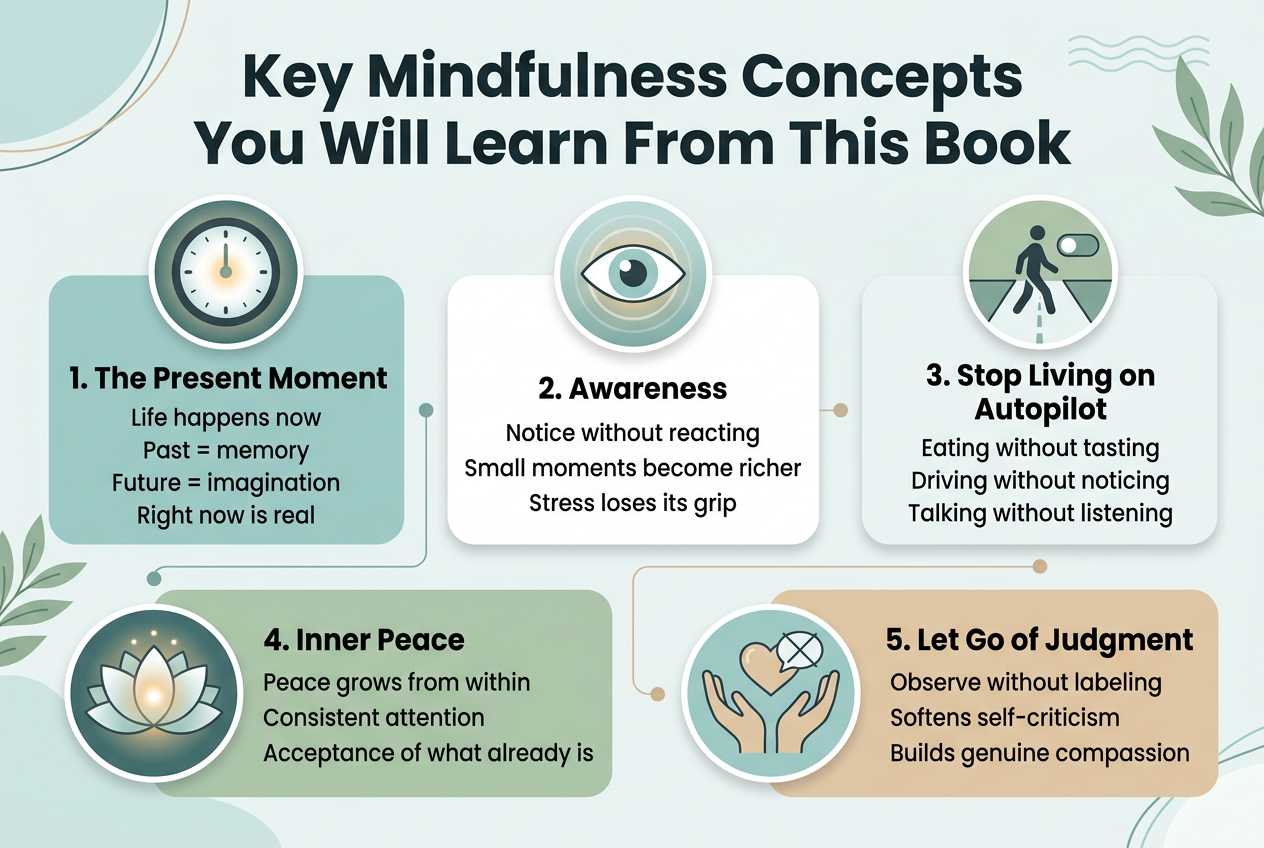
Kabat-Zinn makes something crystal clear: the present moment is the only place life actually happens. I’ve found this simple idea quietly life-changing. The past is memory; the future is imagination. Right now is real.
The Role of Awareness in Transforming Daily Life
Through this book, I learned that awareness isn’t passive — it’s a skill. When I notice what’s happening inside and around me without immediately reacting, something shifts. Small moments become richer. Stress loses some of its grip.
How to Stop Living on Autopilot
Most of my day used to run on autopilot—eating without tasting, driving without noticing, talking without listening. Kabat-Zinn helped me see that autopilot isn’t neutral; it keeps me disconnected from my own life.
The Connection Between Mindfulness and Inner Peace
Peace isn’t something I find by fixing everything around me. This book taught me it grows from within, through consistent attention and acceptance of what already is.
Letting Go of Judgment Toward Yourself and Others
- I judge my thoughts constantly without realizing it
- Kabat-Zinn invites a gentler stance — observing without labeling
- This practice softens self-criticism and builds genuine compassion
Practical Mindfulness Techniques Taught in the Book
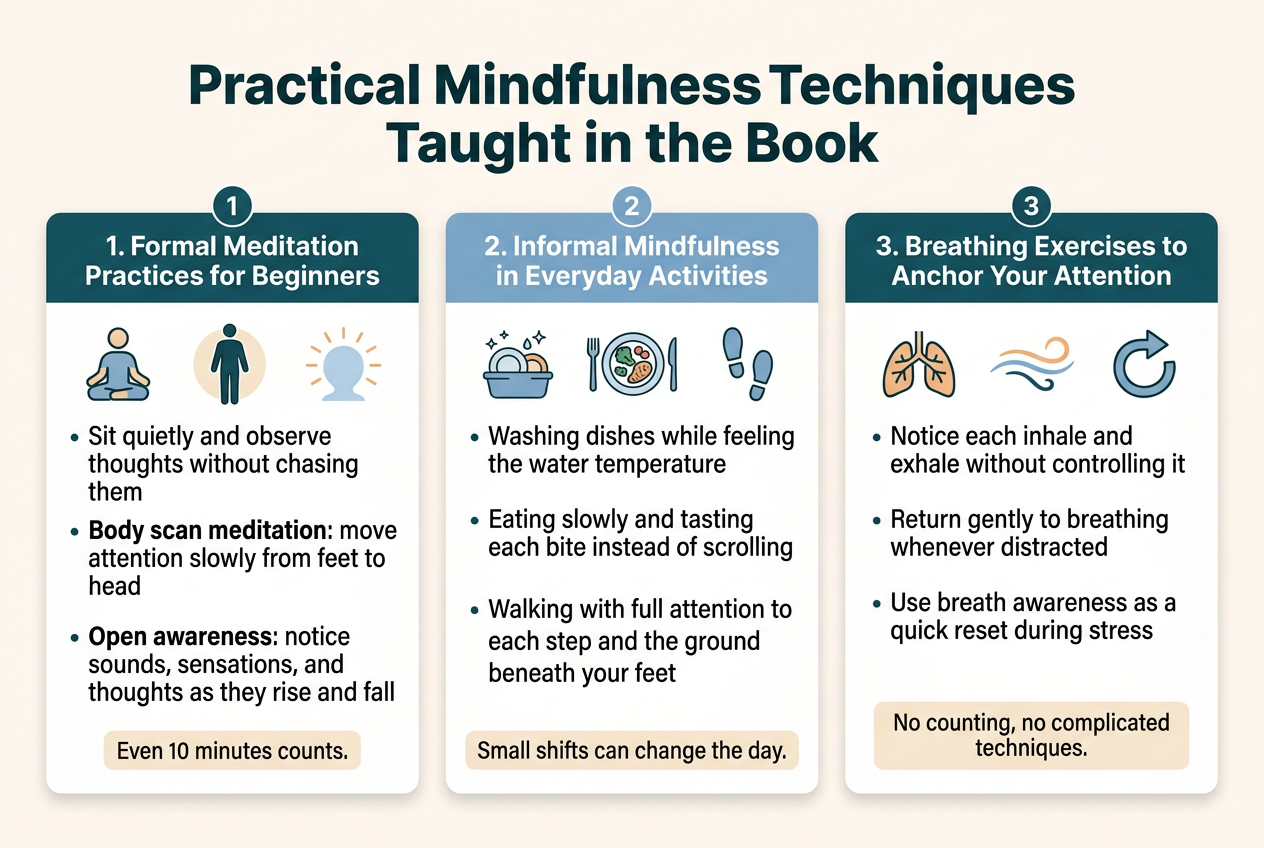
Formal Meditation Practices for Beginners
Kabat-Zinn walks me through seated meditation in a way that feels completely doable. He encourages:
- Sitting quietly and observing thoughts without chasing them
- Body scan meditation, moving attention slowly from feet to head
- Sitting with open awareness, noticing sounds, sensations, and thoughts as they rise and fall
What I love is that he never makes me feel like I need hours of silence or a special cushion. Even ten minutes counts.
Informal Mindfulness in Everyday Activities
This is where the book really clicked for me. Kabat-Zinn shows how ordinary moments become practice:
- Washing dishes while actually feeling the water temperature
- Eating slowly and tasting each bite rather than scrolling my phone
- Walking with full attention to each step and the ground beneath my feet
These small shifts rewired how I move through my day.
Breathing Exercises to Anchor Your Attention
When my mind spirals, my breath anchors me. Kabat-Zinn teaches me to:
- Simply notice each inhale and exhale without controlling it
- Return gently to breathing whenever I get distracted
- Use breath awareness as a quick reset during stressful moments
No counting, no complicated techniques — just breathing, noticed on purpose.
How This Book Can Improve Your Daily Life
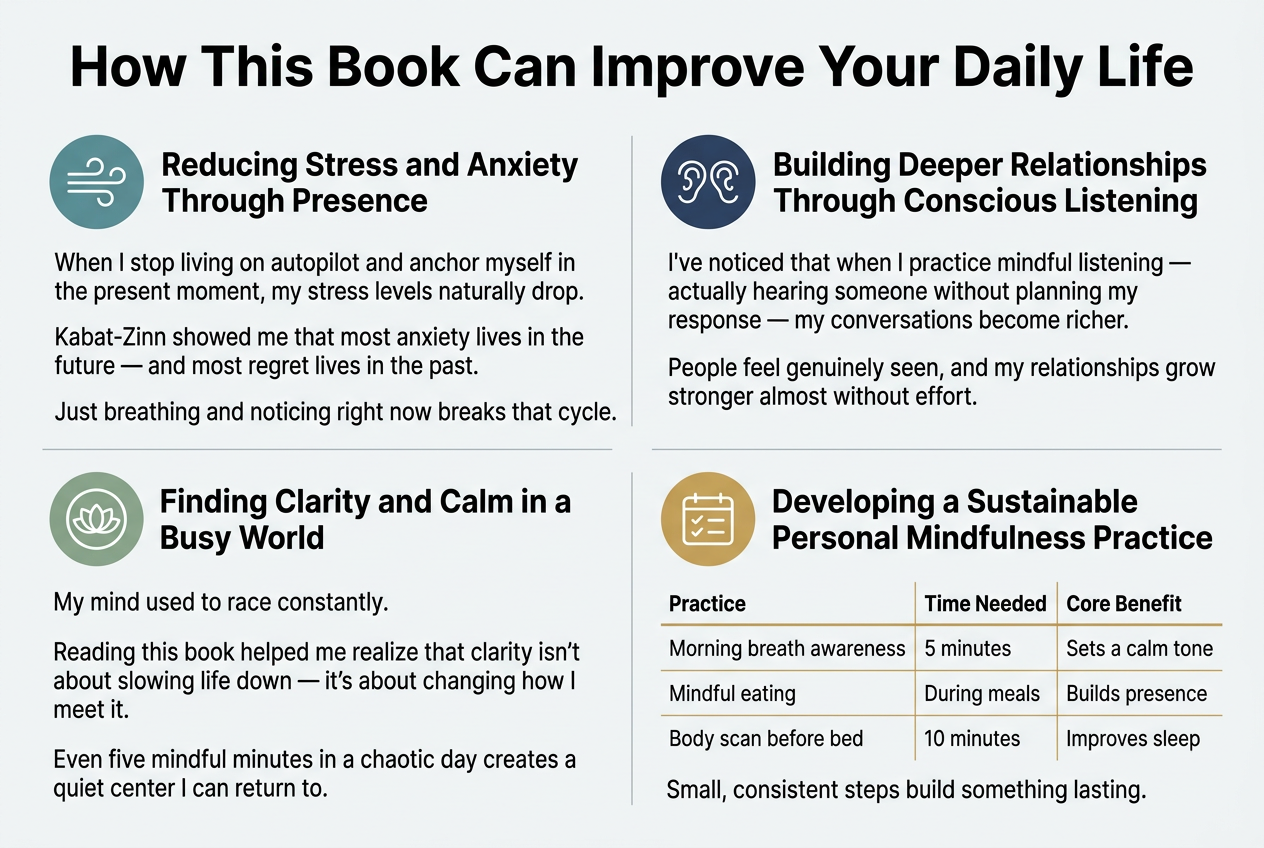
Reducing Stress and Anxiety Through Presence
When I stop living on autopilot and anchor myself in the present moment, my stress levels naturally drop. Kabat-Zinn showed me that most anxiety lives in the future — and most regret lives in the past. Just breathing and noticing right now breaks that cycle.
Building Deeper Relationships Through Conscious Listening
I’ve noticed that when I practice mindful listening — actually hearing someone without planning my response — my conversations become richer. People feel genuinely seen, and my relationships grow stronger almost without effort.
Finding Clarity and Calm in a Busy World
My mind used to race constantly. Reading this book helped me realize that clarity isn’t about slowing life down — it’s about changing how I meet it. Even five mindful minutes in a chaotic day create a quiet center I can return to.
Developing a Sustainable Personal Mindfulness Practice
What I love most is that Kabat-Zinn doesn’t demand perfection. Here’s what a simple daily practice can look like based on his guidance:
| Practice | Time Needed | Core Benefit |
|---|---|---|
| Morning breath awareness | 5 minutes | Sets a calm tone |
| Mindful eating | During meals | Builds presence |
| Body scan before bed | 10 minutes | Improves sleep |
Small, consistent steps build something lasting.
Who Should Read This Book
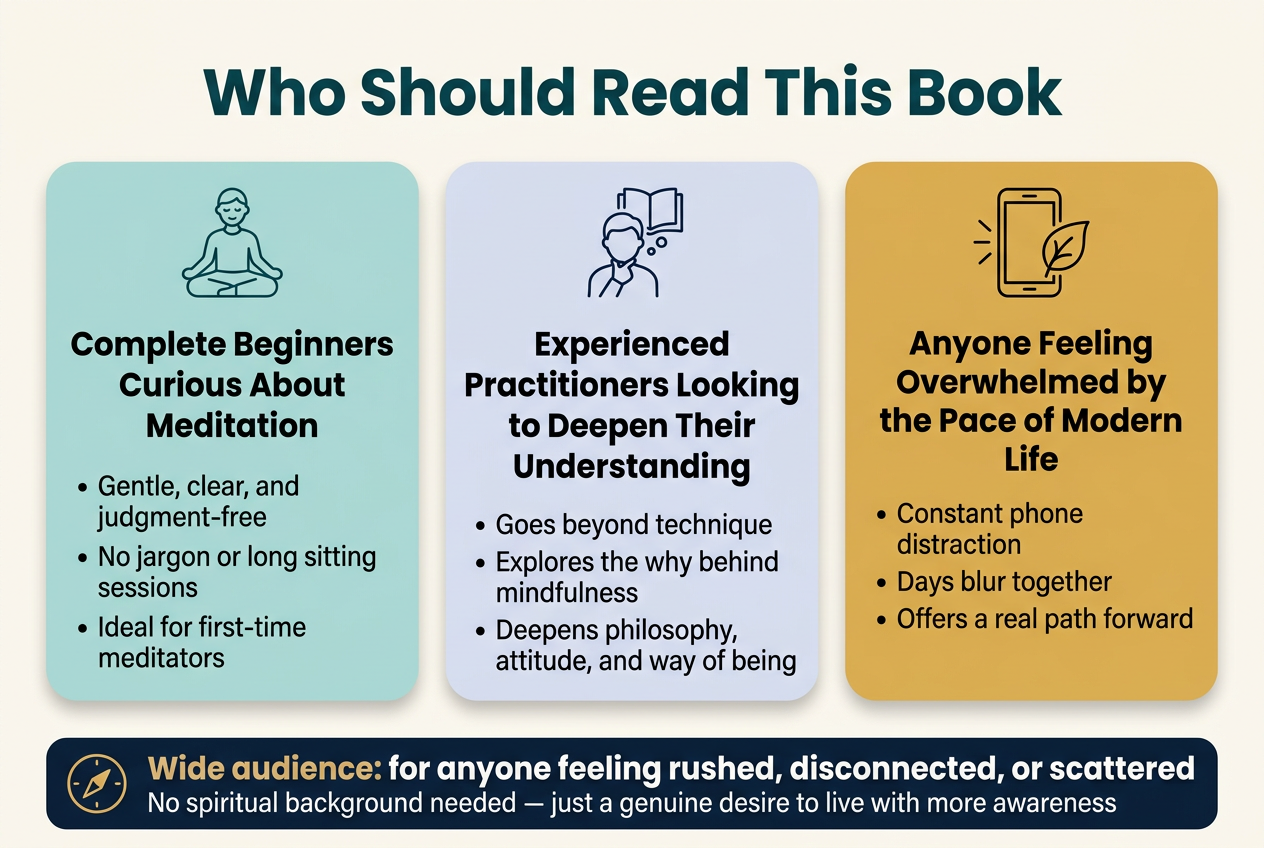
Complete Beginners Curious About Meditation
If you’ve never meditated a day in your life, this book is honestly one of the best places to start. Kabat-Zinn doesn’t throw jargon at you or expect you to sit cross-legged for hours. I found his explanations gentle, clear, and completely judgment-free — perfect for someone just dipping their toes in.
Experienced Practitioners Looking to Deepen Their Understanding
I’d also recommend this to anyone who already has a practice but feels like something is missing. Kabat-Zinn goes beyond technique and touches on the why behind mindfulness — the philosophy, the attitude, the way of being. That depth can genuinely shift how a seasoned practitioner shows up on the cushion and off it.
Anyone Feeling Overwhelmed by the Pace of Modern Life
- Constantly distracted by your phone? This book speaks directly to that.
- Feeling like days blur together without meaning? Kabat-Zinn addresses exactly that.
- Struggling to slow down even when you want to? He offers a real path forward.
I think this book has the widest possible audience because feeling rushed, disconnected, or scattered is something most of us know firsthand. You don’t need a spiritual background — just a genuine desire to live with more awareness.
How to Get the Most Out of Reading This Book
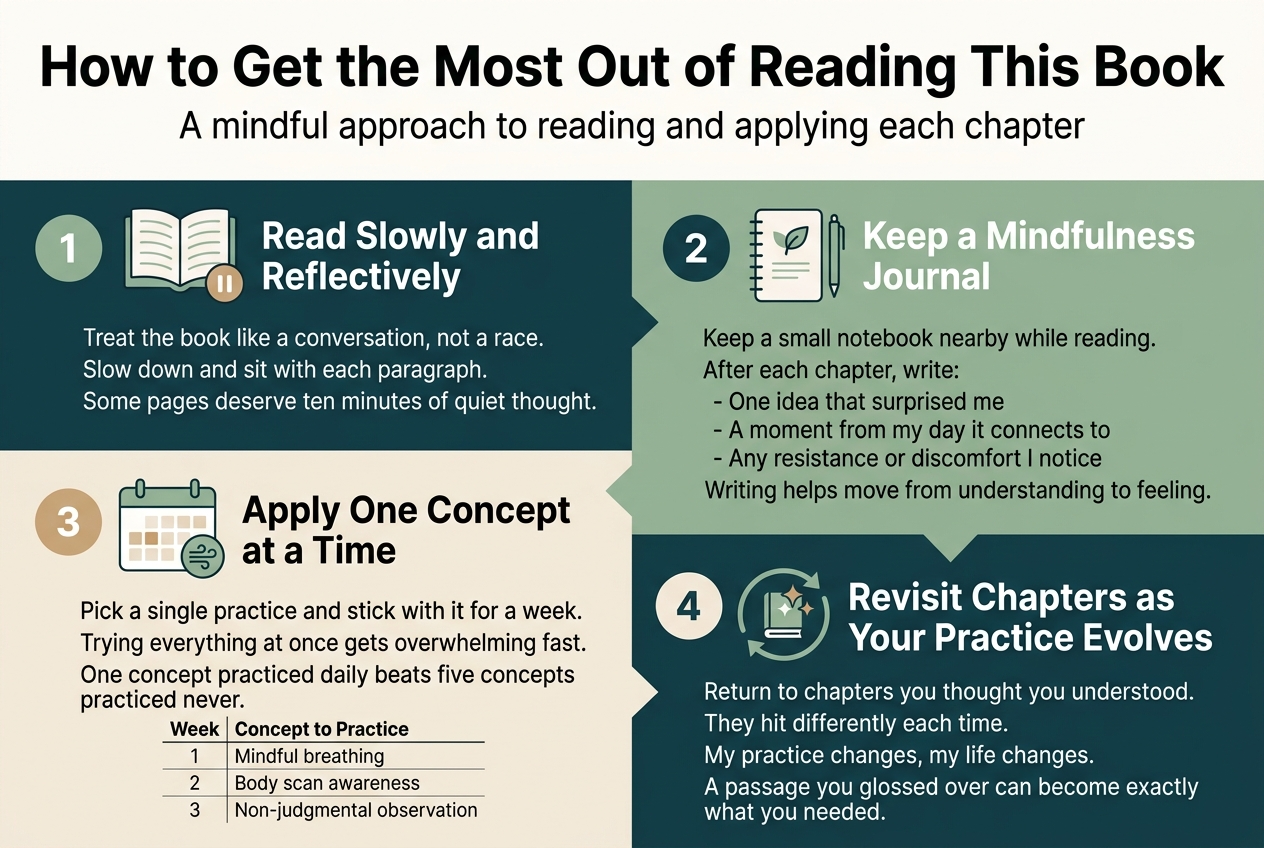
Reading Slowly and Reflectively Rather Than Rushing
I treat this book like a conversation, not a race. When I slow down and sit with each paragraph, I actually absorb what Kabat-Zinn is saying instead of just collecting words. Some pages deserve ten minutes of quiet thought.
Keeping a Mindfulness Journal Alongside Your Reading
I keep a small notebook nearby while reading. After each chapter, I jot down:
- One idea that surprised me
- A moment from my day it connects to
- Any resistance or discomfort I notice
Writing helps me move from understanding mindfulness intellectually to actually feeling it.
Applying One Concept at a Time to Your Daily Routine
I pick a single practice, like mindful breathing or body scanning, and stick with it for a week before moving on. Trying everything at once gets overwhelming fast. One concept practiced daily beats five concepts practiced never.
| Week | Concept to Practice |
|---|---|
| 1 | Mindful breathing |
| 2 | Body scan awareness |
| 3 | Non-judgmental observation |
Revisiting Chapters as Your Practice Evolves
I return to chapters I thought I understood, and they hit each time differently. My practice changes, my life changes, and suddenly a passage I glossed over becomes exactly what I needed.
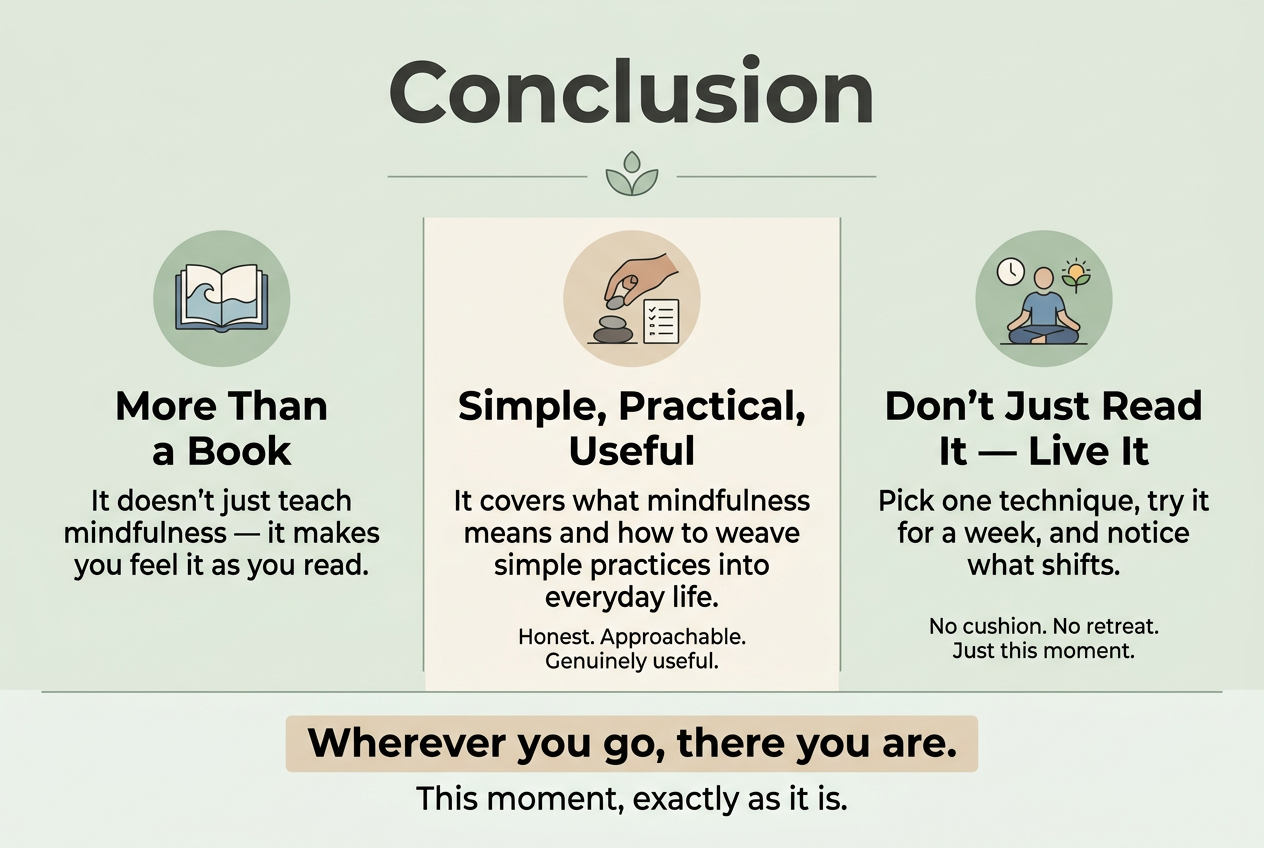
Jon Kabat-Zinn’s Wherever You Go, There You Are is one of those rare books that doesn’t just teach you about mindfulness — it actually makes you feel it as you read. From understanding what mindfulness really means to learning how to weave simple practices into your everyday routine, this book covers a lot of ground without ever feeling overwhelming. It’s honest, approachable, and genuinely useful, no matter where you are in your mindfulness journey.
If I had to give one piece of advice, it would be this: don’t just read this book — live it. Pick one technique, try it for a week, and see what shifts for you. The beauty of Kabat-Zinn’s approach is that you don’t need a meditation cushion or a retreat in the mountains. You just need this moment, right here, exactly as it is. That’s the whole point.
✨ Subscribe to The Zen Journal for soulful book reviews, mindful travel stories, and wellness inspiration delivered weekly.✨