
Emotional Granularity: The Simple Skill That Instantly Improves Your Mental Health
There’s a difference between saying “I feel bad” and knowing exactly which shade of bad you mean — disappointed, overwhelmed, lonely, or simply tired. That difference has a name: emotional granularity, the ability to identify your feelings with real precision instead of lumping them into vague categories like “good” or “bad.” It sounds almost too simple to matter, yet psychologists have found it’s one of the strongest predictors of emotional resilience we know. The more specific the word, the more your mind knows what to do with the feeling—instead of drowning in it.
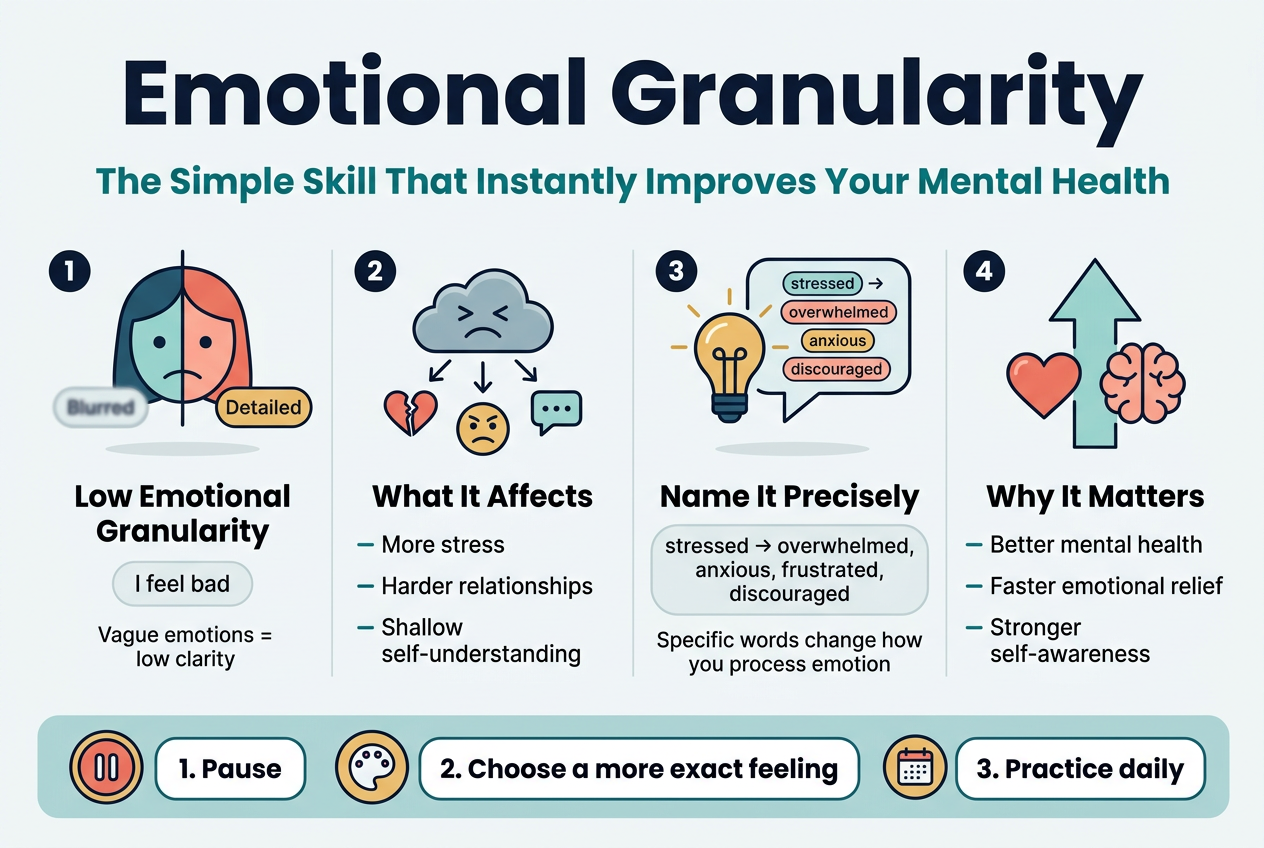
I used to think I had two emotional settings: fine and not fine. Turns out, that kind of vague emotional awareness has a name — low emotional granularity — and it was quietly making my stress worse, my relationships harder, and my self-understanding pretty shallow.
If you default to “I’m stressed” or “I feel bad” without being able to say much more, this is for you.
In this post, I’ll walk you through what emotional granularity means and why it’s not just therapy jargon. I’ll share the real science behind why naming your emotions more precisely can shift your mental health faster than you’d expect. I’ll also give you practical ways to start building your emotional vocabulary today—no journaling degree required.
By the end, you’ll see exactly why this one small skill change makes such a big difference.
What Emotional Granularity Really Means
The Difference Between Broad and Precise Emotional Awareness
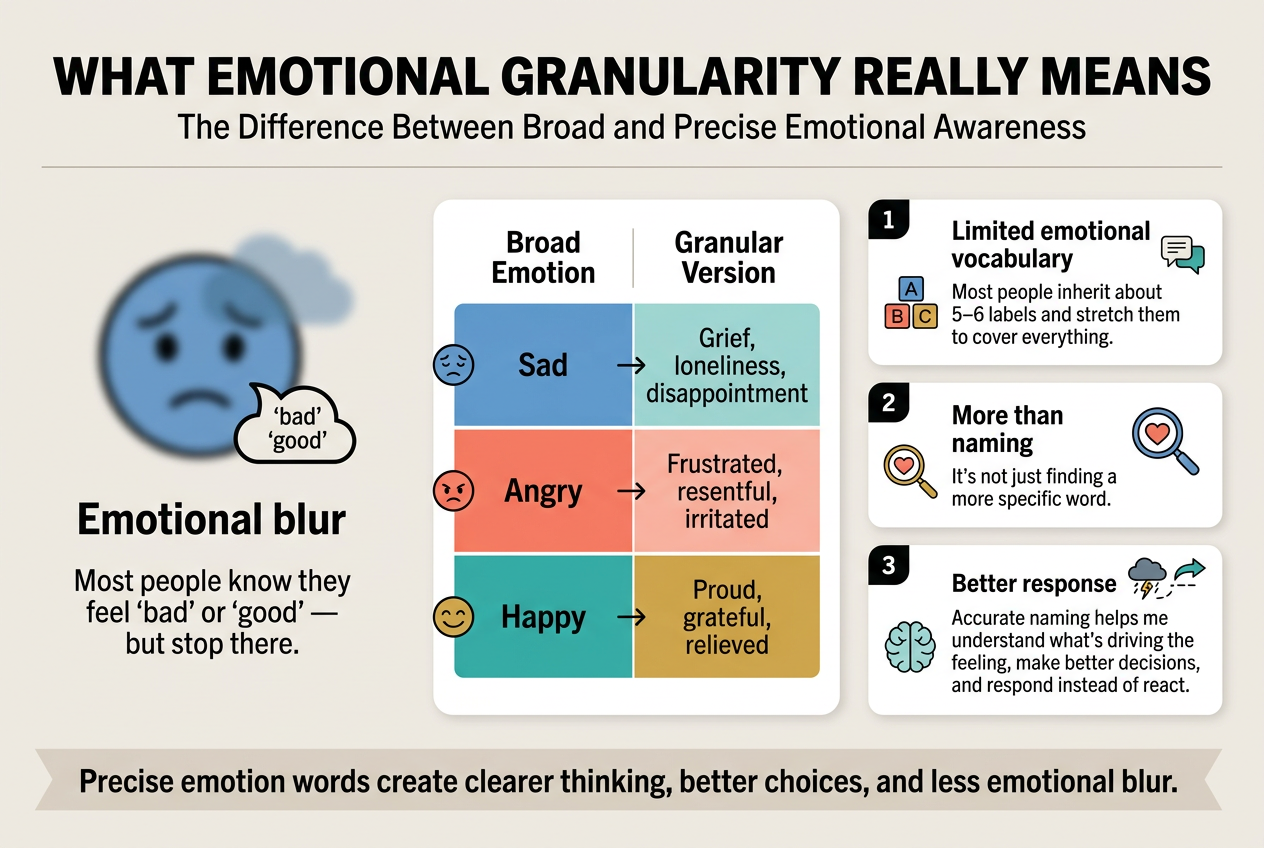
Most people live with what I’d call emotional blur. They know they feel “bad” or “good,” but that’s where the detail stops. Emotional granularity is my ability to identify exactly what I’m feeling with precision —distinguishing between disappointed and betrayed, or nervous and dreading.
| Broad Emotion | Granular Version |
|---|---|
| Sad | Grief, loneliness, disappointment |
| Angry | Frustrated, resentful, irritated |
| Happy | Proud, grateful, relieved |
Why Most People Operate with a Limited Emotional Vocabulary
Honestly, nobody really teaches us this. I grew up learning math, history, and grammar — but identifying emotions with any depth? That wasn’t on the curriculum. Most of us inherited about 5-6 emotional labels and just stretched them to cover everything we feel.
How Emotional Granularity Goes Beyond Simply Naming Your Feelings
Here’s what surprised me: this skill isn’t just about slapping a more specific word on a feeling. It’s about genuinely understanding what’s driving my emotional response. When I can name my feeling accurately, my brain processes it differently — I make better decisions, I respond instead of react, and I stop letting vague emotions quietly run the show in the background.
The Science Behind Why It Works
How the Brain Processes Emotions More Effectively with Greater Specificity
My brain isn’t wired to handle vague signals well. When I say “I feel bad,” my brain gets little actionable data. But when I identify “I feel rejected,” neural networks tied to social processing activate with precision, giving my brain a clear problem to solve.
Research Linking Emotional Granularity to Better Mental Health Outcomes
Psychologist Lisa Feldman Barrett’s research shows people with high emotional granularity:
- Visit doctors less frequently
- Use fewer medications
- Recover faster from setbacks
- Show greater emotional resilience overall
Her studies found that granular emotion labelers were less likely to drink alcohol when stressed and bounced back quicker from negative experiences.
The Connection Between Precise Emotions and Reduced Anxiety and Depression
When I lump everything into “anxious” or “depressed,” those feelings balloon. Precision shrinks them. Naming “I feel anticipatory dread about one specific conversation” makes the problem finite and manageable rather than a fog swallowing everything.
Why Labeling Feelings Accurately Calms Your Nervous System
Neuroscientist Matthew Lieberman’s research on affect labeling showed that naming emotions reduces amygdala activity — my brain’s threat-detection center. Basically, putting words to feelings literally quiets my alarm system, creating space between stimulus and reaction.
Signs You May Have Low Emotional Granularity
Defaulting to Vague Terms Like Sad, Fine, or Stressed
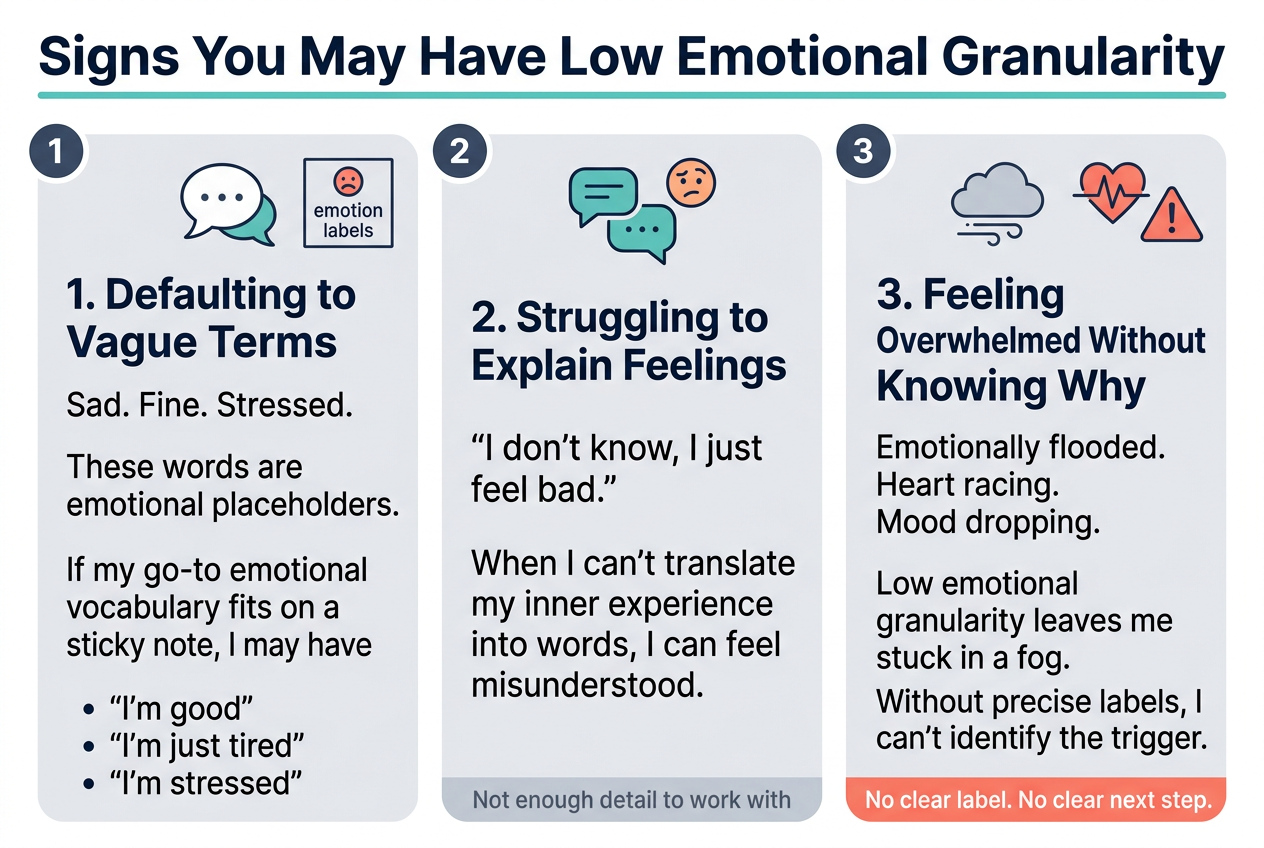
When someone asks how I’m doing, and my automatic answer is “stressed” or “fine,” that’s a warning sign. These words are emotional placeholders — they communicate almost nothing. If my go-to emotional vocabulary fits on a sticky note, I’m likely operating with low granularity.
Common vague defaults I might notice myself using:
- “I’m good” (when something clearly feels off)
- “I’m just tired” (covering anxiety, disappointment, or loneliness)
- “I’m stressed” (masking fear, resentment, or shame)
Struggling to Explain My Emotions to Others
If I find myself saying “I don’t know, I just feel bad” during conversations, that’s a clue. When I can’t translate my inner experience into words, I end up feeling misunderstood — not because others aren’t listening, but because I haven’t given them enough to work with.
Feeling Overwhelmed Without Knowing Exactly Why
This one catches me off guard the most. I’ll feel emotionally flooded — heart racing, mood dropping — with no clear story attached. Low emotional granularity leaves me stuck in a fog. Without precise labels, I can’t identify the trigger, which means I can’t do anything useful about it.
How to Build Your Emotional Vocabulary Starting Today
Using an Emotion Wheel to Discover More Precise Feeling Words
I keep an emotion wheel bookmarked on my phone. When I feel “bad,” I scan it until something clicks — maybe it’s defeated, not just sad. That one word shift changes everything about how I respond.
Practicing Daily Emotional Check-Ins to Sharpen Self-Awareness
Three times a day, I pause and ask myself: What am I actually feeling right now? Morning, midday, evening. It takes 30 seconds and builds remarkable self-awareness over weeks.
Journaling with Specific Emotional Language to Track Patterns
I stopped writing “I felt stressed today” and started writing “I felt overwhelmed and quietly resentful during the 3 pm meeting.” Specific language reveals patterns I’d otherwise completely miss.
Learning New Emotion Words and Actively Applying Them
| Word | Instead of |
|---|---|
| Apprehensive | Nervous |
| Contemptuous | Angry |
| Wistful | Sad |
| Buoyant | Happy |
I pick one new word weekly and genuinely use it in conversation or journaling.
Noticing Physical Sensations as Clues to Exact Emotions
My chest tightness signals anxiety. Jaw clenching means frustration. I learned to read my body first, then work backward to name the emotion accurately.
Real Life Benefits You Will Notice Quickly
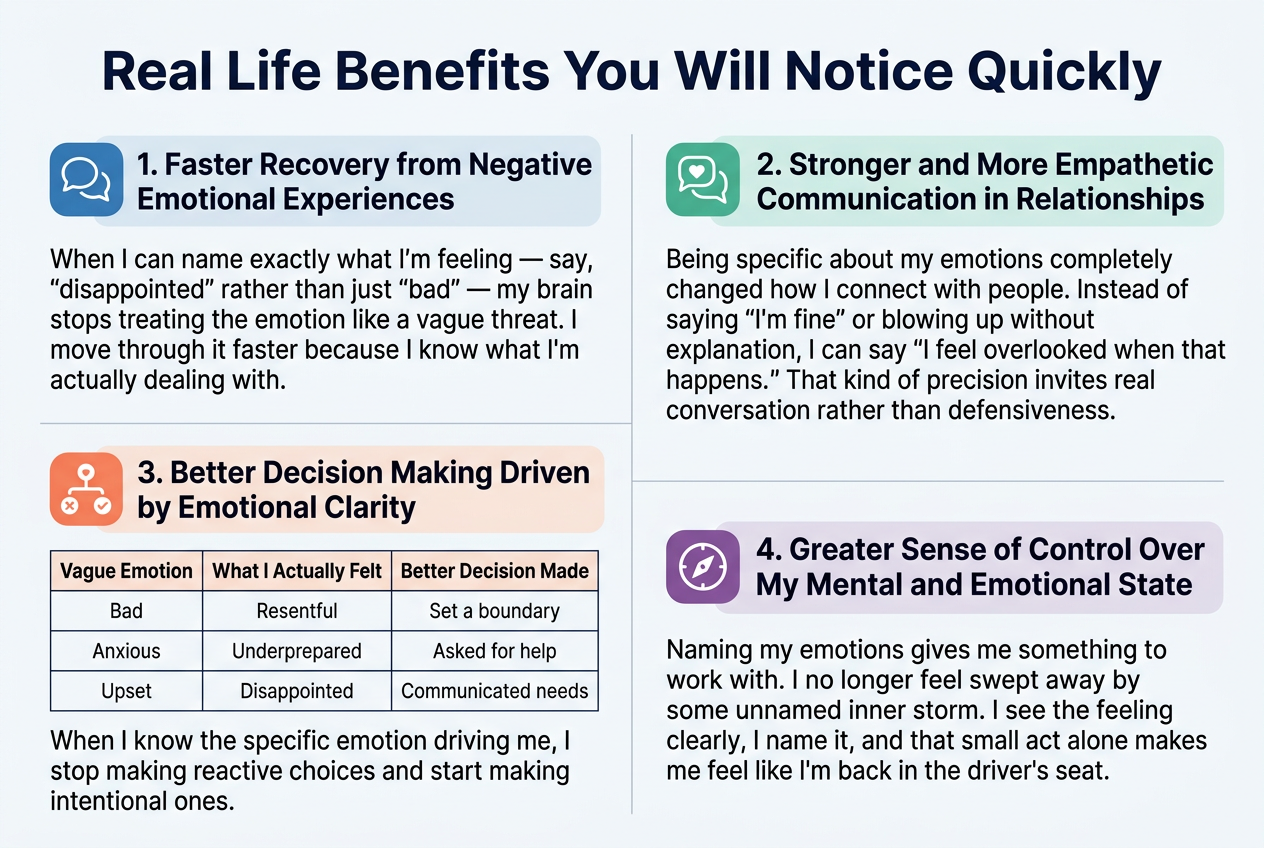
Faster Recovery from Negative Emotional Experiences
When I can name exactly what I’m feeling — say, “disappointed” rather than just “bad” — my brain stops treating the emotion like a vague threat. I move through it faster because I know what I’m actually dealing with.
Stronger and More Empathetic Communication in Relationships
Being specific about my emotions completely changed how I connect with people. Instead of saying “I’m fine” or blowing up without explanation, I can say “I feel overlooked when that happens.” That kind of precision invites real conversation rather than defensiveness.
Better Decision Making Driven by Emotional Clarity
| Vague Emotion | What I Actually Felt | Better Decision Made |
|---|---|---|
| Bad | Resentful | Set a boundary |
| Anxious | Underprepared | Asked for help |
| Upset | Disappointed | Communicated needs |
When I know the specific emotion driving me, I stop making reactive choices and start making intentional ones.
Greater Sense of Control Over My Mental and Emotional State
Naming my emotions gives me something to work with. I no longer feel swept away by some unnamed inner storm. I see the feeling clearly, I name it, and that small act alone makes me feel like I’m back in the driver’s seat.
Common Mistakes That Undermine Emotional Granularity
Confusing Emotional Granularity With Overthinking or Dwelling
I made this mistake early on. Naming my emotions felt like I was just spiraling into them. But there’s a real difference — overthinking loops without resolution, while emotional granularity labels and releases. I spend maybe 30 seconds identifying what I feel, then I move forward with better clarity. It’s more like checking a compass than getting lost in the woods.
Using Emotional Labels to Judge Yourself Rather Than Understand Yourself
I catch myself doing this sometimes — naming an emotion and immediately thinking, “I shouldn’t feel this way.” That’s not the practice. The whole point is curiosity, not criticism. When I notice “I feel envious,” my only job is to understand what that tells me about my needs, not to shame myself for being human.
Skipping the Practice During High Stress Moments When It Matters Most
- High stress is exactly when emotional granularity pays off the most
- When I’m overwhelmed, my instinct is to react fast, not pause to label
- But that’s the moment a single word — “I feel powerless, not just stressed” — can completely shift how I respond
The practice isn’t just for calm days. Train it when things are easy so it shows up automatically when things get hard.
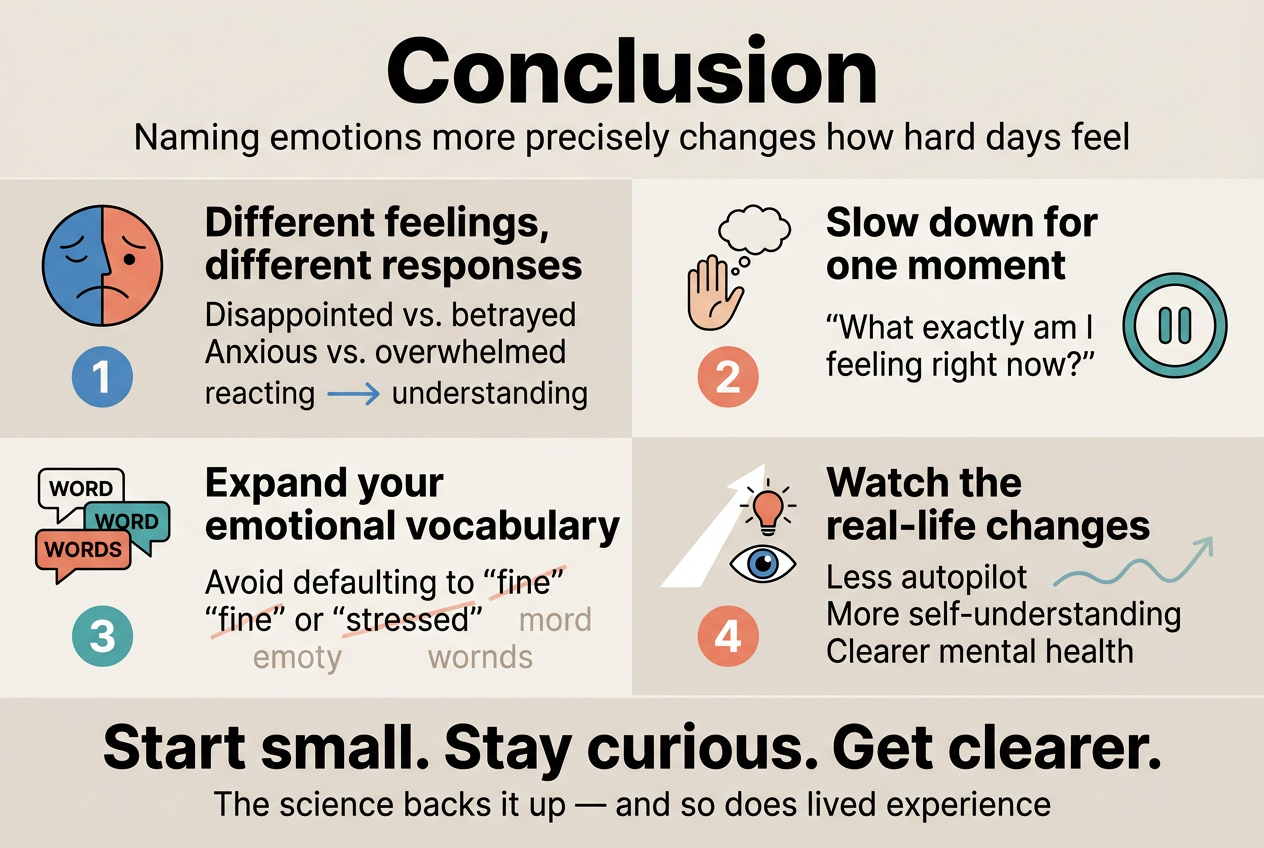
Getting better at naming my emotions has genuinely changed how I move through hard days. When I can tell the difference between feeling disappointed and feeling betrayed, or between anxious and overwhelmed, I stop reacting on autopilot and start actually understanding myself. That shift alone has made a bigger difference in my mental health than I expected.
The good news is that building emotional granularity does not require therapy sessions or years of practice. It starts with slowing down for just a moment and asking myself, “What exactly am I feeling right now?” From there, I expand my emotional vocabulary, avoid common traps like defaulting to “fine” or “stressed,” and pay attention to the real-life changes that follow—that is the whole game. The science backs it up, and my own experience confirms it. Start small, stay curious about your inner world, and watch how much clearer everything becomes.
✨ Join The Zen Journal community — get fresh yoga and wellness insights straight to your inbox ✨