Yoga Nidra: The Effortless Practice for Deep Rest Without Even Moving

Yoga Nidra: The Effortless Practice for Deep Rest Without Even Moving
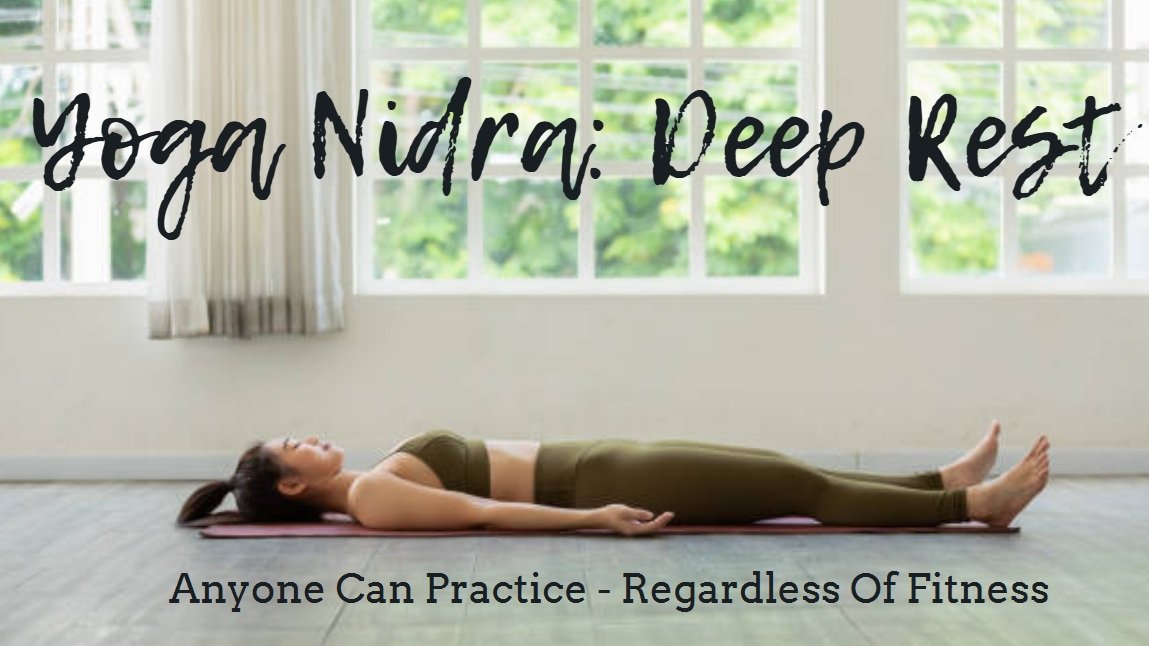
There’s a particular kind of exhaustion that no amount of sleep seems to touch — the mental kind, the one that lingers behind your eyes even after eight hours in bed. Yoga nidra was designed for exactly that. Sometimes called “yogic sleep,” it asks nothing of your body: no poses, no movement, not even much effort to stay awake. You simply lie down, follow a voice, and let your nervous system do what it rarely gets the chance to do — truly let go. It sounds almost too easy to work. And yet for many people, twenty still minutes of yoga nidra can leave them feeling more rested than a full night’s sleep.
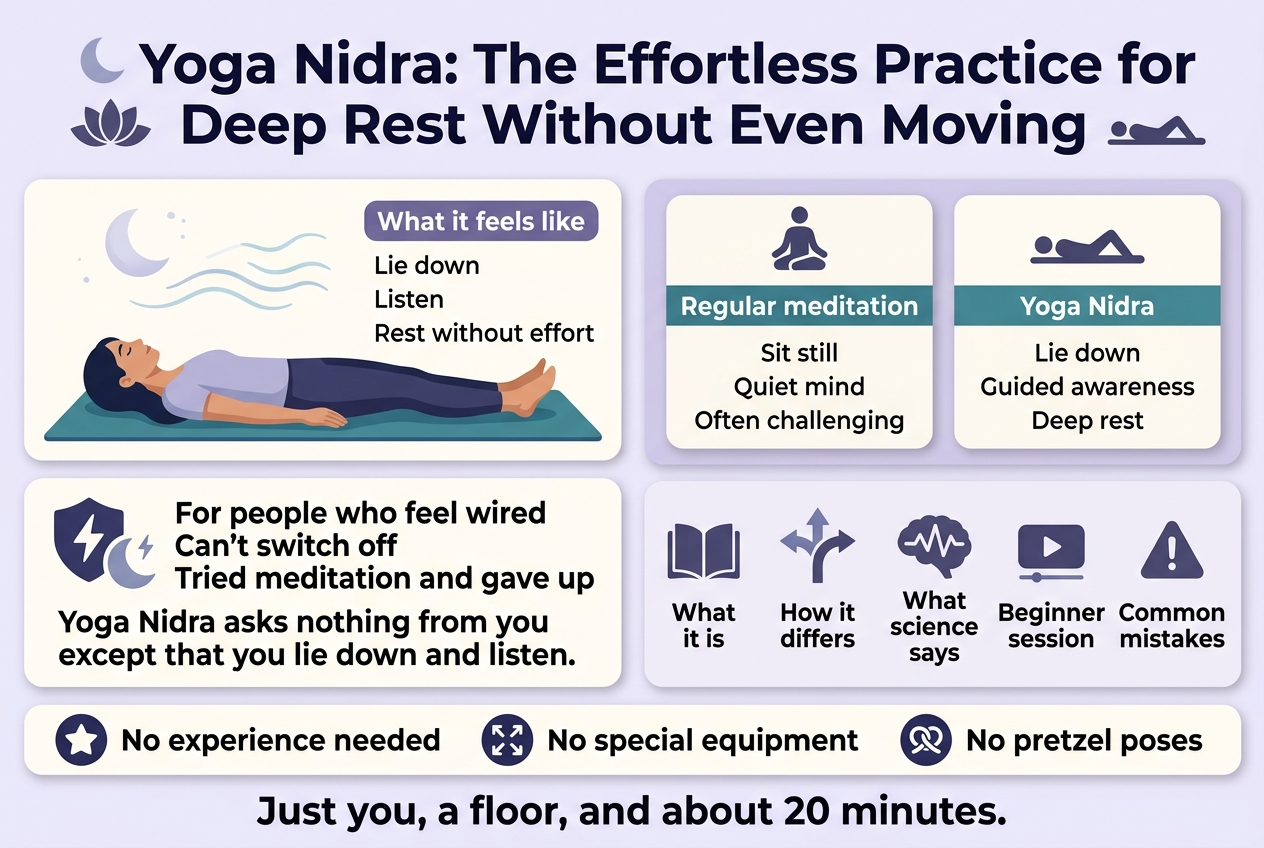
Create a clean, modern infographic illustration in a full-bleed 3:2 landscape layout with a soft calming palette of deep indigo, teal, pale lavender, and warm white. Use crisp sans-serif fonts with bold hierarchy, subtle gradients, simple flat icons, and wide horizontal sections. No centered vertical poster layout.

Top across the full width: a large bold title in dark indigo text reading "Yoga Nidra: The Effortless Practice for Deep Rest Without Even Moving". Place a small lotus icon and a reclining figure icon near the title.

Below the title, divide the infographic into 4 wide sections arranged in a balanced two-column grid with clear spacing:

Left upper section: a calming illustration of a person lying on a yoga mat with eyes closed, a moon and gentle wave lines above them. Add a header in a colored label reading "What it feels like". Under it, include short text lines:
"Lie down"
"Listen"
"Rest without effort"

Right upper section: a comparison block with two side-by-side cards and simple icons. Left card header: "Regular meditation" with a seated figure icon and text:
"Sit still"
"Quiet mind"
"Often challenging"
Right card header: "Yoga Nidra" with a lying figure icon and text:
"Lie down"
"Guided awareness"
"Deep rest"

Middle left section: a bold callout with a shield or lightning-to-moon icon and the text:
"For people who feel wired"
"Can't switch off"
"Tried meditation and gave up"
"Yoga Nidra asks nothing from you except that you lie down and listen."

Middle right section: a horizontal row of 4 small icon blocks with clear labels:
1. "What it is"
2. "How it differs"
3. "What science says"
4. "Beginner session"
5. "Common mistakes"
Use simple icons for each: book, split arrows, brain waves, play button, warning triangle.

Bottom full-width section: a quick facts strip with three bold icon badges and short text:
"No experience needed"
"No special equipment"
"No pretzel poses"
Then a larger final line centered along the bottom: "Just you, a floor, and about 20 minutes."

Use strong visual hierarchy, clean alignment, rounded rectangles for content blocks, and soft shadowing. Keep all text sharp and readable. No extra text beyond the phrases shown.

I used to think rest meant sleep and meditation meant sitting cross-legged with a perfectly quiet mind. Then I found Yoga Nidra, and honestly, it changed the way I recover, recharge, and even sleep at night.

If you feel constantly wired, can’t seem to fully switch off, or have tried meditation and given up because your brain just wouldn’t cooperate — this is for you. Yoga Nidra asks nothing of you except to lie down and listen. That’s it.

In this guide, I’ll walk you through exactly what Yoga Nidra is and how it’s genuinely different from regular meditation. I’ll also share what the science says about why this practice hits so deep, so fast. And I’ll give you a simple, beginner-friendly session you can try today, along with the most common mistakes that keep people from getting the full benefit.

No experience needed. No special equipment. No pretzel poses.

Just you, a floor, and about 20 minutes.

What Yoga Nidra Actually Is and Why It Differs from Regular Meditation
Create a clean, modern full-bleed infographic illustration in a 3:2 aspect ratio with a white background, deep indigo and teal accents, soft gold highlights, and a professional sans-serif font hierarchy. Place a bold title across the top spanning the width: "What Yoga Nidra Actually Is and Why It Differs from Regular Meditation".

Below the title, organize the infographic into four wide horizontal sections with clear visual separation, using icons and simple blocks rather than a narrow vertical stack.

SECTION 1, upper left: a timeline-style block titled "Ancient Roots + Modern Form" with two connected markers. First marker: a parchment scroll icon labeled "Tantric tradition" and "Mandukya Upanishad". Second marker: a lotus-and-book icon labeled "Swami Satyananda Saraswati" and "Structured, teachable form in the 1960s". Add a small brain-wave line graphic beside it with the label "Modern neuroscience confirms restorative brainwave states".

SECTION 2, upper right: a 2-column comparison table with a bold header row titled "How It Differs". Use four rows with clear icons on the left of each row: moon icon for "Sleep", target icon for "Meditation", sofa icon for "Relaxation", and crescent-circle awareness icon for "Yoga Nidra". Include exact table text:
"Sleep" | "Unconscious" | "Unaware"
"Meditation" | "Alert" | "Focused"
"Relaxation" | "Passive" | "Wandering"
"Yoga Nidra" | "Still" | "Consciously aware"
Place a small highlighted note beneath the table: "Yoga Nidra is its own category."

SECTION 3, lower left: a wide band titled "The Unique State of Consciousness" with a simple layered diagram showing awake state transitioning into sleep state. Use a horizontal gradient from bright blue to deep navy with a glowing midpoint labeled "Threshold between waking and sleeping". Add a centered theta-wave icon and the text "Hypnagogic state" and "Theta waves". Include two small callouts: "Deep creativity" and "Emotional processing".

SECTION 4, lower right: a simple accessible-practice panel titled "Why Anyone Can Practice". Show an illustration of a person lying down on a mat with a listening symbol near the ear and a small chair icon nearby for simplicity. Use three checkmark bullets with exact text:
"Just lie down"
"No poses"
"No breathwork"
"No experience needed"
Add a final bold line at the bottom of this panel: "If you can listen, you can practice."
Include a small age badge icon reading "70+" near the figure to imply accessibility for older adults.

Use clear spacing, rounded rectangular cards, subtle shadows, and strong visual hierarchy. Keep text crisp and readable, with titles large and bold, section headers medium-bold, and supporting labels smaller. Ensure all elements are arranged in a balanced landscape composition with wide horizontal flow and no narrow centered poster layout.

The Ancient Roots of Yoga Nidra and Its Modern Relevance

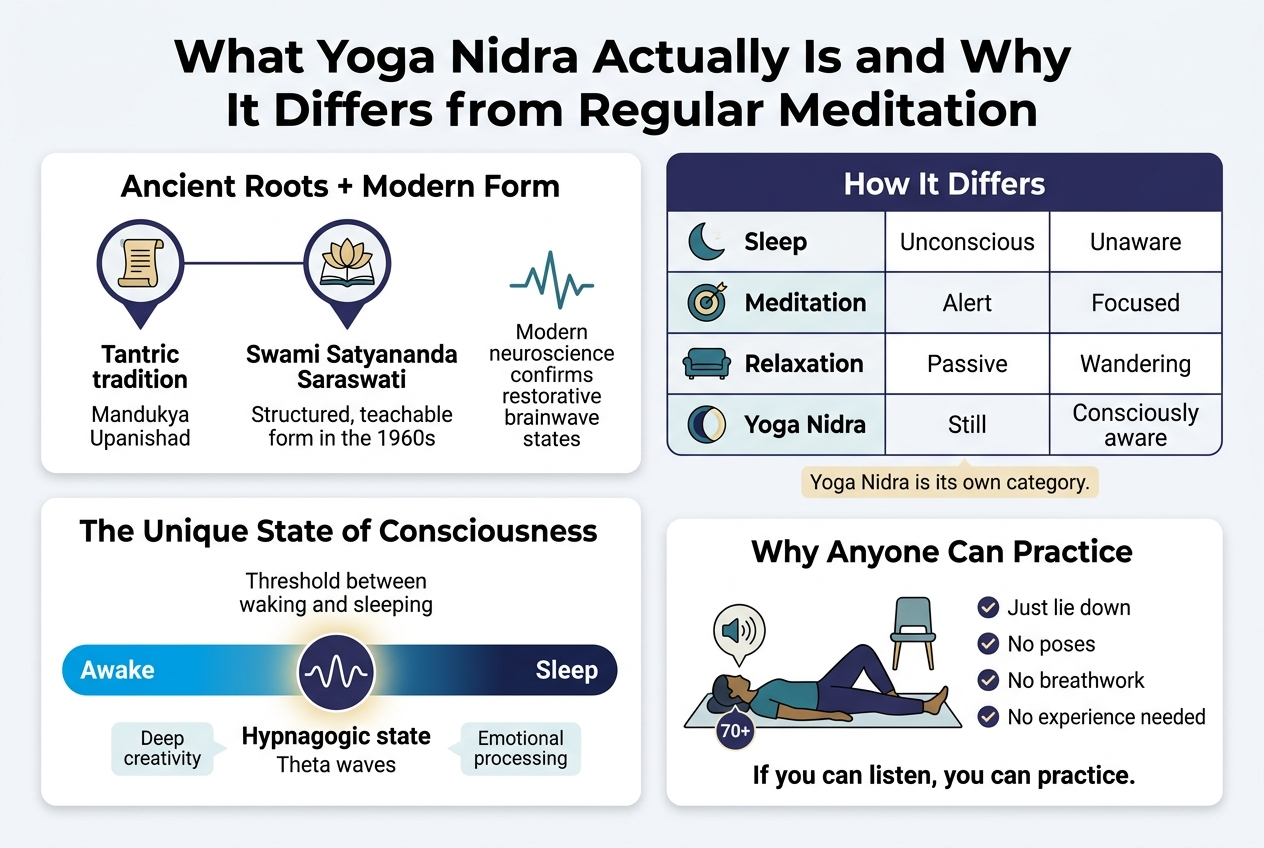
Yoga Nidra traces back thousands of years to the tantric tradition, where it appeared in texts like the Mandukya Upanishad. Swami Satyananda Saraswati brought it into a structured, teachable form in the 1960s — and that’s the version I work with today. What strikes me most is how this ancient practice maps almost perfectly onto what modern neuroscience now confirms about restorative brainwave states.

How It Differs from Sleep, Meditation, and Relaxation Techniques

PracticeBody StateMind State
SleepUnconsciousUnaware
MeditationAlertFocused
RelaxationPassiveWandering
Yoga NidraStillConsciously aware

Yoga Nidra isn’t exactly any of those things — it’s its own category.

The Unique State of Consciousness It Targets

I think of it as the threshold between waking and sleeping — the hypnagogic state. Here, the brain shifts into theta waves, the same ones active during deep creativity and emotional processing.

Why Anyone Can Practice It Regardless of Fitness or Flexibility

You just lie down. No poses, no breathwork, no experience needed. My 70-year-old neighbor does it after lunch. If you can listen, you can practice.

The Science Behind Why Yoga Nidra Works So Powerfully
Create a clean, modern full-bleed infographic illustration in a 3:2 landscape aspect ratio with a wide horizontal layout, no poster frame, no inset margins. Use a calm wellness palette of deep teal, soft blue, lavender, white, and subtle aqua accents. Use bold sans-serif typography for the title and clean readable sans-serif body text. Organize the design into three wide horizontal sections with clear visual hierarchy, icons, and labeled blocks.

TOP SECTION:
Place a large bold headline across the top: "The Science Behind Why Yoga Nidra Works So Powerfully"
Add a subtle brainwave line graphic spanning behind the title, with glowing wave peaks shifting from beta to delta.

LEFT WIDE SECTION:
Title this block: "How the Brain Shifts into Theta and Delta Wave States"
Show a horizontal flow diagram of four connected rounded cards with wave icons and frequency labels:
1. "Beta" — "12–38 Hz" — "Normal waking alertness"
2. "Alpha" — "8–12 Hz" — "Relaxed awareness"
3. "Theta" — "4–8 Hz" — "Dreamy, hypnagogic state"
4. "Delta" — "0.5–4 Hz" — "Deep restorative sleep"
Use a brain icon at the start and a crescent moon icon near Theta and Delta. Highlight Theta and Delta with brighter glow. Add a small caption beneath the flow: "Conscious awareness remains present"

CENTER WIDE SECTION:
Title this block: "The Role of the Autonomic Nervous System in Deep Rest"
Use a split-panel visual with two side-by-side states:
Left panel: red/orange sympathetic side with a tense body silhouette, fast heartbeat line, and text: "Sympathetic" and "fight or flight"
Right panel: blue/green parasympathetic side with a relaxed body silhouette, slow heartbeat line, and text: "Parasympathetic" and "rest and digest"
Between them place a downward arrow and small icons for heart, stomach, and muscles. Add short labels underneath the right side: "Heart rate drops" "Digestion activates" "Muscle tension releases immediately"

RIGHT WIDE SECTION:
Title this block: "What Research Says About Its Effects on Stress Hormones"
Use three clean statistic-style cards stacked horizontally or in a row with icons:
Card 1 with a cortisol drop icon and text: "Lower cortisol levels after just a single session"
Card 2 with an adrenaline bolt icon and text: "Less excess adrenaline"
Card 3 with a serotonin smile icon and text: "Genuine boost in serotonin"
Add a concluding line in a highlighted ribbon: "Calmer, more emotionally balanced, without any medication"

VISUAL STYLE:
Use thin connecting lines, rounded rectangles, soft gradients, and minimal medical/wellness illustration style. Include small decorative sparkles and gentle wave motifs. Keep text legible, balanced, and evenly spaced across the wide canvas. Ensure all content is aligned in a clean, professional infographic layout with strong contrast and clear section separation.

How the Brain Shifts into Theta and Delta Wave States

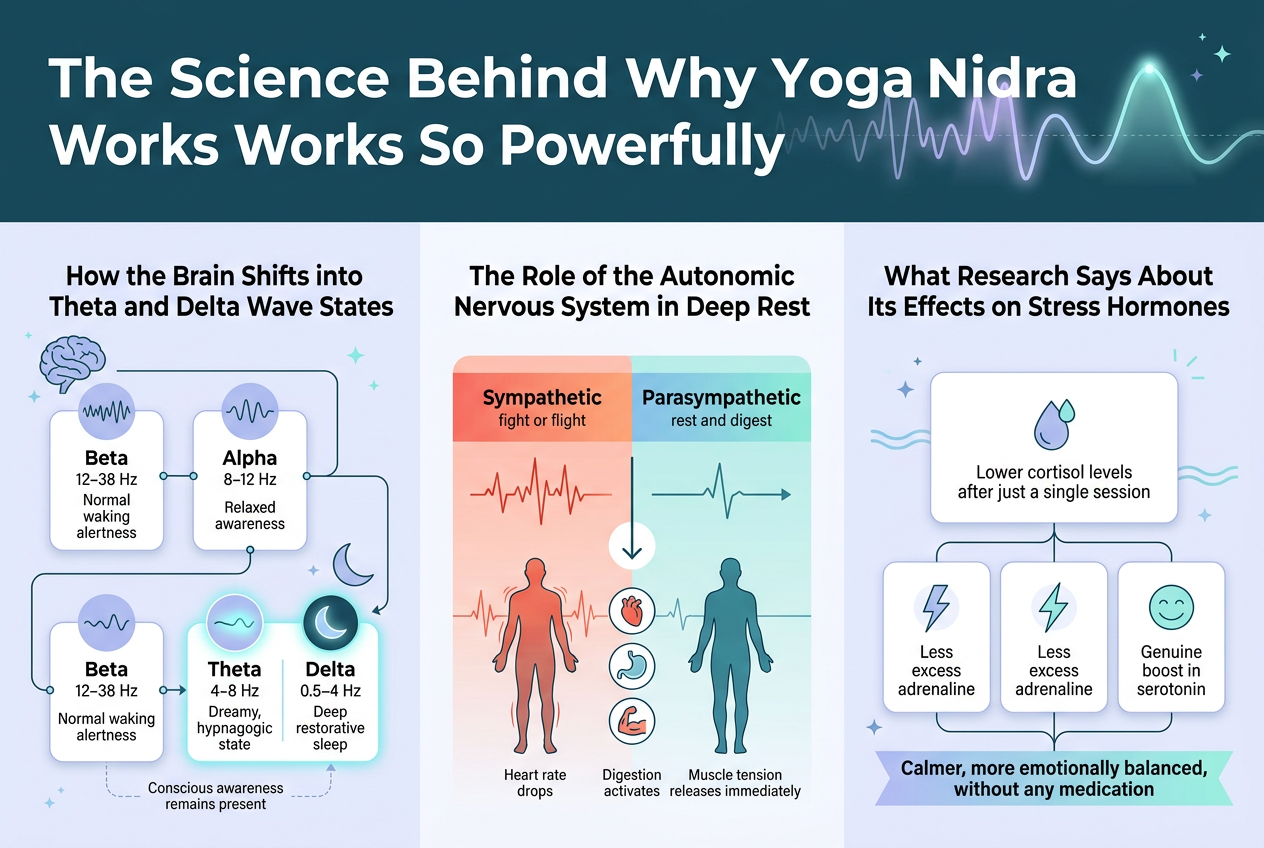
When I practice Yoga Nidra, my brain doesn’t stay in its usual busy beta state. It deliberately slides into theta waves (4–8 Hz) — the same dreamy state I experience just before falling asleep. What makes this remarkable is that I stay conscious the whole time.

With deeper practice, I can even touch delta waves (0.5–4 Hz), typically reserved for deep, dreamless sleep. This is where profound cellular repair and memory consolidation happen.

Brain StateFrequencyWhat It Feels Like
Beta12–38 HzNormal waking alertness
Alpha8–12 HzRelaxed awareness
Theta4–8 HzDreamy, hypnagogic state
Delta0.5–4 HzDeep restorative sleep

The Role of the Autonomic Nervous System in Deep Rest

Yoga Nidra shifts my nervous system from sympathetic (“fight or flight”) dominance into parasympathetic (“rest and digest”) mode. My heart rate drops, digestion activates, and muscle tension releases almost immediately.

What Research Says About Its Effects on Stress Hormones

Studies show Yoga Nidra significantly lowers cortisol levels after just a single session. My body stops producing excess adrenaline, and serotonin production gets a genuine boost — making me feel calmer and more emotionally balanced without any medication.

Life-Changing Benefits You Can Experience from Regular Practice
Create a clean, modern infographic in a 3:2 landscape aspect ratio with a full-bleed layout, no border frame, and wide horizontal organization. Use a calming palette of deep navy, teal, soft blue, white, and light lavender accents. Use bold sans-serif typography for the title and clear readable sans-serif body text. Place a large bold title across the top center:

"Life-Changing Benefits You Can Experience from Regular Practice"

Below the title, arrange five wide content blocks in a balanced 2-row layout: three blocks across the upper middle and two larger blocks across the lower middle. Use numbered section headers with circular icons beside each number. Each block should have a distinct icon and short text. Keep spacing clean and professional.

Section 1 on the upper left: a moon and stars icon in a blue circle. Header text:
"1. Dramatic Improvements in Sleep Quality and Insomnia Relief"
Body text:
"After just two weeks of nightly practice, I noticed I was falling asleep faster and waking up actually refreshed. Yoga Nidra trains my nervous system to shift into deep relaxation on demand — a skill that carries directly into sleep."

Section 2 in the upper center: a softly glowing heart icon in a lavender circle. Header text:
"2. Accelerated Emotional Healing and Trauma Recovery"
Body text:
"I've watched unresolved emotions surface gently during sessions, without the intensity of reliving them. The practice creates a safe internal space where my nervous system processes old wounds quietly, almost automatically."

Section 3 on the upper right: a brain and spark icon in a teal circle. Header text:
"3. Sharper Focus and Enhanced Mental Clarity During the Day"
Body text:
"My morning sessions leave my mind unusually clear. When I'm well-rested at a neurological level, decision-making feels easier and mental fog simply disappears."

Section 4 on the lower left, wider than the top blocks: a calm breathing lungs icon in a green-blue circle. Header text:
"4. Reduced Anxiety and Chronic Stress Without Effort"
Body text:
"What surprises me most is that I don't have to *try* to relax. Yoga Nidra activates my parasympathetic nervous system naturally. My baseline stress levels have dropped noticeably over consistent practice."

Section 5 on the lower right, wider than the top blocks: a resting body and battery/recharge icon in a gold circle. Header text:
"5. Physical Restoration Comparable to Hours of Deep Sleep"
Include a simple two-row comparison table beneath the header with clean lines and bold labels:
"Practice Duration" | "Equivalent Rest"
"20-minute session" | "~1–2 hours sleep"
"45-minute session" | "~3–4 hours sleep"
Add a short line beneath the table:
"My body genuinely recovers during these sessions — muscle tension releases, inflammation reduces, and energy returns."

Use subtle divider lines, soft shadows, and consistent icon style. Keep all text crisp, legible, and left-aligned inside each block.

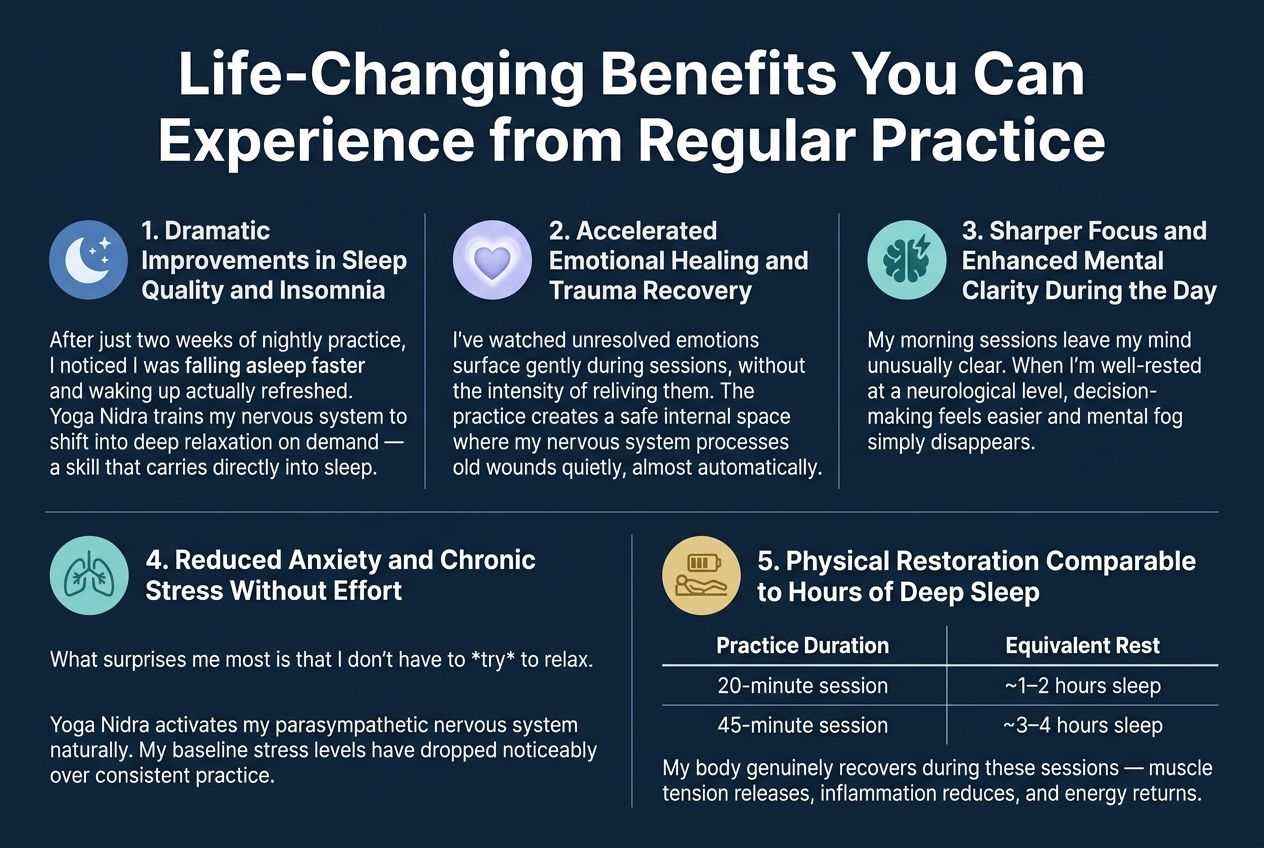
A. Dramatic Improvements in Sleep Quality and Insomnia Relief

After just two weeks of nightly practice, I noticed I was falling asleep faster and waking up actually refreshed. Yoga Nidra trains my nervous system to shift into deep relaxation on demand — a skill that carries directly into sleep.

B. Accelerated Emotional Healing and Trauma Recovery

I’ve watched unresolved emotions surface gently during sessions, without the intensity of reliving them. The practice creates a safe internal space where my nervous system processes old wounds quietly, almost automatically.

C. Sharper Focus and Enhanced Mental Clarity During the Day

My morning sessions leave my mind unusually clear. When I’m well-rested at a neurological level, decision-making feels easier and mental fog simply disappears.

D. Reduced Anxiety and Chronic Stress Without Effort

What surprises me most is that I don’t have to try to relax. Yoga Nidra naturally activates my parasympathetic nervous system. My baseline stress levels have dropped noticeably over consistent practice.

E. Physical Restoration Comparable to Hours of Deep Sleep

Practice DurationEquivalent Rest
20-minute session~1–2 hours sleep
45-minute session~3–4 hours sleep

My body genuinely recovers during these sessions — muscle tension releases, inflammation reduces, and energy returns.

A Simple Step-by-Step Guide to Your First Yoga Nidra Session
Create a clean, professional full-bleed infographic in a 3:2 landscape layout with a soft calming palette of deep blue, teal, lavender, and warm cream, using modern sans-serif fonts with a bold title at the top.

TOP HEADER:
Large bold title centered across the top:
"A Simple Step-by-Step Guide to Your First Yoga Nidra Session"
Add a subtle line icon of a person lying down with a moon or sleep symbol near the title.

MAIN LAYOUT:
Use four wide horizontal sections across the page, arranged left-to-right and top-to-bottom in a balanced infographic flow with clear numbered blocks, icons, and short text.

SECTION 1 — LEFT TOP:
Header text:
"1. Set Up the Perfect Environment"
Add a calm room illustration with dim lamp, blanket, eye pillow, and muted phone icon.
Include these bullet points:
"Dim the lights"
"Grab a blanket"
"Lie flat on your back"
"Keep your phone on silent"
"Use an eye pillow"
"Keep the room slightly warm"
Add small icons for light, blanket, phone, eye mask, and temperature.

SECTION 2 — RIGHT TOP:
Header text:
"2. Body Scan Technique"
Show a simple side-view body silhouette lying down with highlighted path markers moving from hand to arm.
Include this text:
"Move awareness through each body part"
"Start with the right thumb"
"Thumb, fingers, palm, wrist"
"Continue up through the arm"
"Spend 20–30 seconds on each region"
"Notice without trying to change anything"
Add small circular markers along the arm and a gentle glow effect.

SECTION 3 — LEFT BOTTOM:
Header text:
"3. Set a Sankalpa"
Show a meditation icon with a calm thought bubble or soft glowing heart.
Include this text:
"Plant a short, positive statement"
"Keep it simple and personal"
"Example: “I am at peace.”"
"Repeat it three times"
"Say it with genuine feeling"
Add a subtle seed or sprout symbol to suggest intention.

SECTION 4 — RIGHT BOTTOM:
Header text:
"4. Move Through the Stages"
Create a four-step horizontal timeline with four labeled cards and distinct icons:
"Relaxation" — "Heavy limbs, slow breathing"
"Hypnagogic" — "Random images, floating sensation"
"Deep Rest" — "Timelessness, pure awareness"
"Return" — "Gentle sounds, wiggling fingers"
Use icons for each stage: weighted body, dreamy cloud, glowing circle, and rising wave.
Add a final small callout box below the timeline:
"Take three deep breaths before sitting up slowly"

STYLE:
Use soft gradients, clean spacing, rounded cards, thin dividers, and clear visual hierarchy. Keep text crisp and readable. No borders or poster frame. No extra text beyond the wording shown above.

Setting Up the Perfect Environment for Effortless Practice

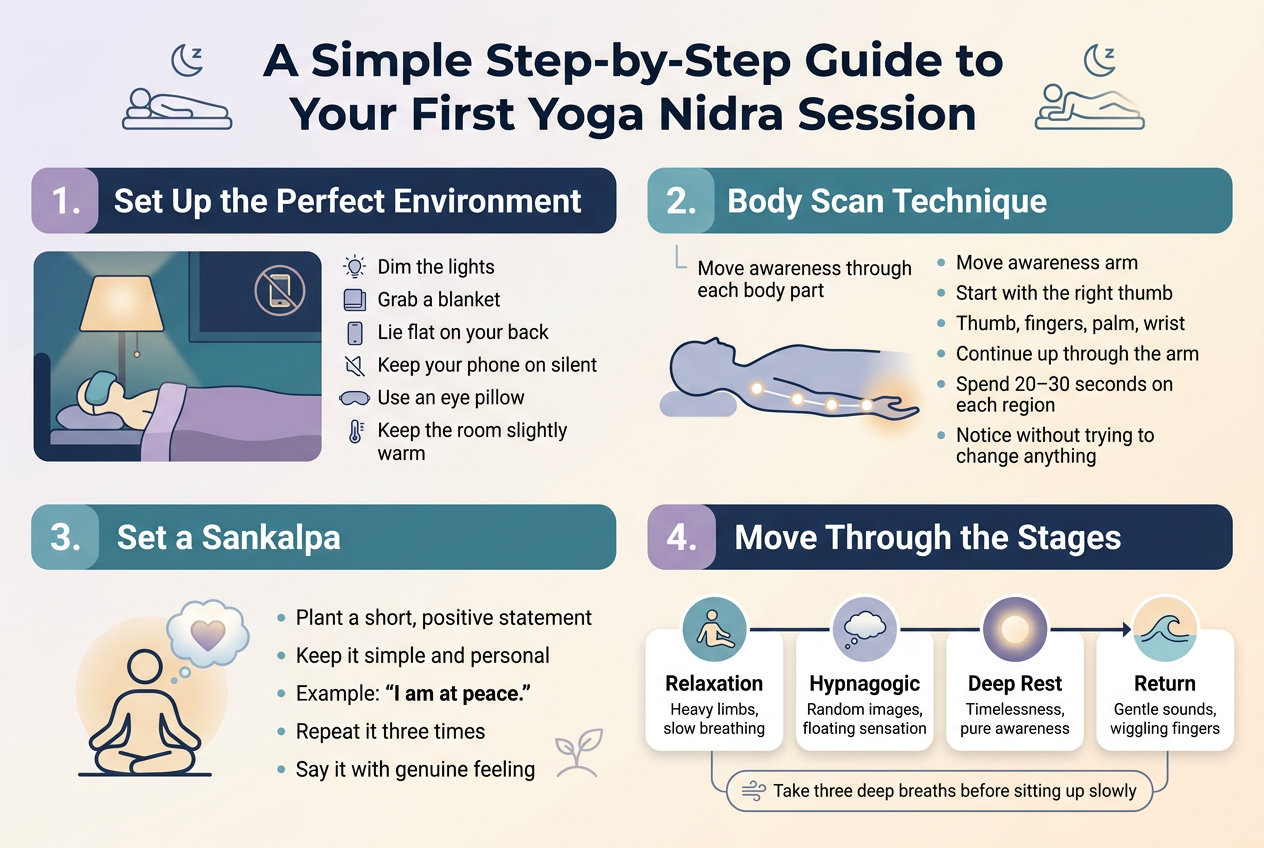
I always dim the lights, grab a blanket, and lie flat on my back before starting. A quiet room matters more than a fancy setup. I keep my phone on silent and use an eye pillow to block any light. The room should feel slightly warm, since my body cools down during deep rest.

The Body Scan Technique That Melts Away Physical Tension

I move my awareness systematically through each body part—starting with my right thumb, fingers, palm, wrist, and up through my arm. My attention alone releases tension without any physical movement. I spend about 20-30 seconds on each region, simply noticing without trying to change anything.

Using Intention Setting to Multiply Your Results

Before dropping into deep rest, I plant a short, positive statement called a Sankalpa. Mine is always simple and personal — something like “I am at peace.” I repeat it three times with genuine feeling. This plants it in my subconscious when it’s most receptive.

Navigating the Stages from Wakefulness to Deep Rest and Back

StageWhat I Experience
RelaxationHeavy limbs, slow breathing
HypnagogicRandom images, floating sensation
Deep RestTimelessness, pure awareness
ReturnGentle sounds, wiggling fingers

I never rush the return. I take three deep breaths before sitting up slowly.

Common Mistakes That Prevent You from Getting the Full Benefit
Create a clean professional infographic illustration in a 3:2 aspect ratio with a full-bleed layout, no poster frame, using a wide horizontal composition with three main content blocks across the page and a clear title band at the top. Use a calming palette of deep navy, soft teal, light gray, and warm accent gold; modern sans-serif font with strong hierarchy.

Top header spanning full width:
Large bold title text: "Common Mistakes That Prevent You from Getting the Full Benefit"
Add a subtle abstract meditation-wave background and a small lotus/meditation icon near the title.

Main body arranged in three wide sections with numbered badges and icons:

Left section, labeled with a large gold circle badge "1" and a brain/hand-grip icon:
Heading text: "Trying Too Hard to Stay Awake or Control the Experience"
Below, short bullet-style lines:
"Yoga Nidra isn't something you do — it's something you allow."
"Mental gripping blocks the hypnagogic edge."
"Drifting toward sleep is fine; gently return when you notice."

Center section, labeled with a teal circle badge "2" and a body-scan/spine icon:
Heading text: "Skipping the Rotation of Consciousness Phase"
Below, short bullet-style lines:
"The body scan is not filler."
"It systematically withdraws attention from the external world."
"It helps drop brainwaves into theta territory."

Right section, labeled with a blue circle badge "3" and a clock icon:
Heading text: "Practicing at the Wrong Time for Your Goals"
Include a neat 2-column mini table with thin lines and alternating soft-gray rows. Table header text:
"Goal" and "Best Time"
Rows:
"Deep restoration" | "Midday or early afternoon"
"Better sleep" | "30–60 minutes before bed"
"Creativity & focus" | "Morning, after light movement"
"Stress relief" | "Immediately after a difficult situation"

Add a slim footer strip across the bottom with a small checkmark icon and text:
"Match your practice time to your intention for better results."

Use clear visual separation between sections, strong iconography, and balanced spacing across the full width.

Trying Too Hard to Stay Awake or Control the Experience

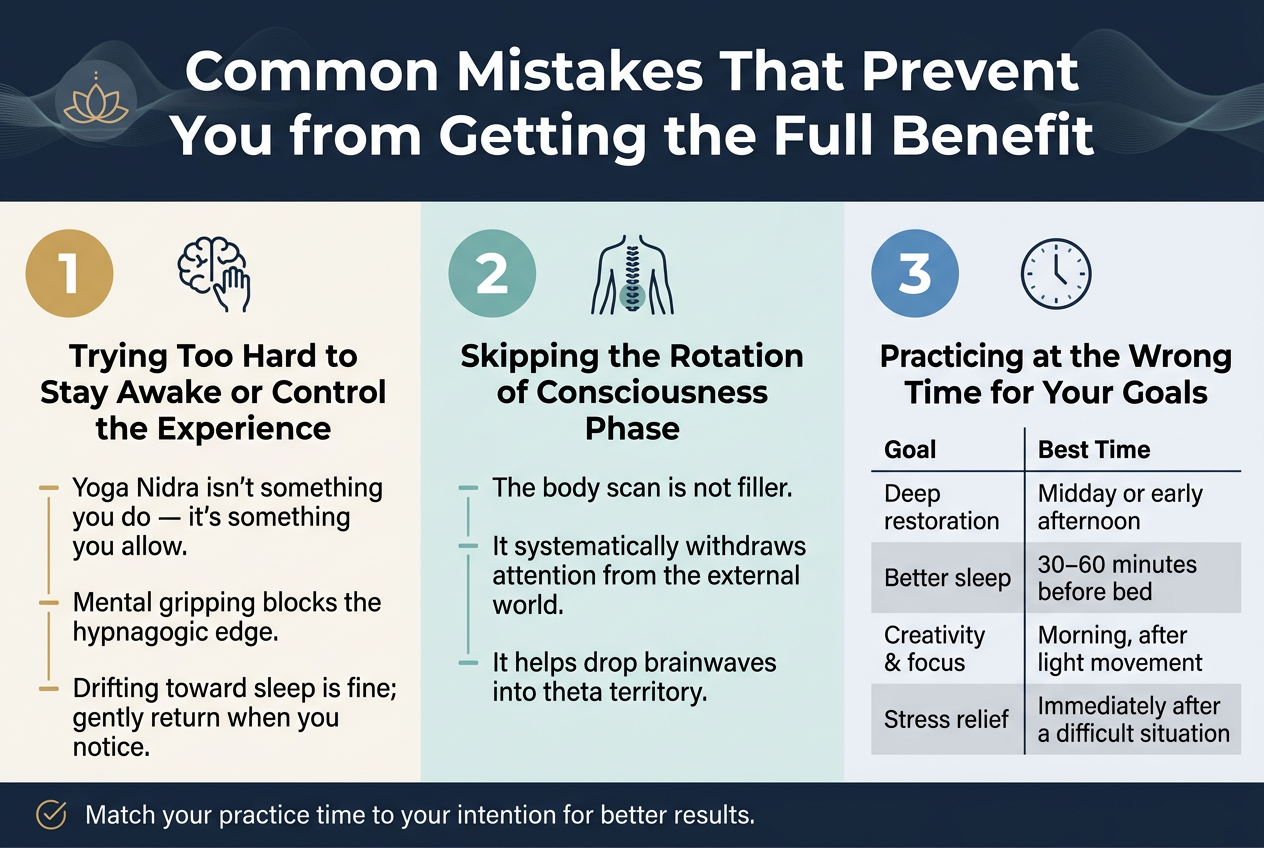
This is the biggest trap I see people fall into. Yoga Nidra isn’t something you do — it’s something you allow. When I catch myself mentally gripping the practice, trying to stay alert or steer where my mind goes, I immediately lose the hypnagogic edge where the real magic happens. If you drift toward sleep occasionally, that’s fine. Just gently return when you notice.

Skipping the Rotation of Consciousness Phase

I used to skip the body-scanning rotation because it felt slow and repetitive. Big mistake. That systematic sweep through body parts withdraws your attention from the external world and drops your brainwaves into theta territory. It’s not filler — it’s the foundation. Skipping it is like skipping the warm-up and wondering why you pulled something.

Practicing at the Wrong Time for Your Goals

GoalBest Time
Deep restorationMidday or early afternoon
Better sleep30–60 minutes before bed
Creativity & focusMorning, after light movement
Stress reliefImmediately after a difficult situation

I match my practice time to my intention, and my results shifted noticeably once I started doing this.

Easy Ways to Build Yoga Nidra into Your Busy Daily Routine

The Ideal Session Lengths for Different Goals and Schedules

GoalIdeal Session Length
Quick midday reset10–15 minutes
Stress relief20–30 minutes
Deep sleep support30–45 minutes
Full restoration45–60 minutes

Even a 10-minute session fits into my lunch break and genuinely shifts my energy for the afternoon.

Best Times of Day to Practice for Maximum Restoration

I get the most out of my practice at these windows:

  • Morning – sets a calm, focused tone before the day picks up speed
  • Post-lunch – fights the afternoon slump without caffeine
  • Before bed – replaces scrolling and actually prepares my nervous system for deep sleep

Using Guided Recordings to Stay Consistent Without Extra Effort

My biggest consistency hack is keeping a favorite guided recording saved and ready. I don’t have to think—I just press play. Apps like Insight Timer or YouTube offer free options across every session length. Removing the decision-making keeps me showing up daily.

Combining Yoga Nidra with Other Wellness Habits for Lasting Results

I stack Yoga Nidra with habits I already have:

  • After my morning coffee, before work begins
  • Following a yoga or workout session
  • As my wind-down replacement for nighttime screen time
3:2 full-bleed infographic illustration, clean professional modern style, wide horizontal layout with no border frame. Top banner across the full width with large bold title text: "Conclusion" in dark navy sans-serif font. Soft calming palette of teal, blue, lavender, and warm white with subtle gradient background and minimal yoga-inspired shapes.

Center layout divided into 2 wide horizontal sections with clear visual hierarchy:

LEFT SECTION: "What Yoga Nidra Offers" as a bold subheading in a rounded rectangular header. Under it, 4 numbered blocks arranged in a 2x2 grid with simple icons:
1. A meditation cushion icon with contrasting arrows and the text: "Different from regular meditation"
2. A brain and wave-lines icon with the text: "Science explains why it works"
3. A glowing checkmark/energy icon with the text: "Real, tangible benefits"
4. A relaxed person lying down icon with the text: "No poses. No huge time commitment."

RIGHT SECTION: "How to Start Simply" as a bold subheading in a rounded rectangular header. Under it, 5 vertically stacked wide cards with icons and short text:
1. A checklist icon with the text: "Follow the step-by-step guide"
2. A warning triangle icon with the text: "Avoid common mistakes"
3. A small clock icon with the text: "Find small pockets in your day"
4. A calendar icon with the text: "Even one session a week can shift something"
5. A person lying flat with a calm sparkle icon and the text: "Lie down. Do nothing. Let your body and mind do the rest."

Bottom strip across the width with a serene illustration of a person resting on a mat, eyes closed, soft glow around the body, with a small caption in bold: "That’s where the magic happens."

Use strong typographic contrast, dark navy headlines, medium-weight body text, rounded cards, subtle shadows, clean spacing, balanced composition, and readable text. Include small decorative stars, waves, and breath-like lines around the resting figure.

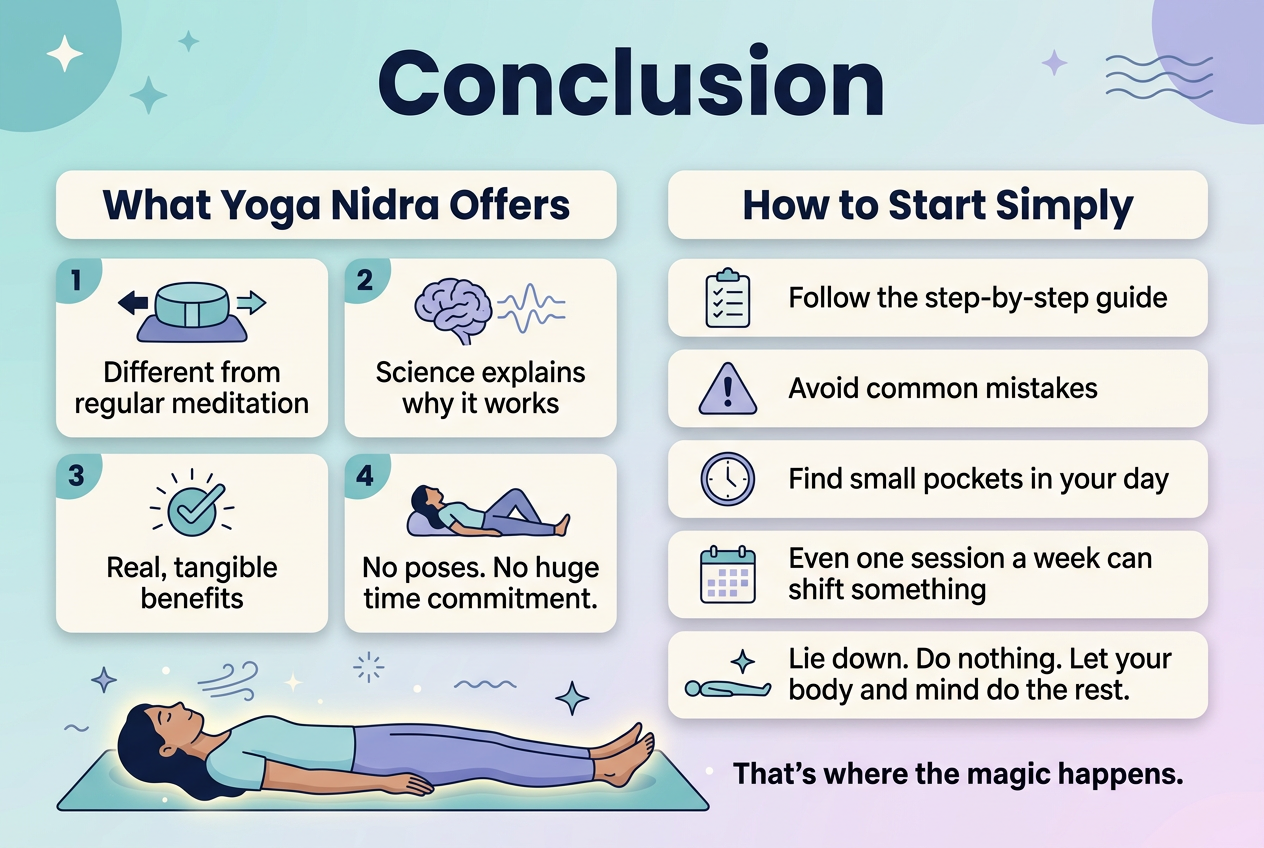
Yoga Nidra has completely changed the way I think about rest and recovery. From understanding what makes it different from regular meditation, to discovering the science behind why it works, to experiencing real, tangible benefits — this practice offers so much more than I ever expected. And the best part? I don’t have to twist myself into any poses or carve out huge chunks of time to feel the difference.

If you’re just getting started, I’d say keep it simple. Follow the step-by-step guide, watch out for the common mistakes that can hold you back, and find small pockets in your day to make it a habit. Even one session a week can make a difference. Give yourself permission to lie down, do nothing, and let your body and mind do the rest—because honestly, that’s where the magic happens.

✨ Join The Zen Journal community — get fresh yoga and wellness insights straight to your inbox ✨