
Chair Yoga for Office Workers: Relieve Tension in 10 Minutes
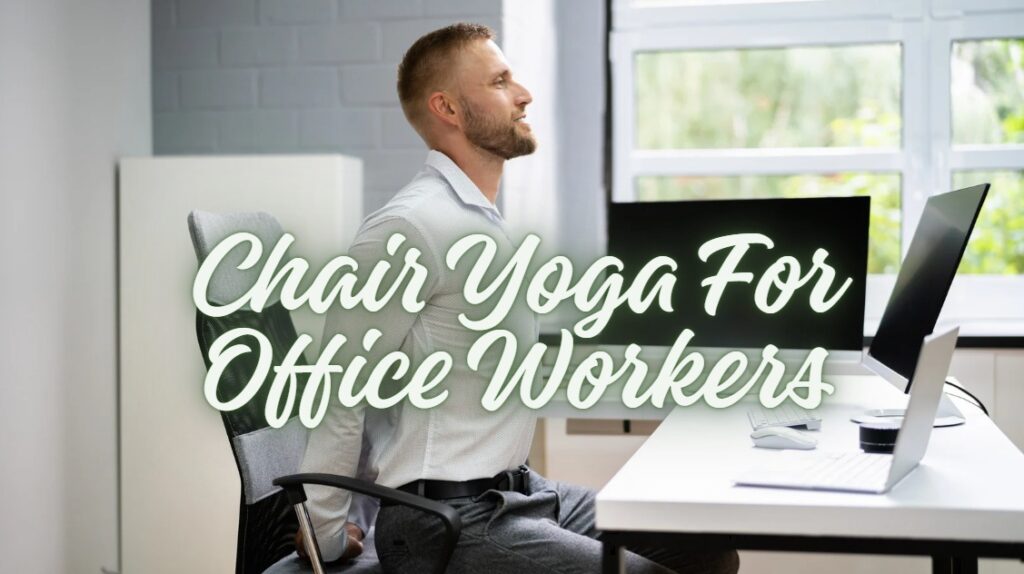
Chair yoga for office workers is a simple, effective way to ease neck tension, rounded shoulders, and aching backs caused by long hours at your desk. This gentle practice fits right into your workday—no mat, no outfit change, just quick movements that melt away stress in 10 minutes or less.
This guide is designed for busy professionals, remote workers, and anyone stuck at a desk who wants to feel better without leaving their workspace. You’ll discover why your body craves movement during long work sessions and learn essential poses that target your most problematic areas. We’ll also walk you through a complete 10-minute routine you can do between meetings and share practical tips for making chair yoga a consistent part of your daily schedule.
Why Office Workers Need Chair Yoga

Common Physical Problems from Desk Work
Your body wasn’t designed to stay hunched over a computer for eight hours straight. When you spend your days glued to your desk chair, you’re essentially training your muscles to adapt to an unnatural position, and the results aren’t pretty.
Your neck bears the brunt of this punishment. You probably crane it forward to get closer to your screen, creating what’s commonly called “tech neck.” This forward head posture puts tremendous strain on your cervical spine and can lead to chronic headaches, shoulder tension, and even numbness in your arms.
Your shoulders tell their own story of workplace abuse. They roll forward and hunch upward as you type, creating knots and trigger points that make you feel like you’re carrying the weight of the world. The rounded shoulder position also compresses your chest muscles, making it harder to breathe deeply.
Don’t forget about your spine – it’s taking a beating too. Sitting compresses your spinal discs by up to 40% more than standing. Your lower back muscles weaken from lack of use, while your hip flexors tighten from constant sitting. This combination creates the perfect recipe for lower back pain that follows you home after work.
Your wrists and hands aren’t immune either. Repetitive typing motions can lead to carpal tunnel syndrome, while poor keyboard positioning creates strain that travels up your arms.
Mental Stress and Productivity Impacts
The physical discomfort from prolonged sitting creates a domino effect on your mental well-being and work performance. When your body hurts, your brain struggles to focus on anything else.
You’ve probably noticed how that nagging neck pain makes it nearly impossible to concentrate on essential tasks. Your mind keeps drifting to the discomfort instead of staying locked on your work. This divided attention leads to decreased productivity and increased frustration as simple tasks take longer to complete.
Chronic pain also triggers your body’s stress response. Your cortisol levels spike, keeping you in a constant state of tension that affects your mood, decision-making abilities, and creativity. You might find yourself feeling irritable with colleagues or struggling to think outside the box on projects that used to excite you.
The sedentary lifestyle also impacts your energy levels throughout the day. Without regular movement, your circulation slows down, reducing oxygen flow to your brain. This leaves you feeling sluggish and reaching for that third cup of coffee to stay alert.
Your posture even affects your confidence and mood. Research shows that slouched positioning can increase feelings of depression and decrease self-esteem. When you feel physically compressed, your mental state often follows suit.
Benefits of Movement During Work Hours
Breaking up your sitting routine with gentle movement can completely transform your workday experience. Even small movements send signals to your body that help counteract the adverse effects of prolonged sitting.
When you stretch and move regularly, you boost circulation throughout your body. This increased blood flow delivers fresh oxygen to your brain, helping you think more clearly and maintain focus for more extended periods. You’ll notice improved concentration and creative problem-solving abilities when your brain gets the fuel it needs.
Movement also acts as a natural stress reliever. Physical activity triggers the release of endorphins – your body’s feel-good chemicals – while simultaneously reducing cortisol levels. This chemical shift helps you feel calmer and more positive, even during high-pressure workdays.
Your productivity actually increases when you incorporate regular movement breaks. While it might seem counterintuitive to step away from work to be more productive, studies consistently show that people who take movement breaks complete tasks faster and with fewer errors than those who power through without breaks.
Regular stretching and gentle exercise also improve your posture awareness. As you become more aware of how your body feels, you naturally start to adjust your posture throughout the day. This awareness helps prevent problems before they become painful.
The beauty of chair yoga is that you don’t need special clothes, equipment, or a dedicated space. You can practice right at your desk without drawing attention or disrupting your workflow.
Essential Chair Yoga Poses for Tension Relief

Neck and Shoulder Rolls
Your neck and shoulders bear the brunt of desk work stress, creating knots that can trigger headaches and limit your range of motion. Start with simple neck rolls: slowly drop your right ear toward your right shoulder, then roll your head forward and around to the left shoulder. Complete three circles in each direction, moving deliberately and breathing deeply.
For shoulder rolls, lift your shoulders toward your ears, pull them back, then press them down and forward. This circular motion helps release trapped tension and improves blood flow to tight muscles. You can do these individually or together – whatever feels better for your body. Hold each position for a few seconds rather than rushing through the movement.
Seated Spinal Twists
Your spine craves movement after hours of sitting in one position. Seated twists wake up your vertebrae, massage internal organs, and improve digestion. Sit tall with your feet flat on the floor, then place your right hand on your left knee. Use this as an anchor point while you gently rotate your torso to the left, looking over your shoulder.
Keep your hips facing forward throughout the twist – the movement should come from your middle and upper back, not your lower spine. Hold for 15-30 seconds, breathing into the stretch, then slowly return to the center and repeat on the other side. Your back will thank you for this gentle wringing motion that counteracts forward hunching.
Hip Flexor Stretches
Sitting tightens your hip flexors, the muscles that connect your thighs to your pelvis. These shortened muscles can cause lower back pain and poor posture. While seated, extend your right leg straight out in front of you, keeping your heel on the ground and toes pointing up. You’ll feel a gentle stretch along the front of your thigh.
For a deeper stretch, scoot to the front edge of your chair and step your left foot back, creating a modified lunge position while keeping your right thigh supported by the seat. This targets those stubborn hip flexors that spend all day in a shortened position. Switch legs after 30 seconds and notice how much lighter your hips feel.
Ankle and Wrist Rotations
Your extremities need attention too, especially if you’re prone to swelling or numbness from prolonged sitting. Lift one foot slightly off the ground and make slow, controlled circles with your ankle – ten in each direction. This simple movement improves circulation and prevents that heavy, stagnant feeling in your legs.
Your wrists work overtime when typing and using a mouse. Extend your arms in front of you and make gentle circles with your hands, then flex your wrists up and down. Spread your fingers wide, then make fists several times to counter repetitive positioning that can lead to carpal tunnel symptoms. These micro-movements keep your joints lubricated and flexible throughout your workday.
The Perfect 10-Minute Chair Yoga Routine
Warm-up Movements for Preparation
Your body needs a gentle introduction before diving into deeper stretches, especially after hours of sitting. Start by rolling your shoulders backward five times, then forward five times. This simple movement helps loosen the tension that builds up from hunching over your keyboard.
Next, turn your head slowly to the right, hold for three seconds, then to the left. Follow this with gentle neck circles – twice in each direction. Your neck takes a lot of strain from looking down at screens, so these movements help prepare those tight muscles for what’s coming.
Finish your warm-up with seated spinal twists. Place your right hand on the back of your chair and gently twist your torso to the right, looking over your shoulder. Hold for five seconds, then repeat on the left side. This awakens your spine and gets blood flowing to areas that have been compressed during long periods of sitting.
Core Tension-Relief Sequence
Now you’re ready for the main event – targeting those problem areas that scream for attention after hours at your desk. Begin with the seated cat-cow stretch. Arch your back and lift your chest (cow), then round your spine and tuck your chin (cat). Repeat this flowing movement eight times to release spinal tension.
Move into shoulder blade squeezes by pulling your shoulder blades together as if you’re trying to hold a pencil between them. Hold for five seconds, release, and repeat six times. This counteracts the forward shoulder posture that develops from computer work.
Your hip flexors desperately need attention, too. Perform seated figure-four stretches by placing your right ankle on your left knee, then gently lean forward. You’ll feel this stretch in your hip and lower back. Hold for 30 seconds, then switch sides.
Don’t forget your wrists and forearms. Extend your right arm forward with your palm facing up, then gently pull your fingers back toward your body with your left hand. Hold for 15 seconds per hand. Follow with the opposite stretch – palm down, fingers pointing toward the floor.
Cool-down Stretches
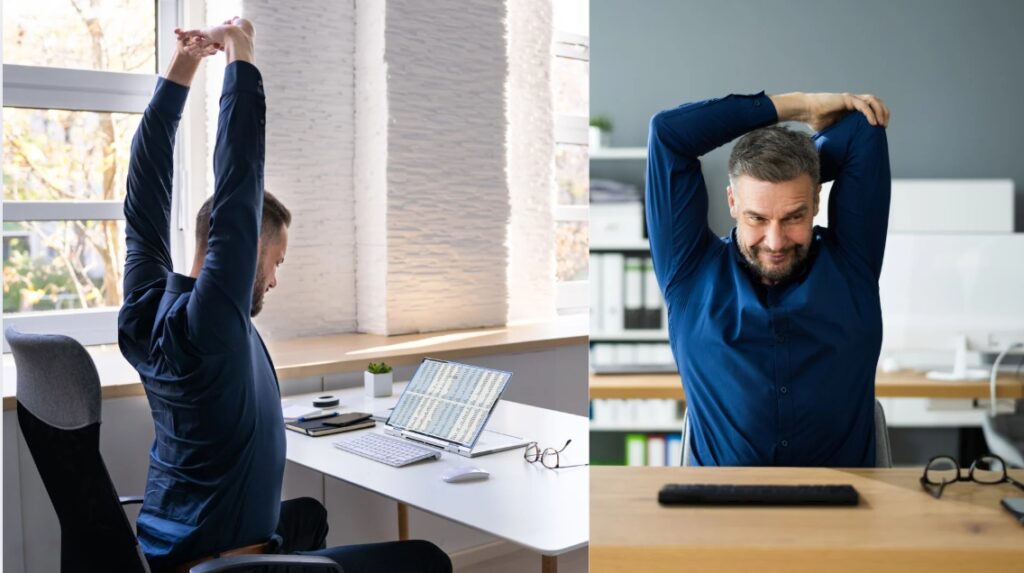
Your final phase focuses on gentle stretches that leave you feeling refreshed and ready to tackle the rest of your workday. Start with seated side bends by reaching your right arm up and over your head, creating a gentle curve along your right side. This opens up your ribcage and helps you breathe more deeply.
Perform ankle circles and calf raises to get circulation moving in your lower legs. Your feet and ankles bear the brunt of prolonged sitting, often becoming stiff and swollen. Simple circles and raises help combat this stagnation.
End with deep breathing while maintaining good posture. Sit tall with your feet flat on the floor, inhale deeply through your nose for four counts, hold for four counts, then exhale through your mouth for four counts. Repeat this breathing pattern three times.
Your final move is the seated forward fold. Slowly hinge forward from your hips, letting your arms hang heavy toward the floor. This gentle inversion helps reset your nervous system and provides a moment of calm before returning to work. Hold for 30 seconds, then slowly roll up one vertebra at a time.
Maximizing Your Chair Yoga Practice
Best times during the workday to practice
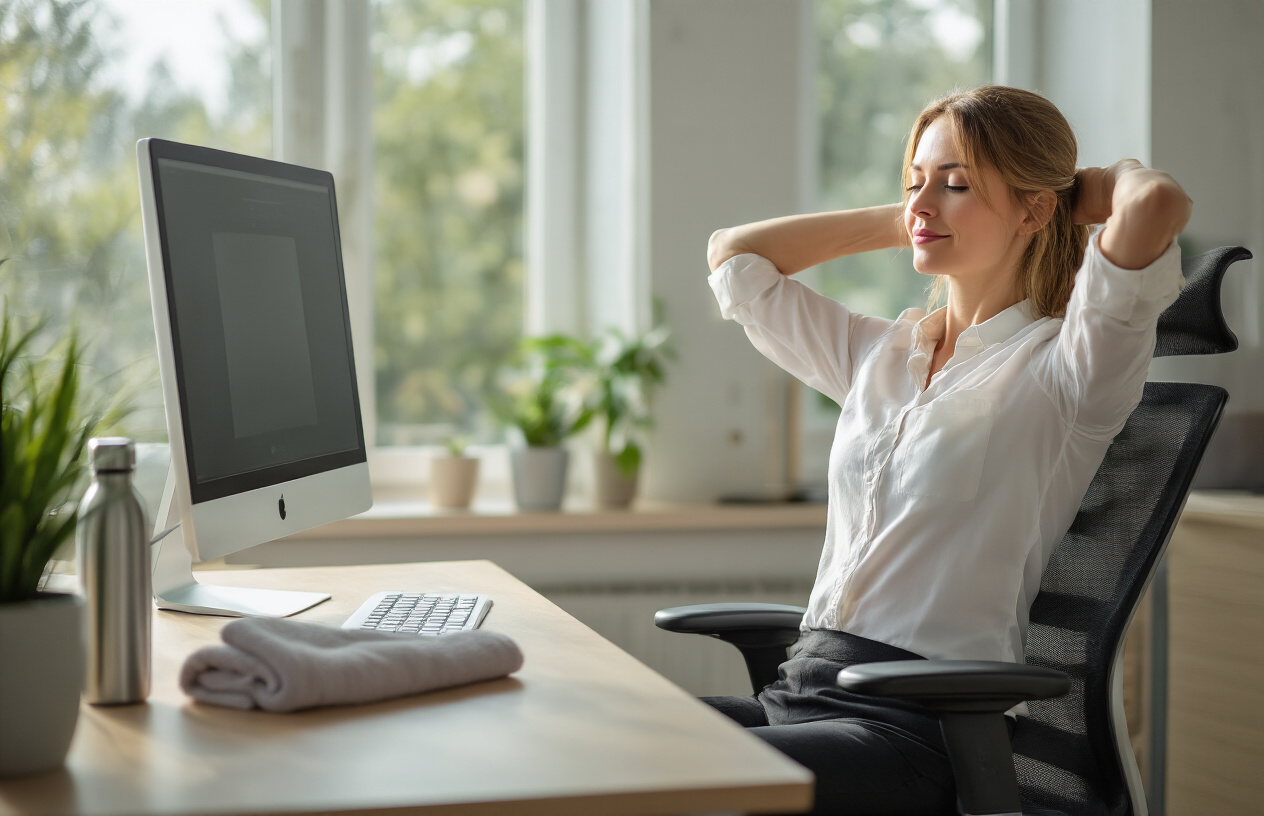
Your body naturally experiences peaks and valleys of tension throughout the day, making certain times ideal for chair yoga. The sweet spot is typically mid-morning, around 10-11 AM, when your energy starts to dip, and your shoulders begin to hunch forward from computer work. This is when a quick 5-minute session can reset your posture and boost your focus.
Another prime window opens during the afternoon slump between 2 and 3 PM. Your spine has been compressed for hours, your hip flexors are tight, and mental fatigue sets in. A brief chair yoga break here acts like hitting the refresh button on your entire system.
Consider these optimal practice times:
- First 30 minutes at work: Counteract your commute’s effects
- Before essential meetings: Center yourself and release pre-meeting jitters
- After lunch: Combat post-meal sluggishness and digestive discomfort
- During transition periods: Between major tasks or after long calls
- End of workday: Release accumulated tension before heading home
Your body will start craving these movement breaks once you establish a routine. Pay attention to when stiffness creeps in – that’s your cue to move.
Breathing techniques for more profound relaxation
Your breath is the secret weapon that transforms simple stretches into powerful stress-busters. Most office workers breathe shallowly, which actually increases tension. Chair yoga gives you the perfect opportunity to retrain your breathing patterns.
Start with the 4-7-8 technique during any pose: inhale for four counts, hold for 7, exhale for 8. This activates your parasympathetic nervous system, triggering your body’s relaxation response. You’ll feel the shift almost immediately as your heart rate slows and muscles soften.
Box breathing works wonderfully during seated twists or forward folds. Breathe in for four counts, hold for 4, exhale for 4, keep empty for 4. This creates a meditative rhythm that deepens the physical benefits of each pose.
Try belly breathing during neck releases: place one hand on your chest, one on your stomach. Focus on expanding your lower hand while keeping your upper hand relatively still. This engages your diaphragm properly and sends calming signals to your nervous system.
Ujjayi breathing – that soft “ocean” sound created by slightly constricting your throat – adds an audio anchor to your practice. It helps you stay present and intensifies the relaxation response.
Adapting poses for different office chairs
Your chair’s design significantly impacts how you approach each pose, but every chair can work with the proper modifications. Rolling desk chairs require you to lock the wheels or brace against your desk for stability during twists and side bends. The key is maintaining three points of contact: both feet firmly planted and your sitting bones grounded.
For high-back executive chairs: Use the backrest as support during spinal twists by placing your hand behind you. The armrests become perfect props for supported side stretches – lean into them gently while reaching overhead.
For low-back or armless chairs: Focus on poses that don’t require back support, like seated cat-cow, ankle circles, and forward folds. These chairs actually offer more freedom for movement, so take advantage of a larger range of motion exercises.
For fixed-height chairs: Adjust your foot position rather than fighting the chair height. If your feet don’t touch the ground, use a footrest or a stack of books. If you’re too low, add a cushion to raise your hips above your knees.
| Chair Type | Best Poses | Modifications Needed |
|---|---|---|
| Rolling desk chair | Seated twists, ankle rolls | Use armrests and backrests as props |
| Executive chair | All poses | Adjust with footrest or a cushion |
| Armless chair | Cat-cow, forward folds | Focus on poses requiring less support |
| Fixed height | Depends on your proportions | Adjust with a footrest or a cushion |
Creating consistency in your routine
Consistency beats intensity whenever it comes to chair yoga benefits. Your goal isn’t perfect 10-minute sessions – it’s building a sustainable habit that becomes as automatic as checking your email.
Start ridiculously small: commit to just three poses every day at the same time. Maybe it’s a neck roll when you open your computer, seated twists before lunch, and ankle circles before leaving. This creates neural pathways that make the habit stick.
Link your practice to existing habits: Attach chair yoga to something you already do consistently. After your first coffee, before checking your calendar, or while your computer boots up. This “habit stacking” leverages your brain’s existing patterns.
Use visual reminders: Set a sticky note on your monitor, program phone alerts, or use your computer’s reminder system. The key is making chair yoga impossible to forget until it becomes second nature.
Track your practice without obsessing over it. A simple check mark on your calendar or a note in your phone creates positive reinforcement. You’ll start seeing patterns – maybe you skip Mondays but nail it Tuesday through Thursday. That’s valuable data for adjusting your approach.
Prepare for obstacles: Identify your most significant barriers in advance. Tight schedule? Have a 2-minute emergency routine ready. Worried about colleagues watching? Learn poses that look like simple stretching. The more you plan for resistance, the less it derails your progress.
Your body will start expecting these movement breaks, creating internal motivation that external reminders can’t match.
Overcoming Common Office Obstacles
Practicing Discreetly in Open Offices
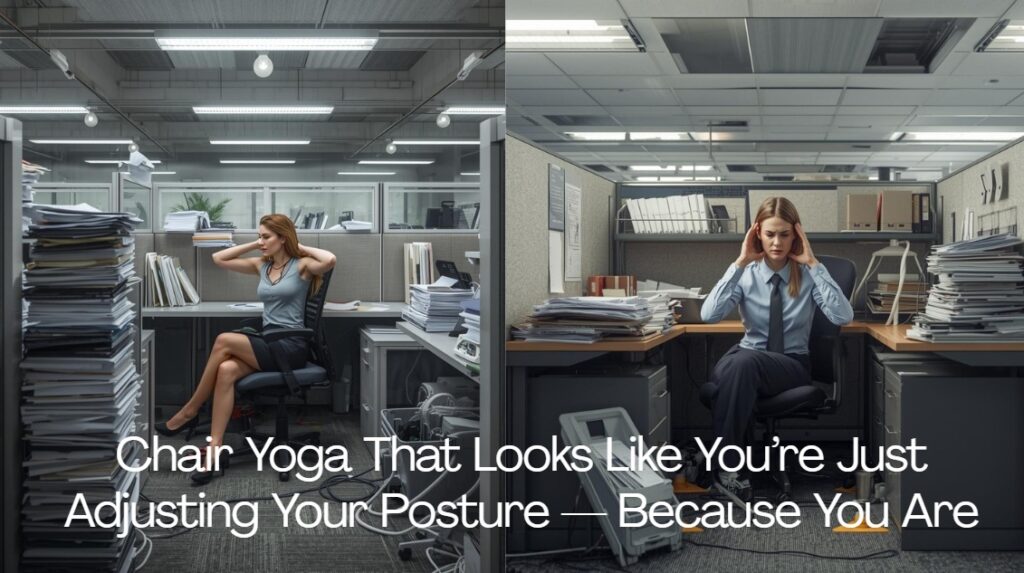
You don’t need to announce your chair yoga session to the entire office. Start with subtle movements that blend into your regular work routine. Neck rolls look like you’re simply stretching after a long period of typing. Shoulder blade squeezes appear as though you’re adjusting your posture. Gentle spinal twists can pass for reaching for something beside your desk.
Position your chair so you face away from high-traffic areas when possible. This gives you more freedom to perform stretches without feeling self-conscious. If you’re in a completely open environment, focus on upper-body movements that you can perform while maintaining your professional appearance.
Breathwork becomes your secret weapon in open offices. Deep breathing exercises require no visible movement yet provide immediate stress relief. You can practice diaphragmatic breathing while reading emails or during phone calls. Your colleagues won’t even notice you’re centering yourself.
Consider timing your practice during natural breaks in office energy – when people are focused on their screens, in meetings, or during lunch hours. These quiet moments give you the perfect opportunity for more comprehensive stretches.
Modifying Poses for Business Attire
Your pencil skirt or dress pants don’t have to limit your practice. Ankle circles work perfectly in any footwear and help combat the effects of sitting all day. Seated forward folds can be modified by simply leaning forward slightly rather than bending deeply.
For lower body stretches, work within your clothing’s range of motion. Hip circles become smaller, gentler movements. Instead of crossing your ankle over your knee for a hip stretch, place your foot on your opposite calf for a modified version that won’t strain your clothing.
Upper-body poses offer the most flexibility, regardless of your outfit. Arm circles, shoulder rolls, and gentle backbends work well in business attire. Keep a cardigan or blazer unbuttoned during your practice for more effortless movement, then button it back up when you’re done.
Shoe considerations matter too. While you can’t remove your heels in most office settings, you can still perform effective stretches. Focus on seated poses and save standing stretches for days when you’re wearing more comfortable footwear.
Managing Time Constraints Effectively
Your 10-minute practice doesn’t need to happen all at once. Break it into micro-sessions throughout your day. Two minutes in the morning, three minutes before lunch, two minutes mid-afternoon, and three minutes before leaving creates the same benefits as one continuous session.
Set phone reminders every two hours to prompt a quick stretch sequence. This approach prevents tension from building up rather than trying to address eight hours of accumulated stress in one session. Your body responds better to frequent, shorter interventions than infrequent, longer ones.
Multitask strategically during low-focus activities. Practice breathing exercises while checking emails, do seated spinal twists during phone calls, or perform neck stretches while reading documents. This way, your yoga practice enhances rather than interrupts your productivity.
Create transition rituals using chair yoga. Start your day with three minutes of energizing poses, use calming stretches before essential meetings, and end your workday with tension-releasing movements. These rituals signal to your body and mind that you’re shifting gears, making your work time more intentional and your personal time more relaxed.
✨ Looking for more ways to bring calm into your routine? Visit my YOGA BLOG for accessible practices and soulful guidance designed to support mindful living.

Those long hours hunched over your desk don’t have to leave you feeling stiff and stressed. Chair yoga offers a simple solution that fits perfectly into your workday, helping you tackle neck pain, shoulder tension, and lower back discomfort without ever leaving your workspace. The ten-minute routine we’ve outlined targets all your problem areas while being discreet enough to practice during busy office hours.
Your well-being doesn’t need to take a backseat to your career. Start with just five minutes tomorrow morning and gradually work up to the whole routine. Set a phone reminder, keep your yoga guide handy, and remember that even small movements make a big difference. Your body will thank you, your mind will feel clearer, and you’ll discover that taking care of yourself at work isn’t just possible – it’s essential for your best performance.
For more soulful stories and mindful living insights, explore The Zen Blog — your space for travel reflections, wellness tips, and everyday calm.
✨ Join The Zen Journal community — get fresh yoga and wellness insights straight to your inbox ✨